|
The Benguela Railway 2012, Part 3 |
|||||||
The railways of Angola are undergoing a remarkable revival, being
reconstructed by the Chinese funded largely by an oil boom. The Luanda
Railway in the north is effectively complete, the Mocamedes Railway in the
south is making good progress and will open in mid-2012, but the most
spectacular progress is being made on the Benguela Railway which will once
again be a through international route in 2012/2013.
For the record. the railway reopened from the coast to Huambo (formerly
Nova Lisboa) at the end of August 2011. Reports on the web indicate that the
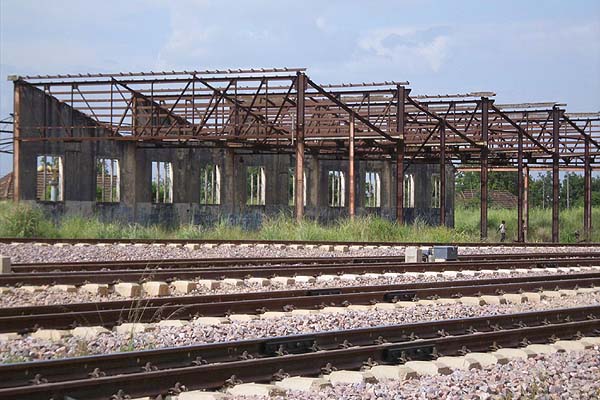
next section to Cuito/Kuito (Silva Porto) was opened in February 2012, Jose da Palma is based in the country and has sent me some pictures of the 'new' railway and some of the steam survivors. This is Part 3, click below for the other parts: Huambo is Angola's second city and was formerly known as Nova Lisboa (New Lisbon). It was the site of the main locomotive works of the Benguela Railway. Today it lies abandoned and there is a large elephants' graveyard. I have not shown too many pictures as Gavin Hamilton (see above) has already provided good coverage. As a major division point Huambo had a large running shed, this is Geoff Monks' 1974 picture showing both Garratts and conventional locomotives:
This is what it looks like these days:
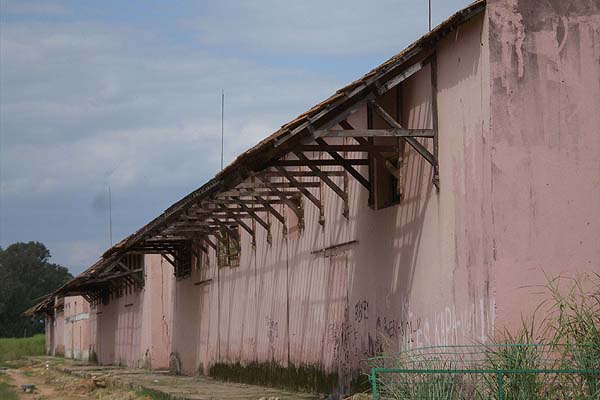
Some other colonial era buildings have fared better.
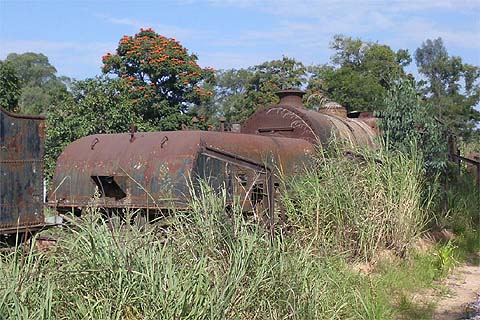
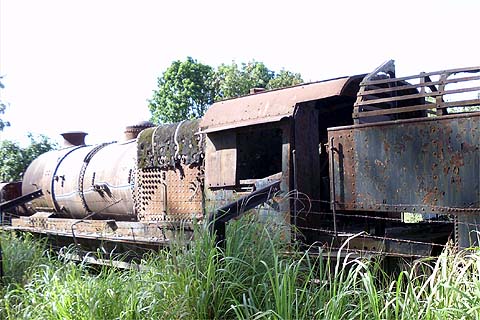
The Benguela Railway operated 5 types of Garratt (Classes 10A, B, C, D and E). Without going into technical details, the 10A and 10B were 4-8-2 + 2-8-4 types built prior to WW2 and with square front water tanks, while the 10C and 10D had the same wheel arrangement and were built post WW2 with rounded front water tanks (the latter's being larger). The 10E were actually much older locomotives being redundant Rhodesia Railways 16th class 2-8-2 + 2-8-2. I would invite those with more experience of the subject to correct any of the suggestions that follows. Gavin Hamilton's website (see above) identifies 11 known Garratts in Huambo and some have since been cut up, 1 10A, 2 10B, 1 10C, 3 10D and 4 10E. The following pictures were taken on 4th February 2012 and to my untrained eye appear likely to be later examples. Note that these locos were both oil and wood burners, hence the different fuel bunker styles. The first is a 10D:
This looks similar to me
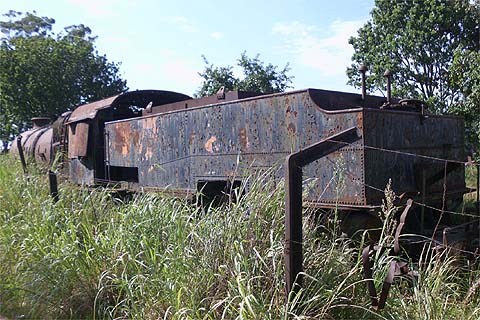
This looks like a wood burning 10C to me.
It's a shame that the long grass makes it impossible to see more detail. After that rather miserable selection here is Basil Roberts' picture of 10C 341 in its 1970 prime. There are more like this in my articulated locomotives section and even more on our Images of Rail CD ROM "Safari Steam South".
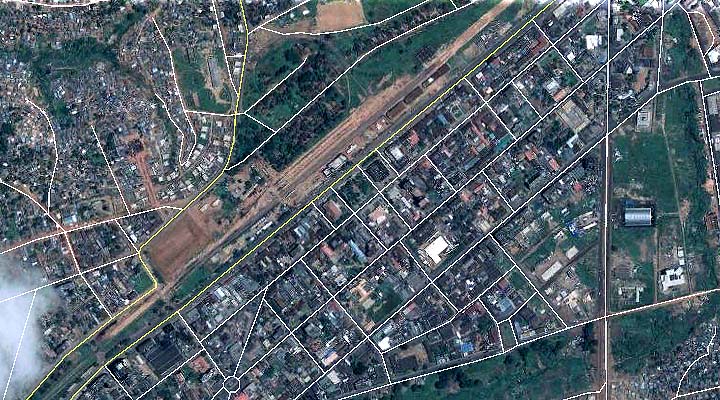
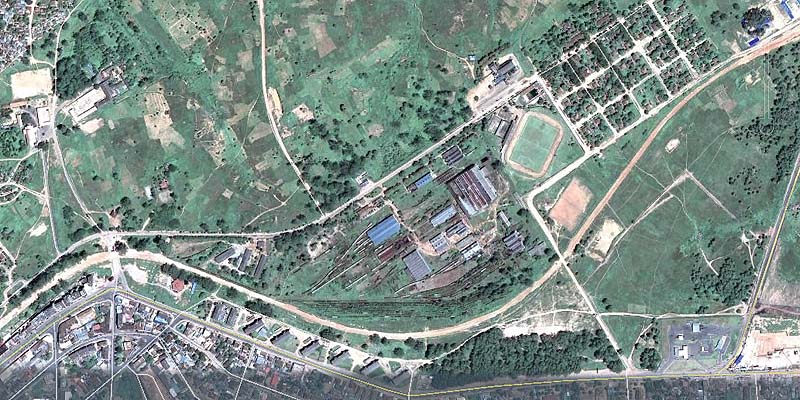
This is the Google Earth view, the top picture shows the station area and the lower picture shows the area of the old locomotive works some way to the east - the different colours are caused by the internal 'join', the locos shown are behind a fence just after the right hand bend.
|