|
This page illustrates examples of articulated steam
locomotives - click here for the introduction to
Garratt locomotives.
The greatest concentration of Garratts in the world was
found in this area. These images are all taken from our CD-ROM
Safari Steam, but since that didn't include South Africa, that country is
not represented here - Roland Beier has since supplied some
from that country.
Angola
All three major (Cape Gauge) railways used Garratts. Those
on the southern CF Moçamedes section were the first to be withdrawn from
service followed by those of the CF Luanda. Basil Roberts - all pictures in
Angola are his - caught Beyer Peacock 4-8-2 + 4-8-2 503 leaving Luanda in May
1970, but they were soon retired after that:

The
'stars in the firmament' of Angola's railways were the wood burning
Garratts of the Benguela Railway (CFB) - derived from specially planted
forests. Here 341 takes wood east of Cubal:

319
is a pre-World War 2 Garratt and another wood burner seen at Luso.

The
later Garratts are easily distinguished by their larger, rounded water
tanks. Oil burner 361 'Rainha Dona Amelia' was photographed at Benguela:

The
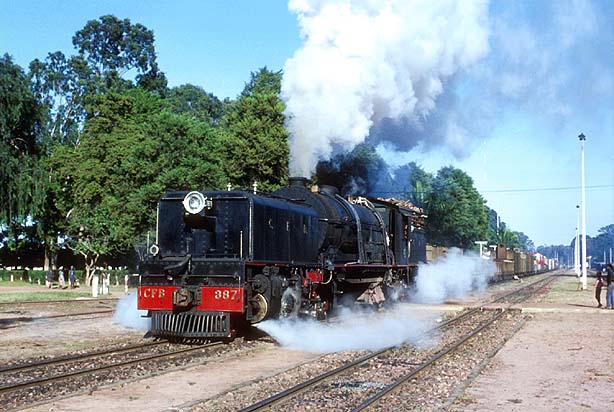
least photographed of the Garratts here were the ex-Rhodesian 16th class.
387 leaves Luso with a train for the coast.
Botswana
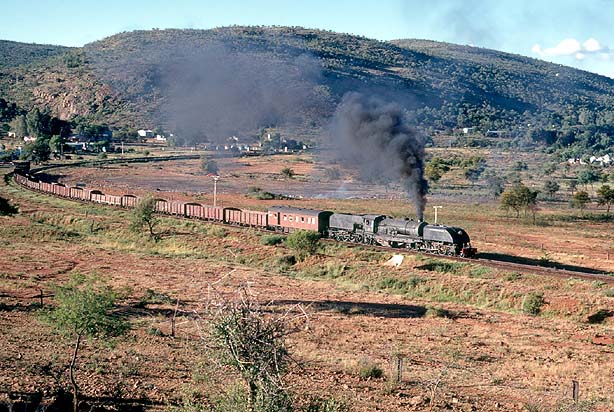
The railway line between through the country between South
Africa and Zimbabwe was traditionally operated by the latter's steam
locomotives. Hence the use of (Rhodesian Railways) 15A 369 departing Lobatse southbound on 3rd January 1973.
This is Robert Kingsford Smith's picture.
Long
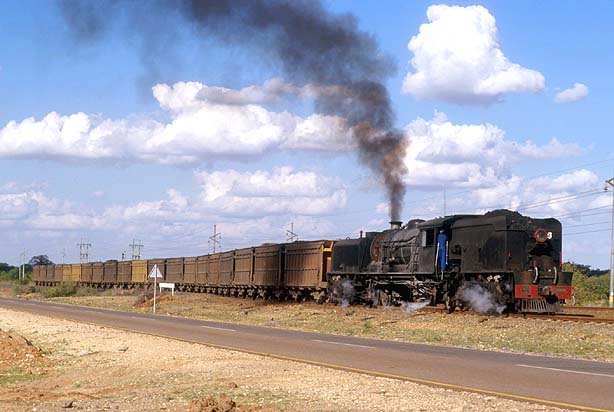
after that service was dieselised, the copper mine at Selebi
Phikwe bought some second hand 14As from Zimbabwe, this is Mike Swift's picture
of 520 (alias LO 809)
working in September 1998, but even this is probably history now - active
steam survives but not the Garratts:
Madagascar
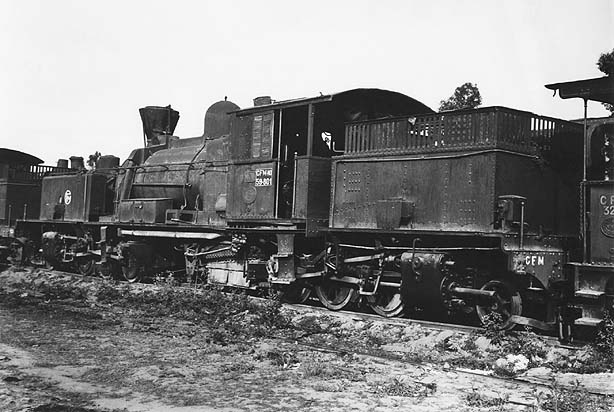
The railways here traditionally used Mallets but 59-801 was a 2-6-0 + 0-6-2 Garratt built by St. Leonard in 1925.
It was out of use when it was photographed by Charles Small:
Moçambique
Garratts in Moçambique worked on the northern lines out
of Beira and more than half came second hand, albeit this is mainly because
part of the section was at one time operated by Rhodesian Railways. These
pictures are again from the Basil Roberts collection. This is one of four
recorded ex-South African Railways GF 4-6-2 + 2-6-4 Garratts at Beira in August 1968.
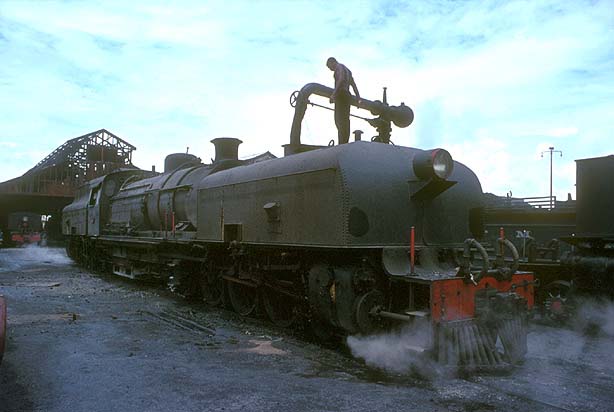
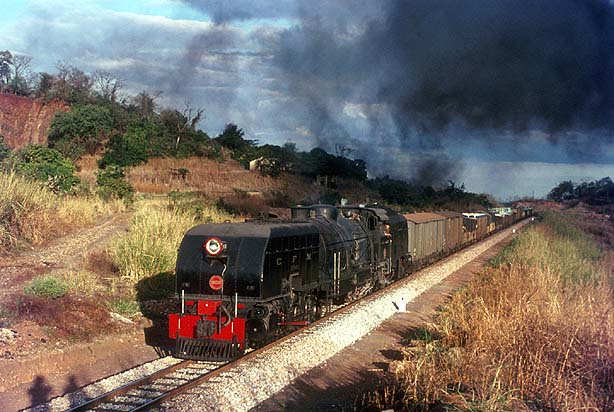
These 4-8-2 + 2-8-4 Garratts were built by Haine St. Pierre,
956 emerges from the clouds and embarrasses the excited gricers who failed
to notice their shadows...
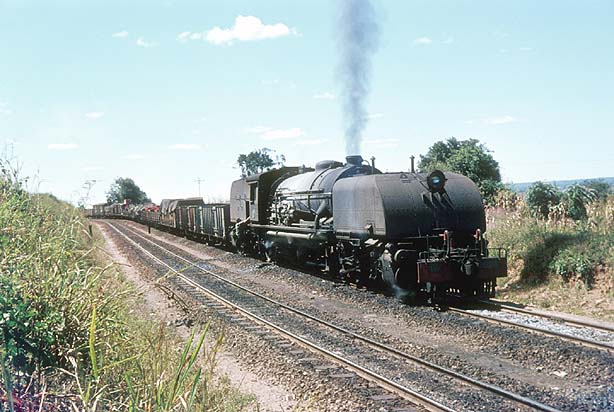
These were former RR 2-8-2 + 2-8-2 18th class Garratts, War Department locomotives. This is ex-RR 281, now 981, at Beira in August 1968. (BR)

Pride of the Moçambique Garratts were the Henschel 4-8-2 + 2-8-4 locomotives, invariably turned out immaculately in maroon of almost East African richness.
This was the last class of steam locomotives delivered to CFM and 973 was at Beira in 1968.
(BR)

Zambia
When the former Rhodesian Railways was
divided, many Garratts became the property of Zambian Railways but it had
little incentive to keep them going as most of the coal they burned was outside the
country. Basil Roberts caught 16A 624 pulling away from Sakania on its return journey to
Ndola in the north of country in April 1968.
Zimbabwe
I spent some three weeks in Zimbabwe in May 1980, it was a
good time for steam there. At this time, 14As were rarely seen on line work,
here 515 leaves Dabuka, between Gwelo and Bulawayo.
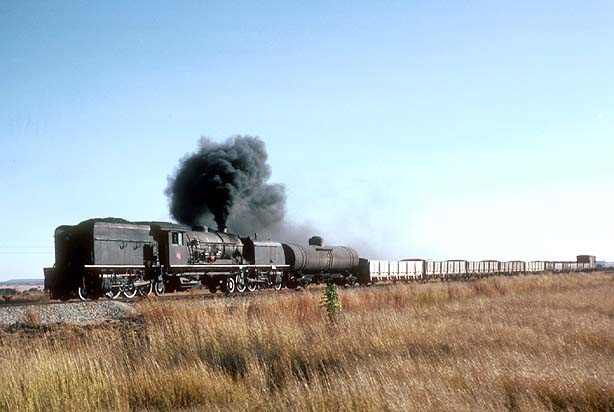
15A 411 storms through the Lukosi Gorge near Wankie with train 111.
I was fortunate to be able to photograph it; this train traditionally ran at night but had been retimed during the troubles and this area had been a 'hot spot'.
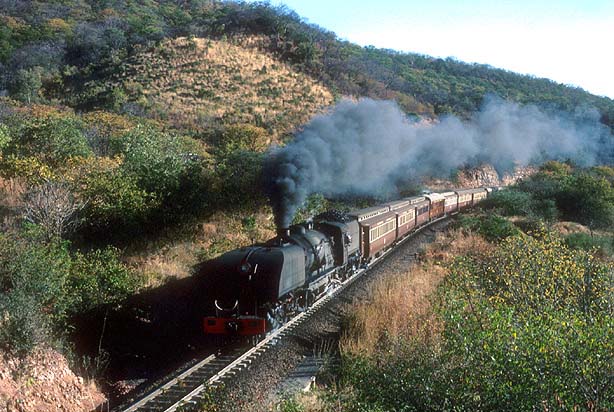
The light and temperature were just perfect for 16A 629
as it departed from Gwelo on a short working to the chrome mines at Selukwe.
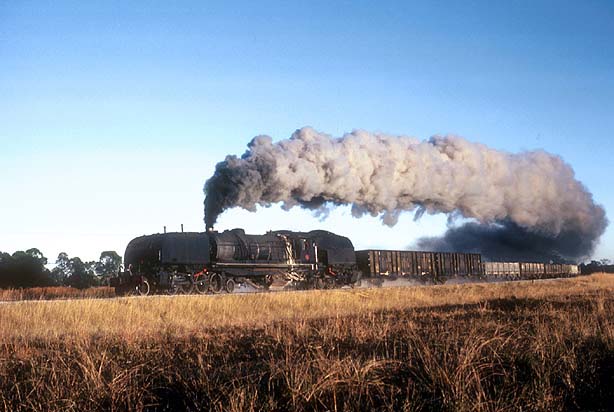
20A 747 storms across the Lukosi bridge heading for Thomson Junction.
At the time, there was still a guard house (hidden by the train) although it was no longer in use following independence.
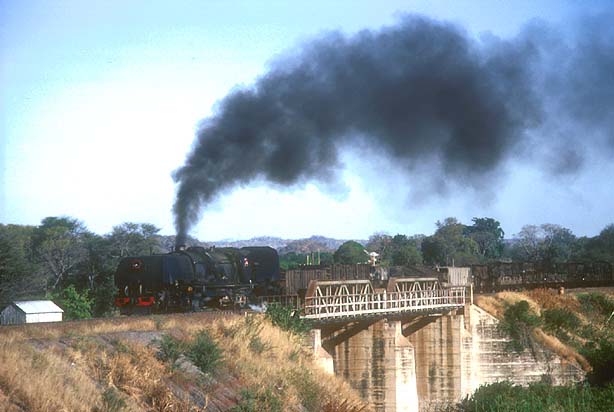
Visiting GMAM 4135 from South Africa rounds
'404 curve' in the Lukosi Gorge with 'smoke by request'.

|