For Caribbean countries not covered here, please visit a
series of articles which are linked from my Tales page - Railway Relics (and more) in the Caribbean.
(Updated 6th January 2026).
Antigua Index
|

|
Back in 2013/14, Thomas Kautzor visited several islands in
the West Indies to record surviving
industrial and railway heritage. At the time Kerr Stuart 0-4-2ST Marion
(1178/1911) was under active restoration.
and it has since been put on exhibition outside the Museum of Antigua and
Barbuda. This is Phil Barnes' picture from 21st March 2017 (13th
February 2020).
|
Argentina Index
Local
magazine Tren Rodante http://www.trenrodantedata.com (Link broken by September 2025)
has articles of steam interest. I've yet to work out how to view back numbers...
Click below for summary pages for older stories
Rio Turbio Railway
The paragraph below originated some 10 or more years ago and
for a long time, things went very quiet. Now it is reported on the Coalition for
Sustainable Rail website (http://www.csrail.org/)
that things are on the move, in particular, 107 and 119 which have been
despatched to Buenos Aires for restoration. There are pictures of work
in progress on Flickr. Perhaps in a realistic move, steam is planned
only for tourist operation but no doubt the tour operators will be eagerly
waiting for the chance to recreate some 'real' coal trains. Thanks to Trevor
Heath for this (added 13th February 2014). A
set of pictures is now also available on this
site (extra picture, 20th June 2015). Progress
is such that 119 has now had its boiler refitted as seen in these pictures
supplied by Shaun McMahon (28th August 2015). I
have now added two press releases and more
pictures on
progress from June and August 2015 (updated 14th September 2015).
119 has now been successfully steamed and has gone home where
it will undergo more testing before entering service. Congratulations to Gabriel Asenjo of G&G and Shaun McMahon
as part of INTI for all the hard work they have put in to get this project so
far in a relatively short time. Click here
for a photo report (23rd October 2015). A short
YouTube video https://www.youtube.com/watch?v=Sz6NjQrw5XQ
is now available (3rd November 2015). Local
magazine Tren Rodante http://www.trenrodantedata.com
had an article in edition 202 which covers this, but also an illustrated
historical (Spanish language) article on RFIRT (3rd November 2015). A
further November press release has now
appeared (27th November 2015), followed by news
up till the end of the year (13th February 2015)..
Trevor Heath tells me that 119 has at long last been out on
the road and there are two videos available https://www.facebook.com/maquinasavapordegyg/videos/1950005881706792/
and https://www.facebook.com/maquinasavapordegyg/videos/1951445204896193/
(21st January 2018)

As a development of the news about the Rio Turbio system in the two
paragraphs that follow (7th September 2004),
Locomotives International 71 carried a report - since confirmed by other
correspondents - that the railway is considering reintroducing steam power owing
to the soaring cost of diesel and the poor condition of their locomotives. The
country is in a poor economic state and conventional alternatives like buying
newer, more fuel efficient diesels is not an option. Shaun McMahon is reported
to be working on the project which will see 116 (actually 107) and then 119
returned to service. Shaun has now sent me a news
release detailed ambitious development plans for the Rio Turbio system (2nd
November 2004), including a possible international link to Chile. Hugh Odom's
site has additional
news on developments (5th June 2005). Martyn Bane's site also contains an
August 2006 press
release http://www.martynbane.co.uk/modernsteam/smcmahon/rfirt/aug06news.htm
(link dead by April 2015) which confirms that big things are afoot in the south of the country
(added 25th August 2006).
Martyn Bane has visited the Rio Turbio system and an
extensive report (1st February 2004) of his visit covering the
remaining steam
locomotives was posted on his own site (some of which now appears on http://www.martynbane.co.uk/modernsteam/ldp/rfirt/santafes.htm), similarly a
visit to the FCAF, http://www.martynbane.co.uk/modernsteam/smcmahon/fcaf/fcafjan04.htm
(link dead by April 2015, 2nd February 2004). It seems that tourist steam may start to
operate at Rio Turbio (11th March 2004).
Bernd Seiler reports (23rd February 1999) "Steam on the Rio Gallegos system
finished some time in 1997 following the arrival of diesels." Ian Thomson (18th
October 1999) places it in November 1996 although steam was used with diesels for braking
purposes into 1997. Yard shunting will have lasted rather longer and several enthusiast
groups have since run steam charters on stretches of the line. Reports have appeared
locally that steam may be introduced as part of a plan to develop the area for tourism.
Click here for one such
(Spanish language) report (3rd June 2000). Click here for more information (link added 2nd October
2000, but http://www.trendelsur.8m.com is dead by 1st November 2018).
The Train at the End of the World (FCAF)
This is a 500mm gauge (narrow gauge or miniature
according to your point of view) running out of Ushuaia into a national park in
the deep south of the country - it carries large numbers of tourists many of
whom arrive in cruise liners. Check out the
English language version of
their website, some basic information is also available
on this site. For an excellent video clip on the railway see http://www.youtube.com/watch?v=F60Eta_ao54
(7th January 2009). Jack Neville sent a
report of a November 2014 visit (23rd December 2014)
Currently it has 3 steam locomotives on the
roster:
-
"Camila" 2-6-2T (Winson Engineering ? / 1995)
-
"Ing. L. D. Porta" 0-4-0 + 0-4-0 Garratt
(Tranex, Carupá, Argentina ? / 1994)
-
"Engineer Zubieta" 0-4-0 + 0-4-0 Garratt
(Barries Engineering, Girdlestone & Associates, Port Shepstone, KwaZulu-Natal, South Africa ? / 2006)
For some time Shaun McMahon was chief engineer
here and as such was involved in ensuring that the steam locomotives were
modified to reflect best 'modern' practice as far as was practical. Articles on
this have appeared from time to time and are best accessed via the 'Modern
Steam Index Page' on this site, although you can access some of the key ones
directly as follows:
The Esquel Railway
The railway is under threat again as the
provincial government announced a 'temporary closure' following a strike by
railway workers (http://www.argentinaindependent.com/tag/la-trochita/
link broken 5th April 2019).
While the 'Old Patagoninan Express' is iconic, it has been the opposite of a
cash cow for as long as anyone can remember and news like this is bound to deter
individual and tour group visitors. However, a later Spanish language reports
stated that the dispute had been settled and the railway would resume operation on 2nd February 2013 (http://www.infobae.com/notas/692737-Avanza-el-dialogo-por-La-Trochita-en-Chubut.html)
(1st February 2013).
James Waite was
here in October 2014 and apart from some stunning pictures he has written
about the history of the line and its steam locomotives (13th December 2014).
|

|
Fabrice Lanoue spent a week in the country in April 2011,
he has produced a two part illustrated report which includes an eye witness
account of a spectacular derailment on the
Esquel line (updated with a video link, 28th June
2011), click here for the second
part (17th May 2011). Following the
derailment, I understand that trains were suspended pending an enquiry,
Richard Wallace tells me (31st July 2011) that
the management had told him that they expected to be running trains again in
August or maybe September 2011. Certainly it appears that operations have
resumed in 2012 (see below and also Richard
Wallace's November 2012 report, 17th December 2012)
|
 |
La Trochita's own website is now http://www.patagoniaexpress.com
(Link broken by September 2025) and the timetable is here http://www.patagoniaexpress.com/el_trochita.htm
(Link broken by September 2025).
The latter has contact email addresses for operations at both ends of the line.
Thanks to Hans Schaefer for tipping me off on this one (19th
July 2012). David Thornhill points out that the UK's Railway Gazette reported an allocation
of just over GBP 1 million to renovate the line, welcome, but realistically this
is small beer for such a long line (18th October 2007).
There are some earlier
reports available (last entry 15th February 2005).
Getting up-to-date information on the Esquel operation has never been easy,
but Chris Lewis has emailed me the current (early 2005) schedule. I have made
this available as a
PDF file (15th December 2004). Chris has
now (15th December 2005) send me the
2006 timetable too.
|
Other websites
Martin Coombs has his own site covering the 'Railways of the Far South' (2nd December
2002) including information on several present and former narrow gauge railways. Martin wrote a brief report of his
December 2000 visit but pressure of work meant it was delayed (added 22nd February 2001).
Older Trip Reports
Colin Churcher has sent me an account of his trip
there in 1995. Manfred Schoeler sent me a report of his visit in
August and September 1996 with two of his pictures. See also the TUT report (3rd Dec
1998) for details of then current activity.
Other Preservation Items
For a blog / website which must show the majority
of preserved steam locomotives in the country, see Fabian Pesikonis's 'Vapor en
Argentina' - http://vapor-steam.blogspot.com.ar/
(3rd November 2015).
 |
Fabrice Lanoue spent a week in the country in April 2011, he
has produced a two part illustrated report the first
of which covers Esquel, the second part
covers other locations (17th May 2011).
Robin Patrick has provided an
illustrated report of the November 2008 RTC trip which included some of the
locations above (9th December 2008), while Bill Longley-Cook somewhat later has
provided a
different perspective (16th August 2009). Neil Edwards was here with a tour group in August 2009 and reports
on his brief visit to Posadas for the 'preserved locomotives' (23rd
August 2009). Frank Ludwig reports on preserved
steam at Posadas, Concepción del Uruguay and Tandil (28th
April 2013).
Richard Wallace reported on a
November 2012 RTC trip (17th December 2012).
|
 |
Marcelo Benoit (28th June 1999) has sent the a large number of pictures covering preserved locomotives in the
country and I have added a
second set of photos (10th May 2000). I have added more pictures of
preserved locomotives (1st November 2001) which includes a preserved narrow gauge
(Luttermöller to me but the owner says Klien Lindner) 0-10-0 shades of Java, Indonesia.
Carlos Alberto
I have since added a
third page - picture left - covering some of the locomotives of the Ferroviario Club del Central Argentino
(http://www.fcca.org.ar) in Perez,
Santa Fe (updated 9th October 2012).
|
Barbados Index
The only railway in Barbados closed as long ago
as 1937, but the St. Nicholas Abbey Sugar Mill has built a 1.5km 2'6"
narrow gauge tourist line which is operated by a Jung Mallet which worked
in Java, Indonesia and a Le Meuse 0-4-0T. Click here for
more initial information (21st March 2018). The railway is now open and running their
steam locomotive, see https://snahr.com/ and https://www.youtube.com/watch?v=QdRbWzUBEXA.
(24th July 2019)
Clive Hepworth has visited the railway and has
sent me an enthusiastic illustrated report (30th
September 2021) while Mike Tyack reports on further
developments in January 2025..
Bermuda Index
Trevor Heath has sent me this link on the Bermuda Railway - http://www.bermuda-online.org/railway.htm
- a wonderful look at the remains of another 'long forgotten railway' which
includes the remains of an old Baldwin steam locomotive, it is not clear when
this picture was taken (9th May 2008).
'Tapir Baby' has pointed out that Colin Churcher has uploaded an album from
the Anthony W. Burges collection which contains 39 priceless images of, inter
alia, the Bermuda Railway - https://www.flickr.com/photos/colinchurcher/albums/72157669353693454
(8th March 2020). This includes some of the BR
rolling stock which found its way to Guyana.
Bolivia Index
Chris Lewis was in Bolivia in September
2004 (24th
October 2004) and reports noting six steam locomotives in Guaqui on
Lake
Titicaca. Ian Thomson adds "The locomotives at Guaqui are, for the most
part, as in "World of South Américan Steam", from some 30 years ago.
The saddle tank is a
Peckett. The main changes over the past decades have been: (i) Hunslet
2-8-0 No. 10 was sent to the stillborn Museo at Sucre (although where
it is at right now I have no idea), I think bearing the makers' plates
from No. 9; (ii) a couple of locomotives have been cut up, Nos. 4 and 6
if I remember correctly, but I'll have to check; (iii) No. 704 was sent
to Guaqui from the Uyuni-Villazón line, initially to work tourist
trains under an also stillborn arrangement with
Wagon-Lits. No. 704, which was built by
ALCO was operable until some seven years ago, at least, and I rented it
a few times for tour groups. Also
operable was No. 9. All the locomotives belong to residual ENFE. I
included Nos. 9 and 704 in the list of rolling stock which should be
declared national monuments.
No. 704 is the only non F.C. de Guaqui machine at Guaqui. The 1939
diesel No. 1 is dumped at
Viacha, or at least was when I was last there a few years ago."
Ian Thomson reports on his latest visit
(11th November 2003): "In Santa Cruz de la
Sierra, Nos. 544 and 796 have been placed in a shed specially
constructed for them in the
Ferrocarril Oriental workshop area. They are visible from the street.
No. 544 is operable,
and I am told regularly appears on a local TV ad. The Company seems to
be investing quite
heavily in refurbishing passenger equipment for tourist charters. All
other dumped steam
locomotives have disappeared, presumably for scrap, except the remains
of an ex-FCAB
Vulcan Foundry 4-8-2. I am told that the locomotives dumped at Roboré
are still there.
Roboré is shortly to become less inaccessible, since a highway is being
built, parallel
to the railway, between Santa Cruz and Puerto Suarez/Corumbá. Once
opened, the Railway
will withdraw regular passenger services." Marcelo Benoit questions
this
last statement (3rd August 2007), "The railway has invested
heavily to COMPETE with buses despite the opening of the road (I cannot
call it a highway)."
For recent pictures of the steam graveyard at Uyuni, see http://www.darkroastedblend.com/2008/01/train-graveyard-in-bolivia.html
(thanks to Trevor Heath for this one, 5th March 2008,
this site cannot be accessed from China)
|

|
Torsten Schneider saw no live
steam in October 2001 but some interesting relics including the famous
graveyard at Uyuni (24th October
2001). CRJ 104 reported a return to steam at Santa Cruz in August 1995. Ian Thomson reports (14th May 1997)
"The guy in charge of liquidating ENFE's assets, whom I have known personally for
around 20 years, went to look at the Vulcans and the Hitachi in Cochabamba over the
weekend. I am hopeful that at least two of the bunch can be saved and put back into
working order, one of them in Chile. I have been invited by the Ferrocarril Oriental to
work out a project for tourist trains, and hope to do so in the first week of June. Steam
could be used on a part of the runs. No. 544 is no longer working but is being kept nice
and clean in the depot at Santa Cruz, and I presume No. 796 must be available too,
although I did not see it last time I was in Santa Cruz."
|
Ian Thomson adds (29th Nov 1997): "No. 544 took a train, which I arranged for
Ffestiniog Travel with the Passenger Manager, from Warnes to Santa Cruz via
Montero, on
Saturday 22nd November. The locomotive was not in a very good condition. The trip took
around seven hours instead of the intended four. Injectors of both kinds were mainly to
blame. The train consisted in the ex-FCALP diner and sleeping cars, plus miscellaneous
wagons. We nearly got in late enough to take advantage of the sleeper in nighttime
mode."
See the TUT report (3rd Dec
1998) for details of the then current activity.
Brazil Index
Introduction
Brazil is a nightmare country to cover for the steam enthusiast. Apart from
its shear size, 'Inventario das
Locomotivas a Vapor no Brazil' by Regina Perez (9th
December 2006) lists 419 extant steam locomotives. For more information on this
book see http://www.revistaferroviaria.com.br/memoriaferroviaria/. I can't afford
a copy but I am told it is well worth obtaining. However, the percentage of
locomotives listed which are anything like operable is tiny and the smaller
tourist operations come and go at an alarming rate.
I have spent a day using various sources to put together an
outline guide to tourist railways in the country (21st
October 2008, latest update Marcelo Lordeiro pictures of Bauru, added 17th
October 2012 and information on ABPF Regional Sul de Minas page 24th
October 2012) and would appeal to those who have recent experience of
travelling independently here to let me have comments, reports and some pictures
so it can become a useful ongoing resource. Tom Schultz spent 3 days in November
2009 on the tourist railways in São Paulo and Minas Gerais - read his
illustrated report (17th December 2009), see also Cliff
Schoff's report of his January 2011 visit (12th April
2011). When I culled broken links on this site those for Brazil were among the
worst offenders. A good source for comprehensive tourist train timetable
information is Samuel Raschdi's http://www.fahrplancenter.com/AIFFLABrasilienTurismo.html,
thanks to Thomas Kautzor for this (15th April 2015). Tom Schultz made a further
visit to tourist railways in São Paulo and Minas Gerais in December 2019. His
report is available as a pdf
(6Mb) (21st December 2019); it will be of
particular interest to other potential visitors as it has practical advice and
gives a great flavour of the lines and the areas they run through.
The Brazilian Magazine Revista Ferroviaria (http://www.revistaferroviaria.com.br)
has an English language (part) mirror site http://www.revistaferroviaria.com.br/
from which some information on steam preservation may be found (thanks to Henry Posner III
for this one, updated 21st October 2008).
Steam on the EFDTC
Eddie Edmunson tells me that his 11 page article on the
surviving steam locomotives in the Tubarao area has appeared in the
August-September 2024 online edition of Locomotives
Magazine (23rd August 2024).
The metre gauge EFDTC has been long dieselised but in its day
provided some spectacular steam activity. James Waite joined a
tour group which sought to recreate the good old days (28th
August 2013). At the same time James has written about the
history of the line and also provided some
evocative pictures from his own visit in 1977 (28th
August 2013). Trevor Heath tells me (16th August 2016)
that a series of steam specials using Alco 2-8-2 153 are planned to run on
Saturdays between Tubarao, Laguna and Imbituba, click this
link. The first on August 6th was cancelled owing to lack of customers,
perhaps starting a new venture which clashed with the Olympics was not a great
idea, in the event the train certainly ran on 20th August 2016 (4th
September 2016).
Surviving Brazilian Steam Locomotives
|

|
I know of no list on the web (and the book mentioned above is bound to have
been out of date by the time it was published). Eddie Edmundson provided a long list of surviving steam locomotives in
North East Brazil (29th January 2002) and a survey of steam locomotives spotted outside
the North East of Brazil (originally uploaded 29th January 2002, Martin Murray
added some later observations, 3rd April 2002). Torsten
Schneider updated (17th April 2002) his own summary of steam locomotives/sites
in the country - he knows it is incomplete and we would both welcome help in filling
in the gaps and adding other locations. Torsten's list includes a large number of web site
links (many of which have since died) and valuable access details. (I agree with Torsten it would be difficult to combine
his and Eddie's lists!).
|
Some of the better known large steam locomotives are covered in Dona
Teresa Cristina Survivors
(latest entry 10th April 2006). For me, the most charismatic locomotives
of this railway were the 'Mallets' - actually they were not true examples as
they were not compounds - and I was very pleased to hear that the restoration of
2-6-6-2 204 by the ABPF at Rio Negrinho had reached the stage where it has been
steamed and moved under its own power as seen in the following YouTube clips http://www.youtube.com/watch?v=A81oSh7QLCI,
http://www.youtube.com/watch?v=TUiXtw6t3ck
and http://www.youtube.com/watch?v=JypekOjw3kw
(15th June 2012).
Sentinel Steam alive and other working steam
News from Bruno Sanches (21st
November 2014) is that the Sentinel operation at Cruzeiro is no more, the
tracks are ripped up and the locos in store. This is believed to have been the
last real steam operation in the Americas. Later good news is that they have
been secured for preservation by the local ABPF branch in Cruzeiro which has
some mixed gauge track for occasional operation (18th
August 2015).
|

|
What must be the most remarkable story of 2002 was the survival of two active Sentinel locomotives at the
Amsted-Maxion wagon works in Cruzeiro
(SP province). An illustrated article (showing 166, 0-4-0 Sentinel, one of 8398-8400/1931)
appeared in the Brazilian Magazine Revista Ferroviaria in
July 2002. Although these have appeared in various preserved locomotive lists, it seems
that, in the UK at least, no-one seemed to know that they were actually 'working
steam'
(4th September 2002). Thanks to Henry Posner III for initially tipping me off on this one.
Bought in 1960, the two survivors work in turn (the remains of a third are derelict)
normally within the 'raw material yard'. Prior arranged visitors are very welcome to observe them....
They were reported to be still at work in September 2008 (7th
October 2008), Neil Smith saw one
at work on the FarRail tour in August 2009 (23rd
August 2009) and James Waite was here in August 2012 and also saw one
of them in steam (2nd September 2012).
|
A report appeared in the UK Guardian newspaper on 6th March 1999, detailing the
continued use of a 1927 Kerr Stuart at Usina Serra Grande at Sao Jose de Laje, some 250km
south of Recife. This is probably metre gauge 0-6-2T #4 (4193/1927), the system is
reported to still have about 20km of track and bring in 20% of the harvest.
Unfortunately, I do not have a sufficiently good copy of the article to reproduce the
photograph that went with it. The Dorrridge Travel group was here in late 1999 and I
believe they saw active steam at work.
Although (3rd June 2000) Sergio Matire told me about Tubarão (see below),
Torsten Schneider said there is no longer active steam here (17th April 2002):
"By the way since Brazil needs a lot of electric power, the complex
at Capivari near Tubarão is working at full power to burn coal to make steam and generate
electric power. Since this happens all motive power of Ferrovia Tereza Cristina is working
in this, but, yes always we have but - they need more locomotives and also someone
remembered the steam locos, 405 and 410 which have returned to work in the line as
shunting locos, but on steam how long this will work?? The statistics says that Brazil
need electric power at least for one more year, imported from Uruguay, Argentina, Bolivia
and Venezuela... "
São João del-Rei
|

|
This is perhaps the most famous museum operation in Brazil. Cliff Schoff travelled on the
São João del-Rei preserved railway in
October 1999 and sent me a
report (27th December 1999). Cliff paid a return this to the railway in November 2001,
you can read his report.
(15th Jan 2002) or view the
accompanying pictures (26th January 2002).
|
Other steam preservation items
|

|
Things are stirring at Cajamar, where the very considerable
remains of the 600mm gauge former Perús Pirapora Railroad are being sifted through by
members of the IFPPC (Society for Preservation of Perús Pirapora Railroad) with
a view to a partial restoration and operation. Locomotives are now being moved
off site for restoration and one has been steamed (7th
February 2011).
Check out the Society's blog http://www.efperuspirapora.blogspot.com.br/
(new address, 2nd January 2013) - for regular updates, this site also has many pictures -
http://www.thorsteamworld.com (link broken by July 2020) (both added 25th January 2011). Sergio Martire reports that trains are running
every Sunday between 10.00 and 17.00, click
here for a location map. (4th November 2011).
John Kirchner has supplied a nice set of pictures
which well illustrate this "funky, fun place" (28th
December 2011). James Waite was here in August 2012 and sent a brief report (9th
January 2013). James has also supplied some
historical background and a (provisional) locomotive list for the line,
together with some archive pictures taken back
in 1977 (9th January 2013). James Waite also reports on a
little known British metre gauge survivor together with some old coaches
(updated 18th May 2015).
|
|
|
For more information check out
these sites which have then recent pictures (4th September 2009):
http://bbs.keyhole.com/ubb/ubbthreads.php?ubb=showflat&Number=1231361 -
link dead by July 2020
http://bbs.keyhole.com/ubb/ubbthreads.php?ubb=showflat&Number=1232511&page=3 -
link dead by July 2020
http://ngdiscussion.net/phorum/read.php?1,136169,136169#msg-136169
If this name means little to you then check out this YouTube
clip - http://www.youtube.com/watch?v=5-uszh5mnSE.
|
|

|
Thor
Windbergs tells me (28th August
2016) "On 7th July 2016 all the EFPP equipment from the famous “Dead
Line” in the Cajamar Mine was
transported safely down south to Santa Cantaria by a group called
“TREMTUR”. The negotiation has been ongoing for almost 10 years,
remember the EFPP rolling stock is protected
under Sao Paulo Rust heritage:
http://www.apontador.com.br/local/sc/rio_do_sul/enderecos_empresariais/C405807728355O355E/tremtur.html
They intend to restore all of the German locomotives as a tribute to
their German
Immigrant ancestors. As a first step they have now disassembled the
Krauss and Hohenzollern locomotives and sent their boiler to a
specialised company." |
|

|

|
The LCGB had a very successful visit to Brazil in
February/March 2012, but unfortunately an on-line version of the report never
appeared on the club's website. While much of what they saw has previously been
well documented, this delightful 600mm gauge Kerr Stuart Wren (1194/12) was an
unexpected addition to the itinerary. It is at the Army Construction Battalion's Depot at Lages
and had recently been steamed up and down 100 metres of track on a run that is
expected to be extended. Thanks to Ian Wright for the pictures (12th
January 2013).
|
|

|
500mm gauge in my books is about the minimum for a 'real'
steam powered railway. Jung 0-4-2T (#1864) which has been stored for many years at the Barranco scrap yard in Curitiba
has been cosmetically restored and put on a plinth with some wagons in front of the building of the scrap
yard reports Steen Larsen (11th August 2009), at
the same time metre gauge 0-4-0Ts OK # 6589 and Maffei #3874 are both still
present in semi-derelict condition. The Jung and Maffei came from Usina Leão Utinga (Near Rio Largo) in Alagoas
according to Eddie
Edmunson's report. The OK is an amazing geared loco - see http://www.chm.bris.ac.uk/org/murray/ok%206589.htm.
See also Steen
Larsen's 2007 pictures of the other two locomotives (12th August 2009).
|
Neil Edwards has sent pictures
of two metre gauge preserved locomotives at Estacio Ferroviaria, Cruzeiro (23rd
August 2009).
Steve Pratt joined a Brazilian
Steam Safari in September 2008 and has provided a list of active and other
steam locos seen (7th October 2008).
Jose Beraldo has sent me an
update of current preservation news (but this was in 1999!) and for a while
regularly sent me snippets about preserved steam. Sergio Matire later
contributed to this series. Check
it out. (latest picture 24th December 2008). The major preservation site at Campinas has its own web site
http://www.abpf.com.br (link amended 31st
December 2023)..
Eddie Edmunson's report of a
May 1998 visit to the city of Campos dos Goytacazes in the State of Rio de Janeiro and
a live preserved metre gauge Baldwin has reached me rather late! (additional information,
23rd December 2003) and to this I have added picture of unidentified preserved 0-6-0ST and 0-4-0ST in
Brazil (20th/28th December.1998). After a long silence, Eddie Edmundson has been
has been in touch with 'news' of three Porters. (22nd May
2024)
Chile Index
Chris Grimes was here in December 2025 / January
2026 and has sent a brief illustrated update (16th
February 2026). My previous report from here, amazingly, was in December
2012! My recommendation now would be to use them as a source of ideas for
comprehensive Google searches!
Even older reports are now available as follows:
Robin Patrick has provided an
illustrated report of the November 2008 RTC trip which included some of the
locations below (9th December 2008), while Bill Longley-Cook somewhat later has
provided a
different perspective (16th August 2009). Richard
Wallace's November 2012 report covers the wine train (suspended), and trips
with 620 (Valdivia) and 820 (Temuco), (17th December 2012).
Colchagua Valley Wine Train
Click here
for reports predating the inauguration (last entry 1st April 2004).
The Wine Train has finally gone into service, reports Ian Thomson (5th May
2004) it has its own (Spanish language) website http://www.trendelvinochile.cl/
(link added 8th November 2006 but dead by April 2015):
 |
"The Colchagua Valley Wine Train made its highly successful inaugural run on
Wednesday 14th April. The five year gestation period has been criticized for being
lengthy, but it is not easy getting together a project which involved rebuilding 55 kms of
abandoned track, two abandoned stations and a 2-6-0 which was last steamed in 1982. The
total investment cost came to something like USD 4 millions. Financial support was
received from local municipalities, Chilean State Railways, the Association of local wine
producers, Greenwich S.A., the Cardoen Foundation, the regional government, and others.
Credit is due to all the directors of the Wine Train Corporation, and especially Mr.
Carlos Cardoen, President, Messrs. Luis Ajenjo and Nicolás Flaño, present and previous
Vice Presidents, respectively, (and present and previous Presidents of Chilean State
Railways) as well as to Mr. Jorge Carrasco, Manager of the Project, and his colleagues,
Messrs. Domingo Buscaglia and Carlos Vildósola, who coordinated the restoration of the
locomotive and Mr. Alejandro Mancilla who helped likewise with the carriages.
|
President Ricardo Lagos joined the train halfway along its journey from San Fernando,
133 km south from Santiago on the main line, and Santa Cruz, an intermediate station but
the one where the main festivities took place. He declared the Wine Train officially
inaugurated at a well orchestrated ceremony held at Santa Cruz. Just about everything went
right on the day. Two weeks before, on the trial run, the 1913 vintage Chilean built but
North British designed 2-6-0 No. 607 had produced a lot of smoke but hardly enough steam
to activate the whistle, but on the 14th it did everything asked of it. It was still coal
burning which at the end of the summer caused concern that the sparks could set on fire
the very vineyards that the Train is meant to promote. But, even though on the day, after
a murky start, the sun shone through, there was overnight rain, which eliminated serious
fire risk.
Services for the public commenced on Sunday 25th April, but for the first couple of
months trains will be diesel hauled, whilst the 2-6-0 is converted to burning oil. Tickets
are available at CLP 35 000 each, which includes, in addition to the ride on the Wine
Train: train travel from and to Santiago; wine tasting; lunch at the Santa Cruz Plaza
hotel; entry to the Colchagua Museum, also at Santa Cruz, and; local transport in Santa
Cruz."
What actually happened to the oil
burning conversion is unclear, but Colin
Young saw 607 still as a coal burner in February 2008 (26th
March 2008). In late July 2010, Ian Thomson reported "the Wine Train is
currently suspended, as a result of the 27th February earthquake. The
quake didn't do too much damage to the track, and none to the Train
itself, but it put out of action the places the passengers visited in
the destination Santa Cruz area, such as the Colchagua Museum, the
Bisquett vineyard installations, the Plaza Hotel, etc.. The hope is to
have the Train up and running again come September, but, as it has been
loss-making, nothing is absolutely certain. The locomotive and
carriages are being kept, under surveillance, in San Fernando."
(Added 13th August 2010)
Temuco heritage locomotive depot
 |
There are signs of life in Temuco (see also below); in late 2006, there will
be steam specials using Baldwin 4-8-2 820 on certain Sundays between Temuco and
Victoria. For more information see www.museoferroviariotemuco.cl-
in Spanish of course but readily comprehensible in your favourite web
based
translator. Thanks to Louis Cerny for this one (added 8th
November 2006). On
February 24th 2007, Robert Hedgecock had the pleasure of riding the
Temuco railway
museum's Temuco - Victoria excursion behind 4-8-2 # 820 ( Baldwin
1938). The trip went well until Victoria when while the engine was
being turned for the return trip it suffered a boiler tube failure and
the passengers where forced to return to Temuco by diesel railcar or
bus. This being Chile I suspect it will be quite a long time before
this engine is returned to service as funding for repairs will not
likely be soon in coming. However there are several other Baldwin
4-8-2s in the Temuco museum which appear in quite good condition. Also
noted on the trip derelict and heavily stripped in the yard at Pua were
a pair of 2-6-0s these may be Borsig or North British engines. The
station agent said they had originally been intended for a museum in
the north of Chile. The next day the entire train returned to Temuco
being pulled at very slow speed by French built diesel # 7147 the crew
frequently stopping to oil bearing and rods
(added 4th March 2007). Trevor Heath tells me that 820 was in action in
December
2011 (18th December 2011), Mark Carter points out
that the museum's site http://www.museoferroviariotemuco.cl/
advertises regular steam excursions, Tren de la Araucania, which appear to have
been relaunched in February 2010 (28th December 2011).
|
Roger Joanes reports (22nd March 2002):
Temuco: There are fourteen steam locos stored in the former roundhouse here, (and one
more at the passenger station). The roundhouse, which also features a steam crane and the
skeletons of a few carriages, has previously been open to the public as a museum. Although
the museum is now closed, on the day we visited the security guard was friendly and access
was no problem.
Valdivia - Antilhué: A steam excursion has run on this freight-only line every Saturday
and Sunday during the summer holiday month of February. Departure from Valdivia was at
15.00, returning from Antilhué at about 17.00. The loco is a 2-6-0 dating from around
1913, Chilean-built to a British design. It carries the number 620 (screwed on at the
front but the cabside plates were attached with velcro!). The loco ran chimney-first both
ways, turning on the loop at Antilhué. Carriages by Linke-Hofmann dated from the
1920’s or 30’s. It is planned to run this trip every Saturday & Sunday
during January, February, and early March 2003. Further information on website http://www.tren.cl
(link dead by 12th April 2018) and open the section Viajes
Turístocos.
Visiting shipping enthusiasts may also wish to sample the SS Collico, an excursion river
steamer, while in Valdivia.
Puerto Montt: By the bus station are two plinthed 2-6-0’s, one no. 606, the other
carries no identification.
Castro (Chiloe island): 0-6-0T no. 5057 from the island’s narrow gauge railway
(closed 1960) is plinthed at the site of Castro station.
Ferronor
Following quite a few years best described as mothballed
Ferronor's 2-8-2 3511 was reported in steam for an art and food festival at Baquedano
on 29th July 2009 according to a local newspaper article (11th
August 2009).
Santiago Railway Museum

|
David Pendlebury tell me that he and Chris Cairns have produced a very
welcome pictorial
guide to the Santiago railway museum - http://www.lcgb.org.uk/html/santiagomuseum.htm
(link broken by February 2026) following their visit in November 2006
(24th January 2007). There are more than 30
pictures together with a map and other information on the museum.
|
Colombia Index
Books on South American railways are fairly thin
on the ground. Now, Stephen Cossey and Bob Whetham have published 'Colombian
Railways Past and Present' (Past = 1960s) https://www.blurb.com/b/9443765-colombian-railways-past-and-present
which neatly complements Christopher Walker's historical 'Narrow Gauge in
Colombia' (Trackside Publications, out of print and available second hand only
from Amazon, AbeBooks etc). (4th June 2019)
Older reports are now available as follows:
Bogota Steam Specials
 |
Steve
Cossey tells me (30th
November 2011): "I purchased a derelict 1921 Baldwin 2-6-0 in Bogota,
Colombia and am having it restored to running order in the workshops at
Estacion de la Sabana in Bogota. I hope to have it running again in the
original Ferrocarril del Norte livery in March 2012, at which time it
will be the oldest operational steam locomotive in Colombia. I have set
up a blog site to follow the restoration at
http://www.numero8.blog.com - this link was not working 26th
April 2014" A
picture of the locomotive under restoration appears in James
Waite's report of his visit in December 2011 (16th
December 2011). The locomotive ran its first charter train from Bogota to Zipaquira
and back on 23rd May 2014 and ran another trip on 11th July 2014.
Thanks to Tim Malcolm for this one and the photograph (2nd
June 2014). |
|

|
Ray
Schofield tells me he helped run a visit here for PTG. This is a
journey to Usaquen in the north of congested Bogota on 21st September
2017 behind this diminutive Baldwin 2-6-0, owned by Steve Cossey, who
was assisting us with the tour. Here below, we wait for an up commuter
train to pass and in the backdrop can be seen Downtown and Monseratte. |
 |
A year ago I posted this "I understand that 4-8-0 76 (Baldwin
73095/1947)
has been sold to the Ferrocarril del Pacifico in Cali for use on a
tourist train almost certainly a Sunday excursion to
Buga (6th March 2017)." However, on 22nd September 2017, the locomotive
took the party on from Usaquen to the tourist magnet of Zipaquira with
its underground salt cathedral and colonial squares. The next day it
continued north where it is seen after Suesca. (both items, 20th January 2018).
The report about 76 being sold was incorrect reports Kevin Hoggett whose much
delayed report of an October 2017 visit I have now uploaded (15th
August 2020). |
Not much mentioned on the web is 4-8-0 70 which
is preserved at La Dorada (17th May 2012),
similarly there is another
locomotive at Chiquinquirá (originally to be Baldwin 2-8-2 62, but HK
Porter 125 is here), Boyaca (17th
May 2012). There are many plinthed locomotives in the country, I have a long,
long list but it needs more work than I have time to put to it (21st
February 2016).
FC de Antioquia Survivor
 |
 |
Of all the steam survivors in the country,
perhaps the most remarkable one is the 0-4-0 (Baldwin 27133/1905), FC de Antioquia
13 which is preserved in a theme park, Hacienda Napoles in Doradal, Medellin,
photographs by Juan Camilo Lozano (3rd November 2018).
This hacienda was once the property of the notorious drug baron, Pablo Escobar
Gaviria. Thomas Kautzor tells me it came there from a private owner in Santa Fe de Antioquia. A builder's photograph of
a similar locomotive (FCA 27, 39353/1913) appears on page
33 of Chris Walker's 'Narrow Gauge in Colombia', Trackside Publications 2005,
ISBN 1.90009523.8.
|
Costa
Rica Index
Don't get excited, I know of no live steam here but several visitors have
commented on the current situation in the country which includes a tourist
train and occasional freight operation. Click here for more
information (latest entry 7th November 2005). James Waite was here in
April 2012 and has supplied details and
photographs of all known (7) extant steam locomotives (24th
April 2012). Bill Read has provided a brief
update which I have appended to James' report (22nd
March 2016).
Cuba Index
 |
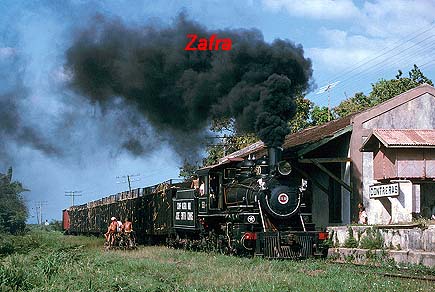
Until 2002, there was 'real' great American style shortline steam operation during the
annual Zafra (roughly December to April with a peak in February/March). By
2004 it was 98% plastic, I believe 2005 was 99% plastic, there was, if anything
even less in 2006 according to the
various reports received (updated, 17th March 2006). Real steam
during the 2007 was almost non-existent, with just one working steam locomotive
(and possibly one or more unreported firelesses) - see the
Zafra 2007 report (updated 30th May 2007).
How RTC can square that with "there are many steam locomotives, all over
eighty years old, twenty of which are in daily use during the Cuban sugar cane
harvest 'Zafra'" beats me. There were barely 10 real steam locomotives that
turned a wheel at all in 2005, it was certainly wasn't true in 2006 and it was
even less true in 2007. Of course, if you count steam on the tourist trains you
might get a bit nearer the mark. All the previous reports which chart the demise
of one of the last great steam experiences in the world have now been
transferred to a
separate page.
|
Roland
Beier informs me (3rd August 2012) that during the summer holidays in
July and August there is now a steam train for Cubans every Saturday
from Moron to Ciegeo de Avila and back. The price of 30 Cuban pesos
(national money, = 1 GBP) covers the return trip plus a meal and a
drink at the recreation park at Ciego de Avila. The loco is 1757 which
is kept at Patria mill for the tourist steam excursions. Trains depart
at 08:00 from Moron and at 16:00 from Ciego. Of course, it is not
"real" steam but at least it is a train dedicated to locals and not to
foreign tourists. The reported link
http://www.invasor.cu/index.php/es/economia/15091-veraneando-en-locomotora-de-vapor
was dead by 26th April 2014.)
David
Greenfield has provided a list of ex-Minaz steam locomotives at three
sites in Central Havana (updated 3rd December 2015
with many relocated),
there is just one which has not yet been positively identified to my
knowledge. To which I have appended
an explanation of what is supposed to be going on there (3rd
May 2009). Trevor Heath sent a photo report showing restoration
in progress (4th December 2009). Clive Fletcher-Wood has sent me some
pictures (27th February 2011) which shows that the
restoration of 1138 has been completed (left below), 1707 is now present (centre
below) and that 1163 is still at the Aguada service station although why it
carries '457' instead of '4' as it did before is beyond me. Ray Gardiner was in
Cuba in February 2011 and reports on restored
steam next to the harbour in Havana (updated 27th
December 2011).
'Cruising Pam' has uploaded a vast array of
pictures of locos in store and under restoration in Central Havana from a
February 2014 visit - click
here to view - you will need to use the list linked above to make sense of
it! (11th March 2014)
Keith Smith paid a tourist visit
to José Smith Comas Mill near Varadero which is now officially a 'sugar
museum' in November 2010 (two more pictures, 5th January 2011, Ken Livermore's
locomotive list 3rd December 2015). At Trinidad,
Marc Enderby found 1590 formerly at Bartolome Maso on
the tourist train (21st May 2011). The number of serviceable locos used for
tourist purposes is quite considerable, the following were seen in steam in
March 2011 on a PTG tour and are shown on the Railway
Herald website (30th December 2011):
The former Marcelo Salado Mill is now host to 'Caibarién
Museo Agroindustria Azucerra'.
Clive Hepworth visited a number of steam tourist
sites in late 2012 and has sent an illustrated
report of what he found (updated 22nd January 2013).
If you want a quick fix of an excellent photographic display of what you
may have missed - check out David
Longman's Cuba Gallery (28th June 2007). Similarly, my own Those were the days - Zafra
Narrow Gauge Steam..., my gallery of Cuban pictures taken
between 1996 and 2001 (6th April 2010).
Minaz placed 55 redundant steam locomotives on sale
back in 2004. I am not sure how many were
ever sold, they didn't include many 'gems' and I believe the price asked did not
reflect the poor condition of most of them. I was later told (30th
March 2010) that the sale has been 'pulled' and that the locomotives are
to stay on the island pending restoration - some have already been moved to
preservation sites and given a paint job. For the record you
can read the original list (4th September 2004).
And
then there was one... By 2008, there was very little left as a memory
of the good old days will be the growing museum at Christina Station in
Havana and tourist operations at Trinidad and a number of (closed)
mills. Yoshi Matsuo tells me that a visit to Manalich mill found the
line to the shed overgrown and no sign of 1402 with a Hector Molina
reportedly going directly to the loading point (3rd March 2008).
Meanwhile ex- Hermanos Ameijeilas 1431 was serviceable at Parque Lenin,
normally on Saturdays and Sundays only. Tim Murray adds (17th March
2008): "The 2 standard gauge Manalich locos still in shed but not used
this season. Likely to go to museum. They have a diesel (34064) that
now goes to the LP. The Trinidad tourist train loco is laid up until at
least the end of April. The PTG group had steam at Bartholomew Masa
mill. The loco still does patio work on a regular basis and the staff
claimed that it would work next season. The 2-8-0 from Venezuela has
gone to Patrio o Morte and is working the tourist train. Ciro Redondo
has two 2-8-0s in shed 'under repair' including 1829. Three of the
other 2-8-0s are dumped at the back of the mill." Alan Pearce and Alan
Murray-Rust visited the Havana area and recorded
some old friends, some of which stagger on like the Hershey and others
which have literally been put out to grass (18th April
2008). A later report (2nd June 2008)
suggested that 1402 at Manalich worked early in the season pending diesel
repairs, 1204 was active at Prieto near the airport and 1728 at J.M. Perez
both on occasions, with the Brasil firelesses more reliable performers.
 |
There have been some
tours which have run Minaz steam locomotives on the main line, to say that the
results have been mixed would be the politest way of putting it judging from
the informal reports I have had. Does all this herald the
death of communism in Cuba?
|
For those with a wider (historical) interest, Wayne Weiss
recommends an excellent site on Cuba tramways http://www.tramz.com/cu/tto.html
(22nd May 2003), similarly check out a Central Santa Lucia site (Rafael Freyre
Mill) - updated 3rd October 2001.
|
Cuba
Steam Center USA
Salida Roundhouse, 734 West 2nd.St
Salida, Colorado 81201
(719) 539-7184 or (719) 530-1496
Cell
Contact Wayne Weiss
for books, videos etc
|
If you missed out last
time then you need to get yourself
a copy of the second edition of:
Industrial Steam Locomotives of Cuba
Full
details on the IRS Shop Site.
|
1500 pictures of 20 years of steam in Cuba's Sugar Mills
on CD ROM:
Zafra
For full details and how to order, click here! |
Dominican
Republic Index
No live steam, of course, but several preserved
locomotives and three very interesting classic diesel powered sugar railroads
all of different gauges Thomas Kautzor
reports.(1st September 2014)
Ecuador Index
The Guayaquil
and Quito Railroad is potentially one of the most splendid train
journeys in the world. The days when it could be covered in its
entirety by public train are long gone, but as conditions allow trains
operate for visiting tour groups on. For example, the RTC group in
October 2007 as reported by Steve Pratt (30th November 2007) "We tried
to cover as much of the G&Q as possible. Steam:
Duran-Yaguachi-Duran (Baldwin No.11); Railcar: Bucay-Huigra-Alausi;
Steam: Alausi-Devil's Nose-Palmira-Riobambe (Baldwin No.17); Steam:
Riobambe-Urbina-Riobambe (Baldwin No. 53); Railcar: Boliche-Tambillo.
Some of the track is in very poor condition, but the tourist railbuses
are still running regularly. Next year (2008) is the centenary of the
line reaching Quito, so there could be some celebrations, though the
practicality of running through the city into the centre of Quito look
remote." Trains Unlimited Tours - which has subsequently entered
bankruptcy - claimed (12th August 2008) that
rebuilding will be almost complete by mid-2009 and that a significant number
of steam locomotives will be operable by then, but that has not happened.
 |
However, by mid-April 2009, even the railway had
admitted that the repair programme was too optimistic and all the three
tours I knew planned had been cancelled, at least for 2009. Read
more (updated 18th April 2009). This includes
Stephen Lacey's first hand report and recent pictures of what are thought to
be all extant G&Q steam locomotives. The next report from Ecuador from Dr. Michael Grimes
starts "The news from Ecuador for 2010 is not good." - read
it in full (1st June 2010), I have then added a rather more
optimistic assessment from September 2010 (14th
September 2010), but there was still a long haul left before trains could
run throughout. A long period of silence ensued before the
very welcome news that the railway is in sight of complete rebuilding (updated
again with the first train running part way 6th January
2013). It will be some 10 years since the first public plans to
restore it to good order were announced. Another update from Dale Brown
appeared on the Railway Preservation News website http://www.rypn.org/forums/viewtopic.php?f=1&t=33408
which indicates that steam will not return until late 2013 at the earliest (6th
June 2012).
|
The UK's Guardian newspaper has a
photo feature on the new line - I suspect this may appear elsewhere too as
they are official pictures (20th March 2013). Now
the spotlight is turning to the steam locomotive fleet, 53 is back in action, read
about it (6th April 2013), page includes a
link to an 8 minute YouTube clip. There will even be regular scheduled
(tourist) steam from 4th June 2013 (6th April 2013), the
through tourist train has now been launched (3rd
July 2013). Gerald Peacock points out that the railway now has a 'bells and
whistles' of a website http://www.ferrocarrilesdelecuador.gob.ec/
(31st October 2013, link found broken on 27th October 2017) - unfortunately by October 2014 it was stripped of any
news items. Apparently #14 is the next in line for restoration and work
has now started on what will be a major rebuild - there is a YouTube video
uploaded on 31st October 2013 - http://www.youtube.com/watch?v=3dlRwbM18Qg
- of it being loaded on to a road truck to be taken to Duran (13th
January 2014). See also http://www.youtube.com/user/EcuAventurero
for more news on the steam fleet (13th
January 2014). Dale Brown's latest update (23rd
May 2014) has both #11 and #53 in regular 'main line' action.
Gerald Peacock tells me (16th
January 2015) that 18 has been returned to operation on the San Lorenzo
Railway north of Quito between Ibarra and Otavalo. There is even a suggestion
of the web that it may have been used on regular services (http://www.ferrolatino.ch/en/news/ecuador/)
but I think this was wishful thinking. Videos of the inaugural train are
available - https://www.youtube.com/watch?v=zEsN3tW5gII
and https://www.youtube.com/watch?v=bUXtwkDALe4
(you can stop watching the second one after 40 seconds). Gerald writes further
(16th May 2015) "Hi Rob, lots of action in
Ecuador, see one recent video of no14 running https://www.youtube.com/watch?v=AphsgK9YIBo,
I never thought this would happen. So now we have 5 locos operational 11, 14,
18, 53 and 58. However the atmosphere of the old railway is gone, but you
can't have everything." Marc Enderby joined
a 2015 tour which featured, in part, 14, 53 and 58 (12th
October 2015), there was a similar American tour a little earlier. Kevin
Hoggett was here in October 2017 and I have now uploaded his much
delayed report (15th August 2020).
By May 2020, a combination of inadequate
maintenance and natural disasters meant that not much more than a third of the
system was operational, remaining trains were stopped and the railway declared
bankrupt, see
this report. (16th August 2020).
One attraction which came as a surprise to me
is the near complete survival of the G&Q steam works at Guayaquil - take a
look at this video, absolutely fascinating (25th August
2012), alas it has now been taken down. Never mind, as a bonus, don't miss
this old 1983 BBC programme on the line http://www.youtube.com/watch?v=X4F_Dm4Anj0
(13th
January 2014).
Click below for reports:
Other information on railways in Ecuador
El Salvador Index
3ft gauge steam survived here on charter operations. You can read a report of the TUT visit in January 2002 (27th March 2002). For a superb
album of real steam from 1968 check out John
West's site (29th September 2017).
 |
Thomas Kautzor has pointed me at an interesting
set of photographs taken here in February 2011 (28th
February 2011) but the link is now dead. Among lots of diesels, this shows Baldwin 8 preserved and steam derelicts at
Sonsonate,
and most interestingly 12 and 101 inside the roundhouse at San Salvador - these
are said to be 'serviceable'. These two locomotives were used in 2002 on the TUT
tour, referred to above. The line from San Salvador to Apopa is currently the
only operational route in the country with a limited passenger service, there
being no freight.
James Waite was here in April 2012 and was
treated to royal hospitality. Read about what
he found (more loco information 10th May 2012), Thomas Kautzor has provided an
update including the establishment of a museum (6th
November 2015). Thomas also advises that there is a small preserved saddle tank
at the port of Acajutla (18km from Sonsonate) - see http://soyacajutlense5.blogspot.co.uk/2012/12/acajutla-historicamente.html
(12th October 2016). See my railway museums pages for more information (22nd January 2018)
|
French Guyana Index
Chris Hodrien has pointed out to me that this site
http://www.revue.inventaire.culture.gouv.fr/insitu/insitu/article.xsp?numero=8&id_article=goergen-1575
(Link broken by September 2025) has a picture of a derelict 0-4-0T at Tigre. More information would be
appreciated (7th December 2007). James Waite subsequently pointed out that
there is a second locomotive below outside the Guyana Space Centre.
Guadeloupe Index
Thomas Kautzor visited the islands in October
2013 and has written a full report of known surviving railways and artefacts on the island
which include two steam locomotives (updated 8th
February 2014). This is completely revised version and replaces
the previous report. The update consists of some
historical pictures of the system at Beauport quite soon after closure.
A further August 2014 update is
available (28th August 2014).
Guatemala Index
For a superb album of real (and charter) steam
from 1968 check out John
West's site (29th September 2017).
With the railway between Guatemala City and the
Caribbean coast effectively defunct, James Waite's visit in April 2012
necessarily concentrated on preserved (and surviving) steam including
industrial items - read his illustrated report
(more loco information 10th May 2012). Thomas Kautzor made some industrial
visits in 2019 and recorded several steam locomotives including a Shay, read
his report (26th October 2019).
RDC announced suspension of operations in Guatemala (3rd
August 2007) citing the government's failure to honour its contract
with the company and the failure of its legal system to enforce it. The
dispute went to the Central America Free Trade Agreement (Cafta) for
arbitration. Whatever happened there, it was bound to be bad news for the railway, its
steam locomotives and especially the people on it who worked very hard to
restore and operate it in the last few years. And, in turn, it is bound to
have a knock-on effect on any attempts to revitalise other railways in the
region. Click
here for three articles from US newspapers which include the background to
the case. I have now added (26th September 2009)
more links to this page, updating the sorry story but basically it looks like
the end of the road for railways in this part of the country. RDC has now won
its CAFTA case (17th July 2012) - http://www.rrdc.com/news_RDC_wins_CAFTA_against_Gua_07_05_2012.pdf
- collecting the significant compensation may take as long as the court case.
I was pessimistic, it took less than 18 months - see http://www.railwaygazette.com/news/news/cs-america/single-view/view/full-settlement-for-railroad-development-corp-in-guatemala-dispute.html
(6th December 2013). What will happen to the
residual operational steam stock left behind is unclear. I guess some private
US railroads will be after them.
For some time, RDC (http://www.rrdc.com)
operated the 3ft gauge Ferrovias
Guatemala (the private company which restored Fegua, Ferrocarriles de
Guatemala, to partial operation after its 1996 abandonment) and
maintained two steam locomotives in operable condition for special
trains for its business customers or tourists. Their operation is
described in the links below.
Click below for reports:
 |
 |
The first picture shows 204 doing a bit of real work while on test
before the 2004 event and the second why it was such an attractive operation.
|
Haiti
Index
 |
Thomas Kautzor has been to Haiti to seek out what
little is left of its railway heritage, including one preserved
steam locomotive - read his report
(24th May 2014). Should you, like me,
be unfamiliar with its railway history, Thomas has also provided
some background. |
Honduras
Index
Jamaica Index
 |
In June 2014 Thomas Kautzor visited the island
where operational public railways are sadly probably history. His
illustrated report covers some of the remaining infrastructure
as well as CLC built 54, the last steam locomotive on the island (26th
June 2014). |
Martinique Index
 |
Thomas Kautzor visited the island in October 2013
and has written a full report
of known surviving railways and artifacts on the island
which include three steam locomotives (17th
November 2013). This is a completely revised version
and replaces the previous report. An August
2014 update is available (28th August
2014). |
Mexico Index
For a superb album of real steam from 1968
check out John
West's site (29th September 2017).
Trevor Heath pointed me at a January 2009 report
on http://www.trainorders.com which
stated that the 3 truck Shay owned by Compania Maderera de Durango is active and
used to switch cars brought by LFCD into their private spur. They also have a
Heisler. I asked for a first hand report, now Trevor has supplied one himself,
the locomotive is defunct..
Thomas Kautzor spent nearly two weeks in Mexico
in November 2012, he saw a lot of (inactive) preserved
steam locomotives on both narrow and standard gauges (13th
December 2012, updated 9th October 2018).
See also my narrow gauge pages for information
on tourist steam.
Nicaragua Index
The Fahr
Plan Center (corrected 30th July 2011) has a series
of pages on the railways of Nicaragua, including FC Muelle de Corinto 0-4-4T No.
1 plinthed in front of the former Puerto Corinto station, now a museum.
:A 4-6-0, FC del Pacifico #21, preserved at the old station in
Granada - http://www.manfut.org/granada/AntEstacion.html (Link
broken by May 2023) and http://www.flickr.com/photos/globevisions/651510602/.
There is a third steam loco on the outskirts of
Chichigalpa, on display on the former trackbed of the railway to Ingenio San Antonio, their former No.
5
(added 30th July 2011, thanks to Thomas Kautzor for
this one).
The Selva Negra coffee museum at Matagalpa maybe
has an "interesting steam locomotive which was used in the early 1900s to transport coffee from Matagalpa to the ports. ...",
it was said to railless so presumably was some kind of traction engine...
Panama Index
 |
No active steam, but a long submerged steam loco and
train have been recovered from a storage reservoir for the Panama Canal (23rd May
2000), with the prospect of more to come.... Mike Clendining has now provided
some pictures of the restored engine and the
current railway situation in the country (16th May 2007).
Glyn Dawson was here in March/April 2009 and
reports on two
further survivors in the remote Darien region (23rd
April 2009).
|
Paraguay Index

|
This was possibly the only all steam state railway left in the world, although
in its final days it was very much a rump operation with the main line severed.
Interest centred on three features, click on individual links below or here for Neil
Edwards comprehensive report
from August 2009 (23rd August 2009). Subsequently, Asunción resident
Renaud Olgiati
reported (14th January 2011) - “At the Asunción end, no traffic at all,
as the abutment of a bridge 3 km out of town has collapsed, the tourist
service to Aregua is stopped until further notice. At the
Encarnación end, I believe that all traffic has now stopped, as the
rising waters of Yacyreta dam have flooded a section of the track on
the Argentine side.”
Thanks to Trevor Heath for this one.
|
Renaud Olgiati reports (10th
February 2012) that the works at Sapucay are now rightly considered a
tourist attraction and are in part open to the public. Realistic plans exist to
re-open the whole railway - read his report.
He also reports (27th May 2012) that "the management of Azucarera
Paraguaya at Tebicuary have plans to turn what remains of their steam
rolling stock en engines, both SG and
MG, into a railway museum in the grounds of the Azucarera". Neil
Edwards
was here in August 2009 and you can read
about what was left then. A widely syndicated article by Associated Press
has appeared (search for this phrase "Paraguay breathes new life to its steam train")
which records that short steam hauled journeys are being offered from Sapucay,
although the picture captions say Asunción! (18th
October 2012). Renaud Olgiati has provided an update which show that steam was almost certainly working at
Encarnación earlier in 2012 although it may well have now ceased. Additionally
the steam tourist service has been halted yet again, but hopefully a new service
will run again from Luque in the not too distant future (22nd
October 2012).
Frank Ludwig was in
Encarnación in March 2013 and confirms that steam
is still in use, but very occasionally - you'll need to be lucky or very
patient to see it (updated 30th April 2013).
The magazine Latin Tracks produced a nostalgic
article on the closure of the 'working' railway at the end of November 2010 - it
is available for download http://www.latintracks.net/pdf/pdffile.pdf
(8th November 2011, since when the link has gone dead). The North British Locomotive
Preservation Group is investigating the possibility of repatriating one of the redundant NBL locos
(8th November 2011).
-
Encarnación
- shunting traffic for the link with Argentina (latest report 28th April
2013), now very occasional and probably finished
-
Sapucay
- the original workshop which ought to be a world heritage site with its
ancient machinery and another potential tourist operation (latest report
see above)
-
Asunción
- which has had a regular tourist train on occasions (last reported
suspended see above). The former station is now a museum - http://www.lcgb.org.uk/html/paraguay2017link.htm
(added 10th April 2018). The online magazine Tren Rodante (http://www.trenrodantedata.com),
edition 258) reports that Paraguay Railways 60, 2-6-0 (North British Locomotive Works 19143 / 1911)
formerly at Encarnación has been restored to service for the Sunday
tourist train. However, before it could begin operation the pandemic
caused a postponement (1st July 2020, thanks
to Tom Schultz for this).
|

|
This is Steve's Cossey's December 2015 picture 54 at
Botanico (then out of use although it was serviceable in 2009). There are more
pictures available from his visit (14th August
2020).
The new
service is slated to run 17km from Aregua to Ypacarai although the article
implies it could be extended back towards Asunción if successful (3rd
July 2020). |
Click on the links below for more information:
-
Earlier
reports (last entry 22nd March 1999)
-
Latin
Tracks report on the revival of the residual railway (27th July
2004)
-
(Bad) news about the
Puerto Casado railway (latest entry 8th August
2017)
-
Steam
Trains in Paraguay - some background information and pictures (9th
March 2009)
-
A gallery of pictures
from August 2007 picasaweb.google.com/tgears1/SouthAmericaTrainsAugust2007#
(link dead by 25th October 2016) by Tom Gears - alas with no captions (9th
March 2009)
The Ferrocarril del Norte was a metre
gauge railway than ran from Concepción to Horquetá, one of its
locos later worked at a bean mill (0-6-0T OK 3609/1909) and is now preserved in
the main street, along with two steam cranes and a
steam roller (11th September 2013).
|

|
This is Ian Thomson's picture of a small mishap. |
Peru Index
Historically there have been a fair few rusty hulks around the country,
several of which have been the subject of speculation about renovation to
operating condition and one or two have actually made it. However, it seems that
realistic steam operation is centred on:
 |
Andes
class 2-8-0 206 is "now stored out of service on a siding in the open
at San Bartolome, Peru. It is in the middle of a string of stored and
wrecked diesel locomotives. The loco has been stored here without any
security. It is obvious that FCCA is not interested in steam excursion
at this time. However leaving the loco in such a spot may lead to scrap
thieves taking any highly valuable parts. Also several wooden coaches
are now on display in Pueblo Libre, Jesus Maria and Barranco from the
former Central Peru line." reports Dale Brown (9th April 2014). |
 |
One locomotive in Peru which is not going
anywhere is preserved in remote Iquitos, a relic of the town's 600mm tramway
which closed many years ago. See http://www.tramz.com/pe/ot/ot00.html
and http://www.iquitostimes.com/railroad.htm (Link dead by May
2023) for more information. Chris Walker tells me it's Decauville 445/1906 (17th March 2009).
|
As I am definitely not an expert on steam in this part of the world, I have
tried my best to extract information from the various reports to get a clearer
picture, but mistakes there will be! Click below for other reports and general
information:
Dale Brown
who lives part time in Lima
reports on the then current scene
(2nd September 2000).
Puerto Rico Index
Thomas Kautzor (8th September 2009)
has told me about a new website by Roger Aponte dedicated to the railways of
Puerto Rico, http://rogerseducationalpage.com/ferrocarrilespr/
(link amended for new site, still under construction, 1st
June 2012). There is a list of railways here http://ferrocarrilespr.rogerseducationalpage.com/?p=1117.
Courtesy of Roger and Dave Deyo, I have uploaded a
page of information about surviving steam locomotives (7th
June 2012).
Roger (10th March 2014)
now advises me of this set of pictures - http://www.flickr.com/photos/barrigerlibrary/sets/72157640461367106/,
he is also adding further information here http://ferrocarrilespr.rogerseducationalpage.com/?p=4465.
South Georgia Index
 |
A short article in Locomotives International included the statement that
there was probably at least one surviving stationary steam engine and steam
locomotive at the
former whaling station of Ocean Harbour. An internet search found pictures of
a single cylinder horizontal engine and a steam winch taken in the 1990s - http://www.railwaysofthefarsouth.co.uk/11cwhaling.html.
Robert
Burton of the South
Georgia Association has provided a succinct
summary of the situation including a picture of a steam locomotive (14th
October 2007) - I have yet to see a positive identification
|
Surinam Index
'Tapir Baby' has pointed out that Colin Churcher has uploaded an album from
the Anthony W. Burges collection which contains 39 priceless images of, inter
alia, the Suriname
Landspoorweg - https://www.flickr.com/photos/colinchurcher/albums/72157669353693454
(8th March 2020).
As an epilogue to what appears below, read Thomas
Kautzor's on the spot report from a September
2014 visit (11th November 2014).
Ton Mulder has sent me some pictures of dumped steam locomotives in this former Dutch
colony. I have now posted these
and added some background information supplied by Chris Walker (more information 1st
May 2000, roster corrected 2nd April 2013, updated 28th
November 2013). Ton now reports (16th May 2001) that a Dutch business has signed a letter of
intent with the Surinam Government to reactivate up to 90km of the line.
 |
 |
Well, that was the theory. In practice, Hans Scherpenhuizen tells me he
visited Onverwacht on 26 January 2005 (report added 21st
March 2005). The situation was more or less the same as depicted in 2000. No restoration
had taken place. The station canopy had collapsed, which means the rolling stock
was left in the open to disintegrate. One engine seems to have moved to a plinth
at the adjacent road to the station: the 0-4-0 tank engine must be 'Dam'. Here
are two of the pictures he sent, the second locomotive is Breda built 'Para'.
Thomas Kautzor in a brief report states
"All that's left of the Landspoorwegen is PARA, the Breda 0-6-0T skirt
tank, on display together with two coaches at Onverwacht, plus the
plinthed German 0-4-0T
across the road and the remains of one of the smaller 0-4-0Ts from the
closed
sugar mill at Marienberg outside Fort Nieuw
Amsterdam. Everything else, including the Borsig tram locos and the
line itself
was scrapped 3-4 years ago." (25th September 2014)
|
Uruguay Index
Active steam in Uruguay is mainly provided by the locomotives of these
three organisations:
This page naturally concentrates on 'live' steam as opposed to
'preserved/conserved/stored' steam. I added photographs of surviving
steam locomotives in Uruguay courtesy of regular correspondent Marcelo
Benoit (updated 9th May 2006), you can contact
Marcelo on marcelobenoit@redfacil.com.uy. Try
http://members.tripod.com/lfu1/index-24.html
which links to all Uruguayan railway pages. Tabaré Bordach of CEFU
had previously provided information on other
remaining narrow gauge steam locomotives (updated 3rd
August 2007)
 |
A word of explanation about the two preserved Uruguayan N
class 2-6-0s. For some years (1991 to 2005) CEFU's 119 masqueraded as 120. Now
the real 120 has been restored by AUAR it has been given its true number back,
but in some images on this site it will obviously carry '120'. Simple? As a
result, I have tried to describe her as 119 (120), but is possible that some
references have escaped my attention.
On the left is the real 120 recently restored, in steam on 28th April
2007, an absolute charmer at a mere 97 years old (picture by Marcelo Benoit
added 3rd August 2007).
|
As part of my streamlining of this page to make it more
manageable, I have set up 4 separate pages to cover the more recent news of
the four most significant preserved steam locomotives. Note that sometimes
more than one of them operates on any particular occasion and some duplication
of text (but not pictures) may occur in these pages.
 |
Earlier reports of steam in Uruguay between 1999 and 2003 are covered in
a separate page.
Marcelo Benoit has provided a
pictorial record of steam activities in Uruguay in 2007/8 (6th
March 2009).
Marcelo Benoit reports that 2005's
Heritage
Day
celebrations on September 24th and 25th (added 22nd October 2005)
included AUAR's steam crane exhibited by ANP on Montevideo Port
dockside.
|
 |
Little has been heard from Uruguay for some
time so I was very happy to receive a report of Fabrice
Lanoue's brief stopover in the country (17th May
2011). Following this, Marcelo Benoit has sent me a summary of
steam activity covering 2009, 2010 and the early part of 2011, basically
N120 has been the backbone of the steam programme, sadly CEFU 3 has
still not worked for a while, click the link for the
full illustrated report (9th June 2011).
CEFU's 119 has now steamed, see a short video of a test run in April
2011 - http://www.youtube.com/watch?v=8artIIed0gw
(9th July 2011). After another long break,
Marcelo has sent further pictures
from 2011 - 12 including some other static preserved items (updated 2nd
May 2013) |
 |
Jack Neville rode a charter for a cruise
liner hauled by AUAR 120, read his report
(2nd December 2014). Steve Cossey was able
to join an excursion to Florida on 7th November 2014 and the next day
CEFU's Manning Wardle 0-6-0ST ANP No 3 was in steam inside Penarol (15th
December 2014). |
Venezuela Index
For information about surviving steam see Steen
Larsen's report on the Caracas Railway Museum with Glen Beadon's comments
and corrections (18th September 2014, further
minor correction, 4th October 2014).
Railway Cranes (Steam and Hand) Index
The links on this page have been amended to reflect the addition of dedicated
steam crane pages on this website. John A. Taubeneck has sent me his list of surviving
railway steam cranes of South and Central America (updated 12th
August 2024). I don't normally cover North America on these pages, but I
am prepared to make an exception for such an esoteric subject and have now
added John's list of surviving
railway steam cranes of North America (updated 14th
December 2024).
|


