|
Even a dyed-in-the wool steam enthusiast like me cannot fail to appreciate
that Java's narrow gauge diesels almost all now qualify as 'heritage' since
they were delivered at least 25 years ago, indeed some of those around today
have notched up half a century of service. I have never totally 'cursed' the
mills' diesels as in many cases the field lines would have closed much
earlier if the service had had to be maintained by steam alone. And with
'real' narrow gauge railways around the world in full retreat, Java's estate
railways today offer an unparalleled concentration of traditional 'Decauville'
railways, complete with temporary track to connect remote cutting areas with
the permanent way. During my own early visits from 1975-9, money was short, colour slide film
was expensive and there was steam everywhere. Even on later visits into
the 1980s and beyond I rarely paid much attention to the diesels and I
was amazed when I discovered that over the years I had built up a reasonably
comprehensive coverage!
This article is in three parts:
I am very grateful to Ray Gardiner for providing me with a copy of his 'All
Indonesia Loco List' which has provided much of the information which
follows. Ray's researches continued until his untimely passing.
The Japanese Diesels
A few of
these appeared in the early 1970s, but the main influx arrived from 1976
into the 1980s. The
former are broadly of similar style to European builders of that era, the
latter are best described as uninspired boxes which nevertheless do the job
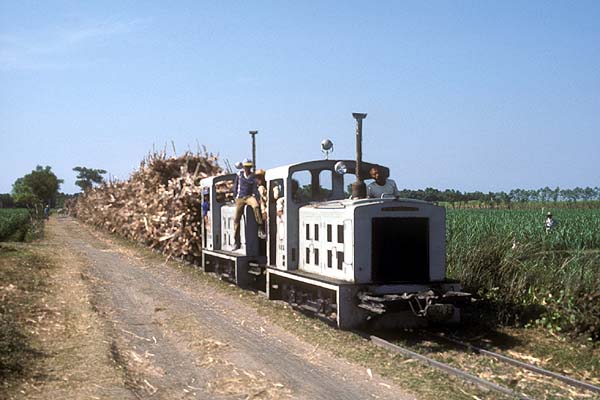
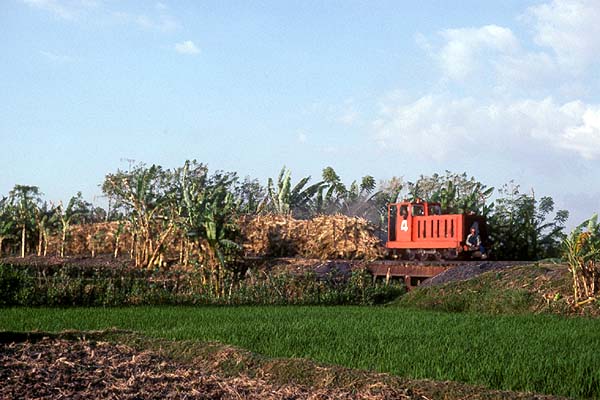
they were built for! These two 4wDM locos were built by Kyosan Kogyo
in 1965, they have been at Olean since about 1973 and are still at work there
although this picture was taken on 9th August 1986. There are other similar locos in
the Situbondo area.
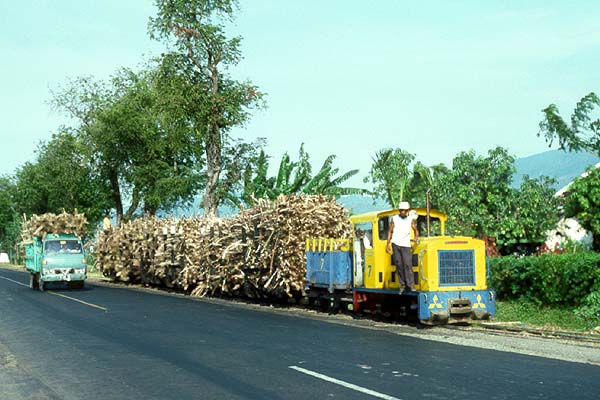
De
Maas 7, working a cane train on 26th August 1984, is another one from the same
batch:
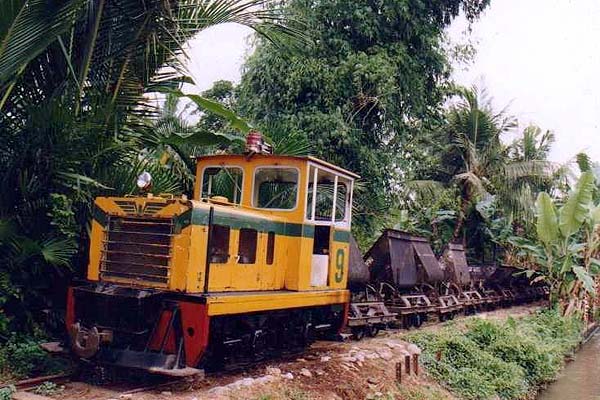
Three small 4wDH locomotives from Horikawa Kohki
were delivered to Pakis Baru in 1982. It seems, I never bothered to photograph
them and I don't know what happened to them when the mill closed in 1999. This
picture taken on 25th August 1996 is courtesy of Lie Tjeng Chiao:
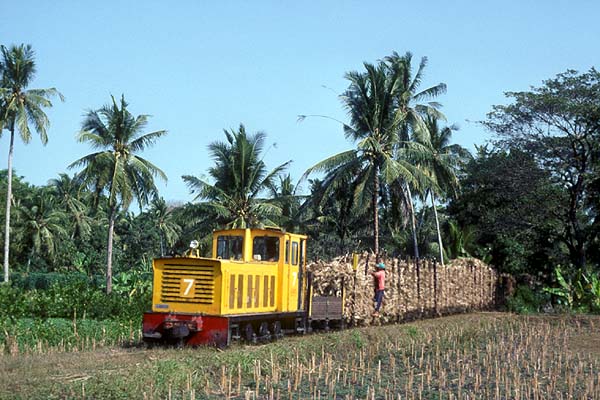
Hokuriku Juki Kogyo
supplied a variety of 0-6-0DH and 6wDH locomotives between 1976 and 1982, the
earlier ones were, I believe, part of the World Bank package which was used to
revamp a number of the larger mills. This is Semboro 7, photographed on 17th
July 2001.
This is Pesantren 13 on 21st August 1983

The company built a few 0-4-0DH such as Kanigoro 3:

Quite a few Keio 0-6-0DH locos were delivered around the
island in 1983, this is Wringinanom 4 at work on 1st August 2000.
And this is Asembagus 7 on a semi-refined sugar train to Jangkar on 7th
August 2003:

For some reason, the West Java mills specified a lighter version, this is
one at Sindanglaut, photograph is courtesy of Ray Gardiner:

And this is a heavier version at Rejosari, photograph is courtesy of Ray
Gardiner:

|