|
Even a dyed-in-the wool steam enthusiast like me cannot fail to appreciate
that Java's narrow gauge diesels almost all now qualify as 'heritage' since
they were delivered at least 25 years ago, indeed some of those around today
have notched up half a century of service. I have never totally 'cursed' the
mills' diesels as in many cases the field lines would have closed much
earlier if the service had had to be maintained by steam alone. And with
'real' narrow gauge railways around the world in full retreat, Java's estate
railways today offer an unparalleled concentration of traditional 'Decauville'
railways, complete with temporary track to connect remote cutting areas with
the permanent way.
During my own early visits from 1975-9, money was short, colour slide film
was expensive and there was steam everywhere. Even on later visits into
the 1980s and beyond I rarely paid much attention to the diesels
and I was amazed when I discovered that over the years I had built up a
reasonably comprehensive coverage!
This article is in three parts:
I am very grateful to Ray Gardiner for providing me with a copy of his 'All
Indonesia Loco List' which has provided much of the information which
follows. Ray's researches continued until his untimely passing.
Christoph Schöttler Maschinenfabrik (Schöma/Schoema)
Java's
Schoemas come in all shapes and sizes and arguably they were as successful in
their time as Orenstein and Koppel in steam days. At the bottom
end of the scale is what I believe is a 1959 built 4wDM at Pesantren. This
picture taken on 10th August 2008 is courtesy of Joop Versluijs:

A superficially similar loco is Semboro 23 photographed on 3rd August 2003. Weighing in at
4 tonnes (is it really that much) this 1979 4wDH is light enough to go down
temporary tracks and make bullocks redundant.

Also very small but with connecting rods is 1976 built
Pajarakan 5, thought to have come here from Jatiroto, photograph is courtesy of Ray
Gardiner. Apparently it was rebuilt like this after a transmission failure.

This 4wDH built in 1960 has had a pair of axles fitted from a scrapped
Orenstein and Koppel 0-4-2T, Thomas Kautzor photographed it at Semboro in June
2010:
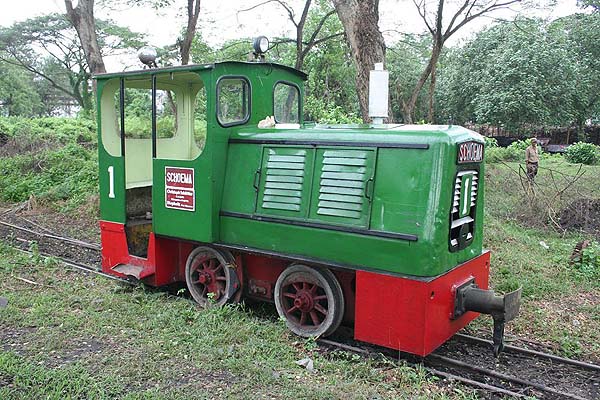
One of the earliest of Schoema's 4wDM is Kedawung's 23, built
in 1950. It was working the yard on 4th June 1978:

Slightly larger is 4wDM Pagottan 1, built in 1951. It was
working the mill's mud train on 17th August 1986:

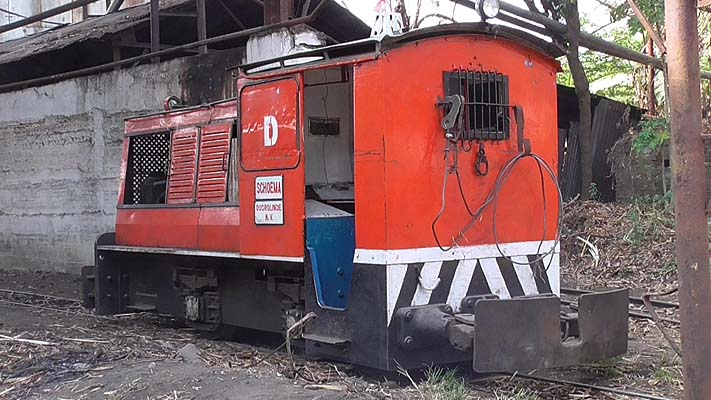
By the time it was photographed by Wilson
Lythgoe in 2015, 1950 4wDM Jatibarang D must have been one of the oldest still
working, it was a 80HP model.
Nearby Pangka had locomotives from the same
batch, 12 had been re-engined with a
Deutz P6L in the late 1970s when It was photographed in the delivery yard in July
1993. It was still in use in 2014 and most likely lasted until the mill closed
a few years later:

Also larger and more powerful, 1975 4wDH Krebet 13 is one of
many of these delivered to the mill at about the same time. It was photographed on 15th
August 2003.

The scene is familiar to many steam gricers in Java, but this is Purwodadi
1, a 6wDH built in 1951. It was photographed on 7th August 2002.

Of the same era and built in 1953 is this 6wDH, Tasikmadu III, working the
empties on 23rd August 1986.

In contrast to the last two locos, this 6wDH built in 1969, Pagottan 4, has a
much more contemporary look. It was photographed at Pagottan on 17th August
1986:

Schoema also built centre cab diesels which must have been easier to
operate in mill yards. One of the smallest is Gending 8, a 4wDH loco built in
1973, photographed on 29th
July 1984.

Gending 7 is a larger 1972 4wDH which I photographed on the same day.

This is a 1976 6wDH, Ceper III photographed on 24th August 1983:

This is a 1972 6wDH photographed at Gempolkerep on 23rd August 1998.

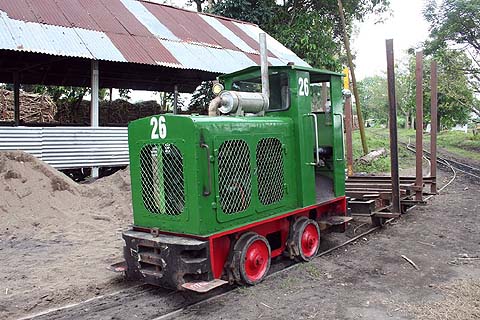
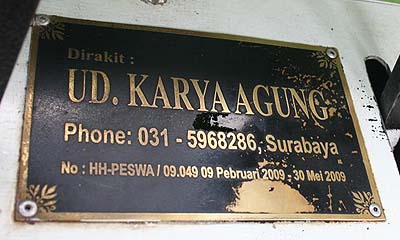
When a Schöma/Schoema is not quite it seems
Thomas Kautzor found this diesel at Semboro in June 2010,
it's actually a 2009 locally produced copy!
|