|
These pages are the work of Thomas Kautzor and date from
June 2021:
Click on the section you are interested in:
Introduction
Part 1 - Sicily
Part 2 - Southern Italy
Part 4 - Sardinia
Two new pictures were added on 9th November 2021, the 600mm
gauge Porter and the 500mm gauge Orenstein & Koppel
With only 10 (under 950 mm) narrow gauge steam locomotives, Italy must have one of the lowest ratio of preserved narrow gauge locomotives among major European countries. Further to that, only two are serviceable, including one as a diesel.
1000 mm gauge locos :
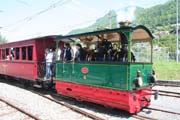 |
Ferrovie e Tranvie Padane (FP) 0-4-0T 4 (Krauss München 4278/1900, 10.0 t), which is operational at the Blonay – Chamby museum railway in Switzerland, was one of four tram locomotives delivered to the FP for use on
Ferrara-Codigoro (Emilia Romana). After the line was converted to standard gauge in 1932, it was used on Rimini-Novafeltria (950mm), where it remained in use until closure in 1960. In 1970 it was acquired by the BC and rebuilt until 1981, its boiler had to replaced with another one acquired from ÖBB Knittelfeld
(Austria) (Blonay, 27.05.2012) |
760 mm gauge locos
After World War I, Italy inherited a number of 760mm gauge railways together with parts of the Austro-Hungarian Empire.
|
|
Localbahn Mori – Arco – Riva am Gardasee (MAR) 0-6-2T 2 “Riva” (Krauss Linz 2360/1890) is operational at the Omaha Zoo RR in Omaha, Nebraska (USA) as CFR 395.104; it was one of four class U locomotives of the same type already in use on the Steyrtalbahn delivered to the Südbahngesellschaft (SB) as 40.01-04 for use on the MAR in Tyrol. In 1914 three of the loco were requisitioned by the k&k Heeresfeldbahnen and sent to Poland for use in industrial service in Galicia. At the end of the war it ended up with MÁV in Sibiu as 395.104 and was later stationed at Alba Iulia by CFR
(Romania) (no photo) https://de.wikipedia.org/wiki/Steyrtalbahn_1%E2%80%936
|
|
FS 0-8-0T R.410.004 (Krauss Linz 7174/1916, 27.5 t, 295 hp) plinthed in St. Ulrich
(Grödenthal)/Ortisei (Val Gardena) since 1973 was one of seven locos built for the k&k Heeresfeldbahnen as class IVc Nr. 4151-4157 for use in Bosnia during World War I. In 1918 the entire class was delivered to the FS as class R.401-001-007 for use on the
Grödnerbahn/Ferrovia della Val Gardena from Klausen/Chiusa to Plan (31.4 km) and the
Fleimstalbahn/Ferrovia della Val di Fiemme between Auer/Ora and Predazzo (50.5 km). After the Val di Fiemme line was taken over by
FEVF, regauged to 1000mm and electrified in 1928/29, the entire class ended up on the Val Gardena line. Two locos (002 and 007) went to Bosnia during World War II never to return and after closure in 1960 the other locos were scrapped, except for R.401.004 which had just come out of general overhaul at OGR Verona (no photo).https://it.wikipedia.org/wiki/Locomotiva_FS_R.410
|
|
Lokalbahn Triest-Parenzo 0-6-2T U.37 (Wiener Neustadt 4867/1908, 24.3 t, 220 hp) is plinthed at Koper station (Slovenia). In 1901/02 Krauss Linz supplied four class U No. U.20-23 to the k&kStB for use on Triest-Parenzo (123 km). In 1908 four locos of the same type built by Wiener Neustadt numbered U.37-40 followed. In 1911, U.37 went to Weiz-Birkfeld and was sent to Bosnia for use on the BHLB Steinbeisbahn as No. 46 in 1916. At the end of World War I it stayed in Bosnia with SHS as U.37. After World War II it worked on various Bosnian industrial railways at
Busovaca, Lasva, Kakanj and Zenica. In 1979 it was sent to Koper to be plinthed (no photo).
|
|
Lokalbahn Triest-Parenzo 0-6-2T U.40 (Wiener Neustadt 4870/1908, 24.3 t, 220 hp) is currently out-of-use at the StLB Murtlbahn (Austria). It also went to the Weiz-Birkfeld line in 1911 and was turned over to StLB in 1921. In recent times it has been in use on specials out of Murau (no photo).
|
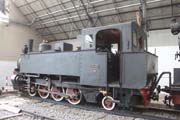 |
FS 0-8-2T P.7 (OM Reggiane 117/1922, 37 t, 295 hp) on display at Museo Nazionale Leonardo da Vinci, Milano; In 1911, Krauss Linz supplied three class P No. P.1-3 to the k&kStB for use on Triest-Parenzo. In 1922, another six locomotives of the same type numbered P.4-9 were supplied by Reggiane, however these are now thought to have been assembled from spare parts which had been stored in Linz since the end of World War I. The locos were reclassified as R.402.001-009 by FS and remained in service until closure of the Ferrovia Parenzana in 1935. In 1938 R.402.001-3/5/6/8/9 were sent to Palermo Sant’Erasmo (Sicily), where they were regauged to 950mm and worked from 1942 until 1957/59. R.402.004 was sent to Croatia (Split-Sinj) in 1943, to Bosnia (Cacak) in 1945 and ended up at Zenica in 1950, where it stayed in service until 1967. R.402.003 ended up at Parma in 1943, went to Rome in 1963 and to the Museum in 1967 (21.07.2013)
https://it.wikipedia.org/wiki/Locomotiva_FS_R.402
|
|
|
750 mm gauge locos
The
Ferriera Fucino steelworks in Avezzano (L’Aquila) had a total of ten
steam locomotives, which were possibly also used by the local sugar
refinery during the sugar beet harvest. The railway closed in 1964.
|
|
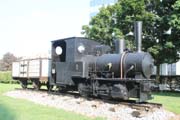
Ferriera Fucino 0-4-0T 1 “Fucino” (Krauss München XXVII
al 5204/1904) is plinthed outside the Buzzi Unicem headquarters in Casale
Monferrato (Alessandria); after closure in 1964 it was sold to Com. Fer. Met. in
Bruneck/Brunico (South Tyrol) and plinthed at the Josef Bachlechner School from
1996; it was restored by Lucato Termica in Castelletto Monferrato (Alessandria)
prior to being put on display in Casale Monferrato by 2009 (28.07.2020)
|
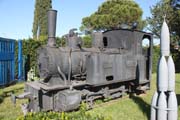 |
Ferriera Fucino 0-4-0T 8 “Monte Velino” (Henschel
15863/1917) plinth Ferrariera Acciaieria Casalina SpA in Pantano Borghese
(Roma). Originaly supplied to K.u.k. Kriegsministerium Wien as 0-6-0T R.IIIc.427
(600mm gauge), in 1920 it was sold to Ferriera Fucino and rebuilt as an 0-4-0T
on 750mm gauge. In 12.2016 it went on temporary display to Avezzano
(03.11.2020)
|
|
Ferriera Fucino 0-4-0T 9 “Aquila” (Henschel 15862/1917) is
operational at Pairi Daiza near Wavres (BE) as KukHb 0-6-0T R.IIIc.426.
Originaly supplied to K.u.k. Kriegsministerium Wien as 0-6-0T R.IIIc.426 (600mm
gauge), in 1920 it was sold to Ferriera Fucino and rebuilt as an 0-4-0T on 750mm
gauge; after closure in 1964 it was sold to Com. Fer. Met. in Bruneck/Brunico
(South Tyrol), where it was plinthed. In 1999 it was sold to R. Bude in
Buschhoven (Germany) and later to Rail Rebecq Rognon (Belgium), where it was
regauged to 600mm and restored to working order. In 05.2012 it was sold to Pairi
Daiza and rebuilt as an 0-6-0T at the North Norfolk Railway in the U.K. between
2014 and 07.2016 (http://www.heeresfeldbahn.de/lokomotiven/oesterreich/riiic/290.html).
|
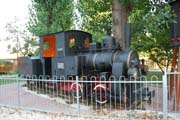 |
Zuccherificio Codigoro (Ferrara) 0-4-0T “Collefiorito” (Jung 2008/1913, 20 PS – 4,82 t), which is plinthed at the Fiabilandia theme park in Rimini, was delivered new to Casalis, Milano (24.07.2009)
|
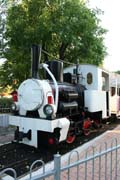 |
Zuccherificio Codigoro (Ferrara) 0-4-0T (CM Saronno 840/1918) is operational as a diesel at the Fiabilandia theme park in Rimini (24.07.2009)
|
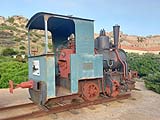 |
E. Mondini 0-4-0T (Jung 3656/1925, 15 PS – 3,70 t) is plinthed at Museo Cala Francese on Isla La Maddalena (Sardegna). It was used at the local stone quarry to move stone blocks to the dock,
|
600 mm gauge locos
|
|
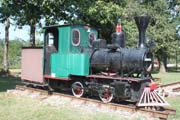
Tiberto SpA 0-4-0T (O&K) is plinthed Volandia, just outside Malpensa Airport (Varese). It is part of the Ogliari collection and while at Museo Ogliari in Ranco (Varese), it carried “Società Veneta, Officine Padova 1915” and “Maffei N°. 3343/1912” plates off TCDD 2-6-2T 35.58, but these have been removed at Volandia (12.09.2020)
|
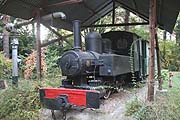 |
Italian Military Railway 0-4-0T (H.K. Porter 6286/1919) is on display at Stamperia Tallone in Alpignano
(Torino) with two enclosed bogie coaches and one open four-wheel coach. The historic print shop and its locomotives can be visited by appointment
https://www.talloneeditore.com/tallone/index.php/component/sppagebuilder/79-guided-tours.
|
500 mm gauge loco
|
|
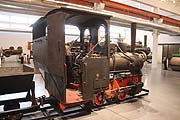
Società Veneta 0-4-0T (O&K 3937/1909, 10 PS) is serviceable at Franco Risi’s private Museo della Vapore (Franco Risi) in San Giovanni in Persiceto (Bologna); it was purchased new by Societä Veneta for use on the reclamation of the Po di Revere on the Moglia-Piarda section near Sermide (MN) and later owned by Fratello Bisson in Fontaniva (Padova); Mr. Risi frequently operated it on portable track at model railway fairs (http://www.museodelvapore.it/Page_Orestein_Koppel.html)
|
|
|


