|
Stoomtrein Katwijk-Leiden 2024 |
|
|
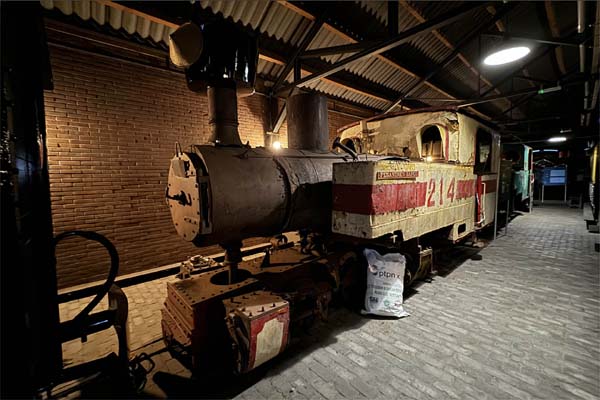
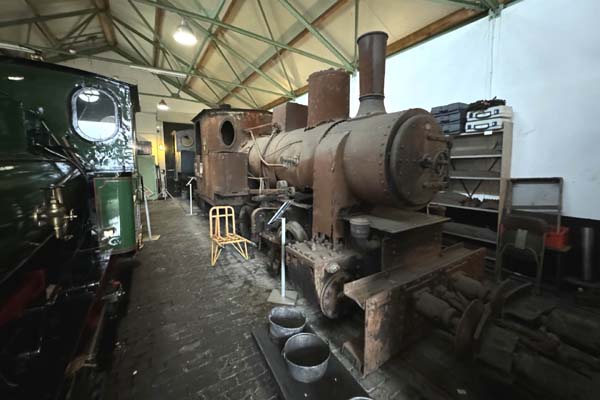
Back in 2007, James Waite visited what was then known as the Narrow Gauge Railway Museum at Valkenburg, and is now known as Stoomtrein Katwijk-Leiden: He returned on 18th October 2024 and found that the museum and railway has developed considerably since then. To the casual visitor the most obvious change is that the running line now encircles the lake, thanks to the construction of a bridge although I understand that it is not in regular use. Click here for the rest of James' visit covering the steam tram locomotives in the museum. Apart from 'Sivolde' and a few other locomotives which live in the museum, nine other locomotives including 607 and the other five in working order live in the engine shed. 214 is a 700mm gauge Du Croo & Brauns (see below) 0-4-4-0T Mallet (159/1928) which worked for many years at Ngadirejo sugar mill south of Kediri in East Java before being transferred to Peasntren Baru just east of the city. It is on loan from the Indonesian government and will need a major overhaul if it is ever to run again. It is missing many parts and the boiler is unfit for further service.
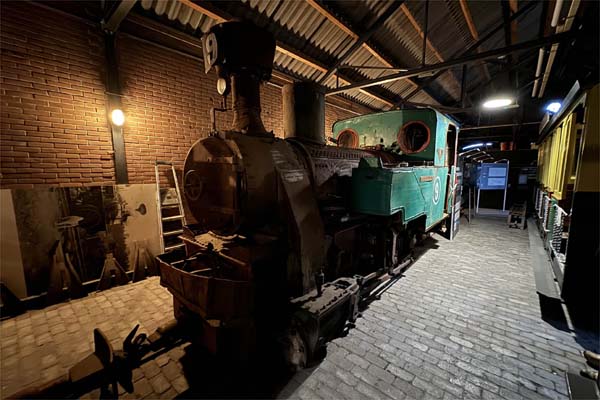
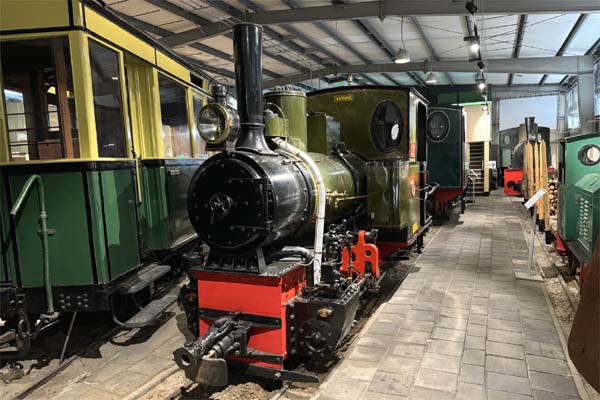
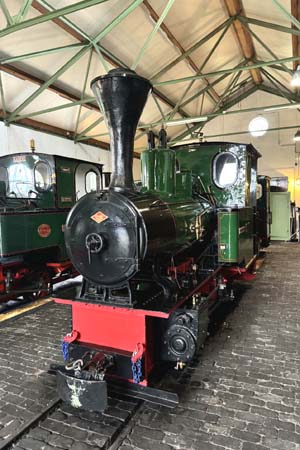
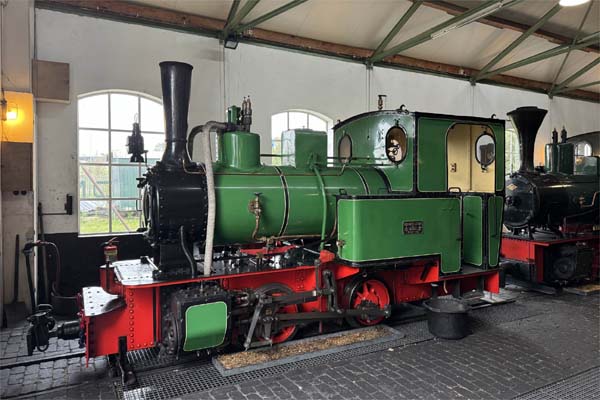
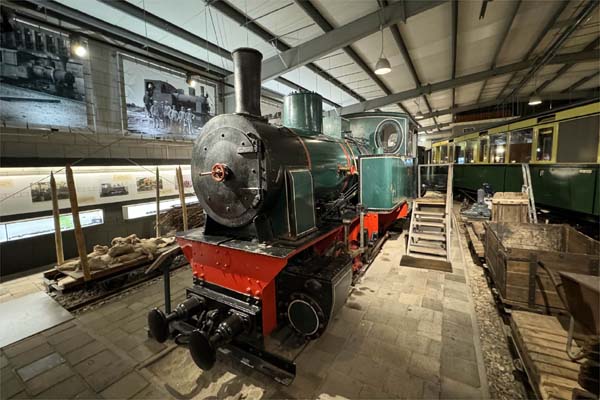
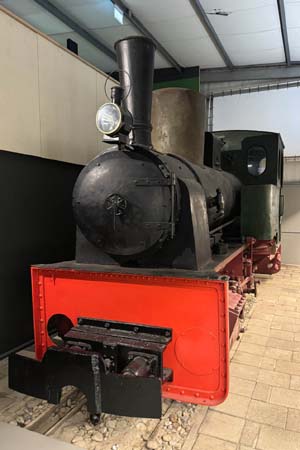
On the other hand, Sumberharjo 9 is more or less complete and had been used at the sugar mill near Pemalang on Central Java's north coast until quite recently, It is an 0-8-0T 700mm gauge Du Croo & Brauns locomotive (81/1925). Similarly 'on loan', my understanding (RD) is that it will need a more formal agreement before any funds can be committed and restoration undertaken. For the time being they are being kept in the carriage shed which is on the opposite side of the running line south of the replica station. This locomotive of type 164 or Bastion, was built in 1921 in the factory of J.A. Maffei in Munich as their 4069 and is the only preserved example that has seen service in the Netherlands. The locomotive was delivered new to Du Croo & Brauns (D&B) in Amsterdam. a trading company and manufacturer of narrow gauge rolling stock which was its Dutch representative. At the time of delivery, Engelbert Adolf Du Croo and Pieter Johan Christiaan Brauns were busy spreading their wings with their own locomotive factory that was established in Weesp. Maffei's importership ended as a result, but the contacts with Maffei did not, because D&B used parts such as windows, chimneys and sand domes from Maffei for its own locomotives. D&B sold the locomotive to the contractor Van Heurn & Volkers which was working on the construction of a railway through Zuid-Beveland from Goes. Sometime in the late 1920s or early 1930s, the locomotive was sold to Spoorijzer Delft. They included it in their rental fleet, which meant that it was used here and there in the country until 1949 when it was sold to Steenfabriek Malburgen near Arnhem. There, it pulled the clay-filled tipper wagons from the floodplains to the brick factory. By the late 1960s, it was already put in reserve and was not officially removed from the active list until 1971. In practice, it was last in steam in 1964. In 1972, the locomotive was added to the collection and was put back into service as locomotive 2 Yvonne in October of that year. This locomotive was a permanent fixture on the track, especially during the years when trains ran in the dunes. However, it did not run much in Valkenburg and is now in the museum because a new boiler is necessary to get it running again. In 1837, Joseph Anton, Ritter von Maffei bought an existing machine factory in Munich, where he built his first locomotive in 1841. In 1931, locomotive production was abandoned as a result of the crisis of 1929, which led to a redistribution of the locomotive quota among German builders. The last locomotive to leave the factory that year had the factory number 5925. Georg Krauss, also based in Munich, then took over Maffei. From 1931 onwards, the combination continued under the cumbersome name Lokomotivfabrik Krauss & Comp. – J.A. Maffei AG, which changed to Krauss-Maffei AG in 1940. Locomotives are still being built there today, but the company is now a subsidiary of Siemens, which owns the majority of the shares. Orenstein & Koppel 11735/1928 is a 700mm gauge 50 HP steam locomotive, delivered to Steenfabriek IJsseloord near Arnhem in 1928. It hauled the clay trains between the extraction site (the clay pit) and the mound at the factory (the dump). The locomotive has A-status in the National Register for Mobile Heritage, because it was the last narrow-gauge steam locomotive in the Netherlands to be used in normal operation in 1969. That was at Steenfabriek IJsseloord east of Arnhem. In that year it was taken out of service because the permanent driver retired and there were no people within the company who still wanted to become a steam driver. It was added to the collection in 1976 and in 2000, after a major overhaul, it was put back on the track in good working order. In October 2011 it had to be taken out of service
as the boiler was life expired.. The floodplains in the immediate vicinity of the factory were already completely excavated. That is why land had been purchased on the other side of the Rhine, at the foot of the Noordberg near Renkum
and this became the work area of the new locomotive. An excavator dumped
the clay into tipper wagons with a capacity of 2.5 m³ and the locomotive brought the train to the
riverbank from where a ferry was used to carry the wagons across. On the other side they were pulled up the embankment by an Orenstein & Koppel locomotive and then driven across the factory site to the brick press. Up to nine wagons could be transported by ferry, depending on the water level. This locomotive with a capacity of 160 HP was built in 1910 by J.A. Maffei
(2933/1910) for the track gauge of 900mm. It was delivered new to the agent Leipziger & Co, who had ordered it for the large German construction company Grün & Bilfinger. That company still exists, in a slightly modified form. Probably before the war, the locomotive was sold to the Belgian construction company Ponts, Tunnels & Terrassements in Genval, in the Belgian region of Walloon Brabant. Unfortunately,
the society knows nothing about the working life of the locomotive. This locomotive was built by Linke-Hofmann (2174/1920) from Breslau in Silesia. The locomotive is part of a series of ten units (2166-2175) of the Ellipse type. For most of these, the factory list only states Vorratsbau. It is possible that it only came this way at the end of the 1920s but it is clear that it was bought in 1931 by the Hollandsche Aannemingsmaatschappij formerly Zanen & Verstoep in Gouda, where it became locomotive 55. In 1934, the locomotive was transferred to contractor Dirk Verstoep in The Hague and became locomotive 20 there. The last inspection by the Stoomwezen took place in 1960 and in 1962 it lost its operating permit. In the meantime, the locomotive was again the property of Zanen & Verstoep in Gouda, again as locomotive 20 and, despite being taken out of service, was fortunately not scrapped. After years of storage, the locomotive was erected as a monument at the Zanen shipyard in Ammerstol. The open-air period did the locomotive no good. In 1988, it was handed over to the society. It is the only remaining 900mm gauge locomotive in the world built by Linke-Hofmann
which has a long history. In 1839, Gottfried Linke founded the Waggonfabrik von Gottfried Linke. One of the first orders was a series of 100 freight wagons for the Oberschlesischen Eisenbahn-Gesellschaft. In 1912, the company merged with the Waggonfabrik Gebrüder Hofmann & Co., founded in 1856, to form the Linke-Hofmann-Werke. In the following period, a number of larger and smaller companies were taken over, and in the 1920s, a huge conglomerate emerged, employing around 50,000 people. The construction company J.P. Broekhoven was established in Nijmegen from the 1920s. They carried out many large works and, in addition to a few smaller
600mm steam locomotives, mainly owned heavy locomotives with a track gauge of 900mm. Over the years, 24 steam locomotives have been registered in the name of Broekhoven at Stoomwezen. Orenstein & Koppel built this 900mm gauge 140 HP locomotive (4126/1910).
Its first owner was Josef Ell from Heidelberg and, in 1914, it returned to Orenstein & Koppel in Amsterdam, who sold it in 1915 to the construction company Arntz & Co in Millingen. Between 1917 and 1925, it was at the construction company Gerard Buve in Haarlem
who had won a contract in 1916 from the State Railways for the construction of the marshalling yard in Onnen and the connecting curve between the Groningen-Assen and Groningen-Stadskanaal lines. At that time, Buve already had
two of this gauge but this was such a large job that he purchased a third locomotive. The connecting curve was completed in 1922, as the last part. In 1923, Gerard Buve was the lowest bidder for the groundwork for the Zuiderpark in The Hague (incidentally the home of a fine 7¼” railway with no fewer than 3 Tinkerbell-type 0-4-0Ts). Here he used his three heavy O&Ks and 52 wooden tipper wagons.
It was a much too low a price and it became his downfall. On 23rd December 1924, Buve was declared bankrupt and, on 19th February 1925, the entire company property
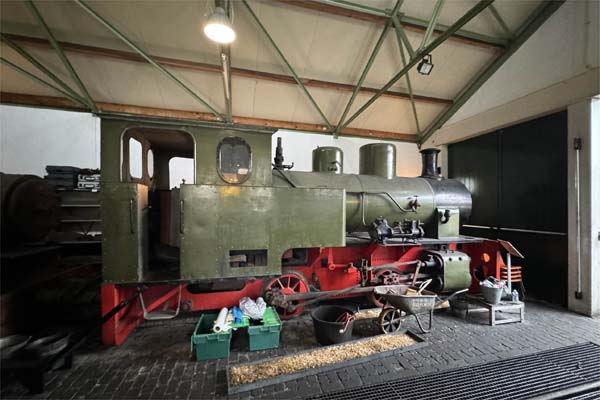
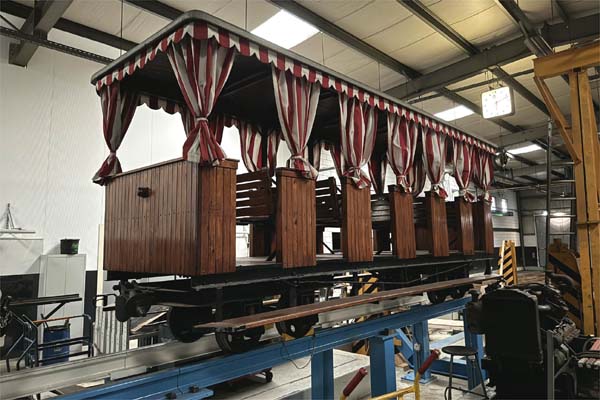
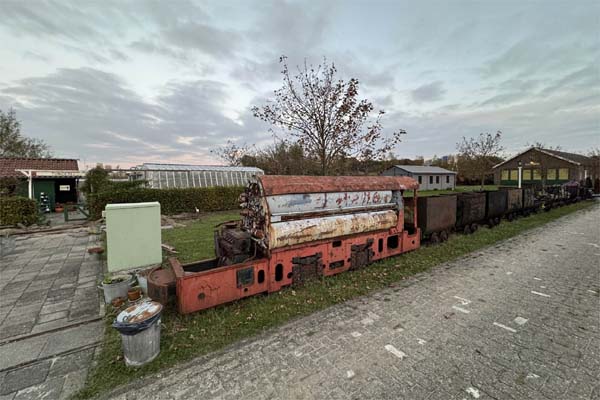
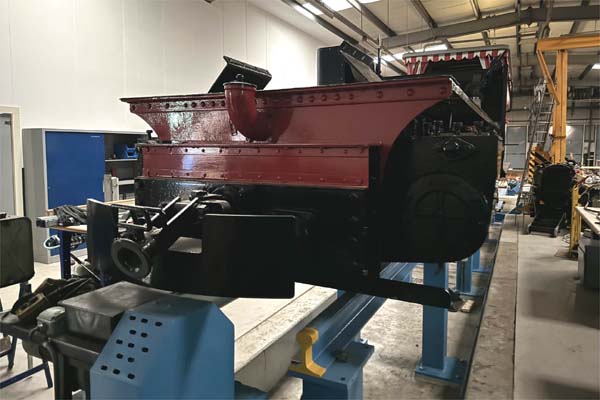
was auctioned off. This coach in the workshop with the curtains comes from the Heidestein estate railway in the hills east of Utrecht. This place with a manor house was purchased by a wealthy gentleman who had relocated back to the Netherlands from Java with his family after his daughter became ill. He was an engineer by training and built a railway, mainly for pleasure, through the estate. It was worked by a O&K diesel. This compressed air locomotive is a Pz type (45HP) built by Jung. The society has another such locomotive, a 570mm gauge Schwartzkopff. Gerard de Graaf informs me that this was running at Oranje Nassau Mijnen in Heerlen. Later it came in parts to Steenkolenmijn Valkenburg (L), where it remained in the yard till we collected it. It is expected to be restored in the near future. Finally, these are the frames of O&K 0-6-0T 7 'J. Pellenbarg' in the workshop, apparently from Lambert Frères who ran quarries in Northern France. James does not know if it has any connections with industrial railways in the Netherlands but Gerard de Graaf adds this minor connection, "A sister loco has been running for contractor H.J. te Siepe in the Netherlands." |