|
Preserved Steam Tram Locos in Holland 2024 |
|
|
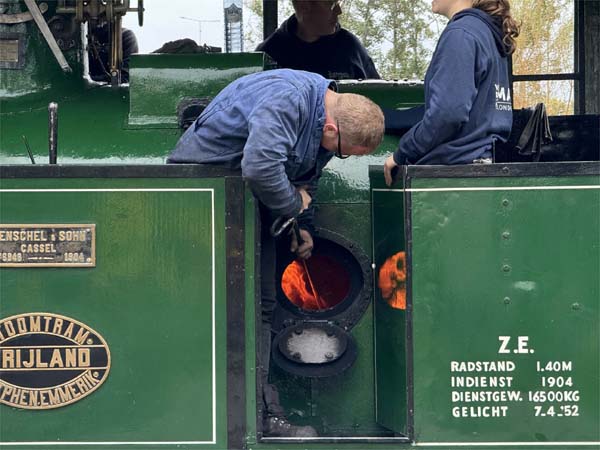
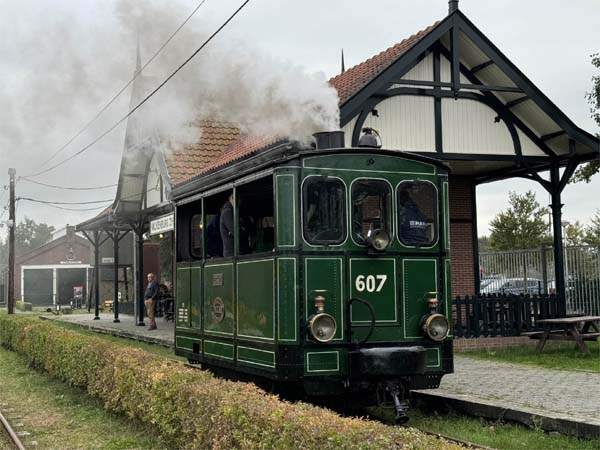
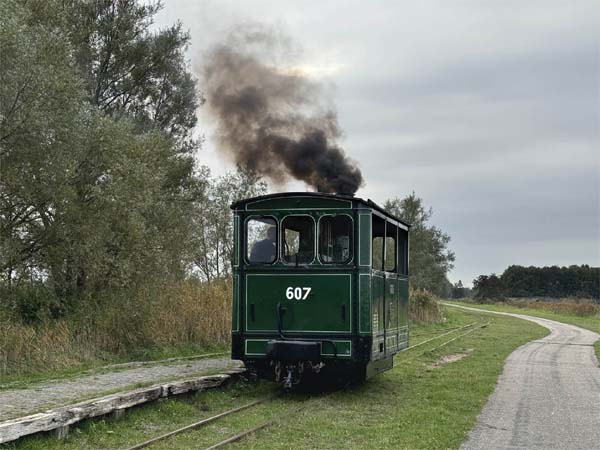
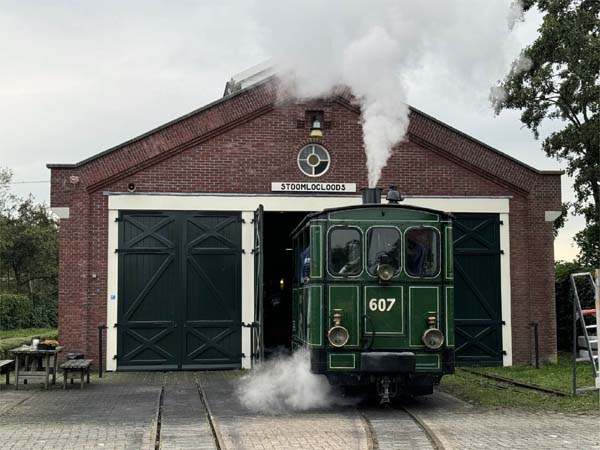
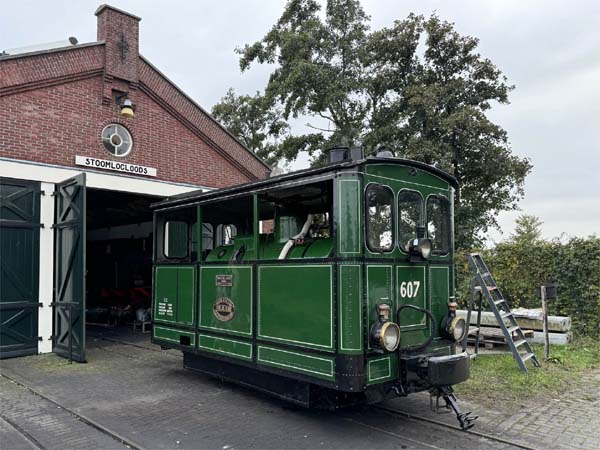
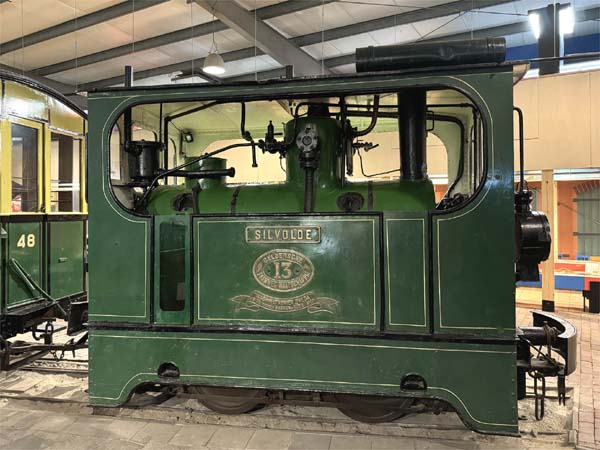
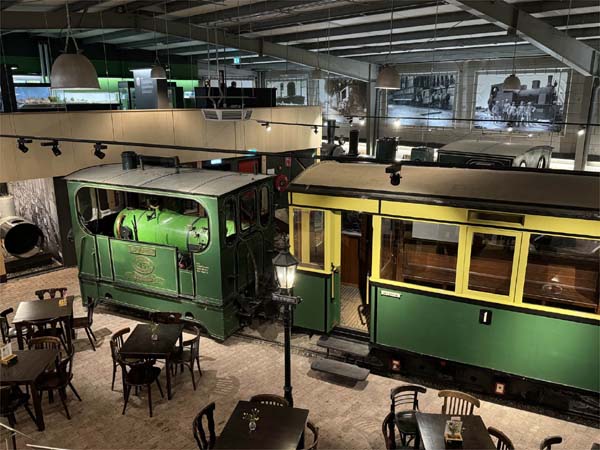
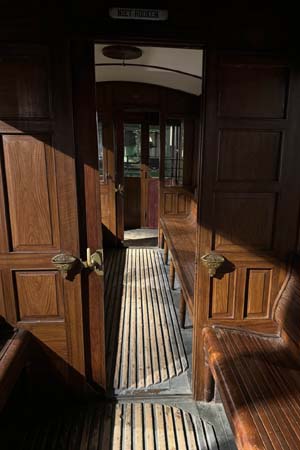
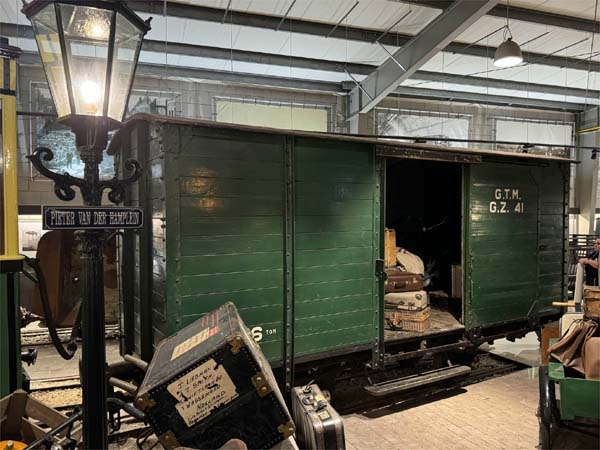
Back in 2007, James Waite visited what was then known as the Narrow Gauge Railway Museum at Valkenburg, and is now known as Stoomtrein Katwijk-Leiden: He returned on 18th October 2024 and found that the museum and railway has developed considerably since then. The information which accompanies his photographs is a lightly edited version of what appears on their website. To the casual visitor the most obvious change is that the running line now encircles the lake, thanks to the construction of a bridge although it seems that it is not in regular use Click here for more information on the history and restoration of 607. Click here for more information on the history of 13. Click here for the rest of James' visit covering the collection in the museum. The occasion was the inauguration into service of 607 'Vrijland' (Henschel, 6848/1904), one of two tram locomotives at the museum. Originally built to 750mm gauge, it had been regauged to 700mm as part of its 'return to steam' overhaul. 'Vrijland' was originally no. ZE7 of the Zutphen Emmerik steam tramway, a 42km long line opened in 1902. In 1926 the line was extended to Deventer and the Gelderse Tramwegen took over operation in 1934. The locomotive was used for freight traffic and, on withdrawal in 1957, was acquired by the Dutch national railway museum at Utrecht. It arrived here on loan in 2003. There had been a ceremony for invited guests, and those involved in the restoration work, with speeches and a train ride but James had been delayed by thick fog both at Heathrow and Schipol and missed both. Fortunately, good friend Gerard de Graaf arranged a footplate ride down the line before 'Vrijland' was put to bed for the night. The station building is a replica of one on the ZE line at a place called Gorssel. The original building at Gorssel still exists and now houses a museum run by the local history society. This shed is a new feature since 2007 and is used to house the active fleet, The rest of the fleet is kept in the large museum building, it includes the other steam tram locomotive GT 13 'Sivolde', also built to 750mm gauge, by Backer & Rueb at Breda (182/1908). Unfortunately, clearances are such that it cannot be regauged and hence there are no plans to restore it to working order. This is the inside of coach 48 which together with van 41 was resuscitated in 1956 and used for tourist trips on the GT for its last two years, regular steam hauled services having ceased many years earlier. All went to Utrecht before eventually finding their way here. The Tramway Company Zutphen-Emmerik (ZE) with a track gauge of 750mm began
operation in 1902 with locomotives ZE 1-6 ( Henschel 6012-6017) built the same
year. These locomotives bore the names of places along the line; in order of the numbers these were Zutphen, Steenderen, Hummelo, Doetinchem, 's-Heerenberg and
Emmerik. At 80 hp they were more powerful than most of their kind because, at the time the plans for the construction of the line were made, it was assumed that a viaduct
would be needed at Emmerik to cross a conventional railway line. In the event a tunnel
was dug with a lesser gradient than that needed for the originally planned viaduct. In retrospect, the locomotives were therefore too heavy and therefore unnecessarily expensive in terms of coal and water consumption. In 1904, locomotive 7 Vrijland was put into service, also built by
Henschel & Sohn, Kassel. The locomotive is named after Cornelis Wilhelmus Vrijland who was mayor of Hummelo and Keppel from 1 February 1883 to 1 July 1920. Vrijland
was always strongly committed to public transport in his municipality and was one of the initiators of the tram company in 1891. In 1934, the ZE became part of the GTW (Geldersche Tramwegen) group without losing its independence and 1, 4 and 5 were scrapped. 2, 3, 6 and 7 were renumbered 602, 603, 606 and 607 respectively. Although 602 was given a new welded firebox in 1946, it was scrapped together with 606 in 1954. In 1954, the ZE was liquidated and the remaining two locomotives, 603 and 607, were taken over by the Geldersche Tramweg-Maatschappij, one of the other participants in the GTW. In the autumn of 1955, 603 was bought back by Henschel for
exhibition in the company museum, where it remains today. Click here for pictures of 607 (above), 13 is a steam tram locomotive delivered to the Geldersche Stoomtramweg-Maatschappij by Machinefabriek Breda t/a Backer en Rueb in 1900. It is named after the village of Silvolde along the Terborg – Gendringen steam tramway. The locomotive mainly pulled light passenger trams, often consisting of one or two passenger carriages and a baggage car. In its later years, it performed shunting duties at Doetinchem. During the jubilee celebrations in 1956 and the year after, in 1957, it was once again allowed to shine in its original role as traction for steam trams in the countryside. It pulled the last GTW steam tram on 31 August 1957 between Doetinchem and Doesburg. From 1879 onwards, it was legally possible to build steam tramways in the Netherlands. Such a steam tram ran at a limited speed and could be built on the verge of the road. This saved expensive land purchases that were necessary when building standard gauge railways. Due to these much lower construction costs, the steam tram became an important means of transport in large parts of the Netherlands. This applied to Gelderland and especially in the De Graafschap region where a number of steam tram companies opted for narrow gauge for reasons of cost. The Machinefabriek Breda probably copied the concept of the square steam tram locomotives from the English company Merryweather. They built over 300 tram locomotives, mostly for the domestic market. A few tram locomotives went to the distant Indies and a few were also delivered for use in Barcelona, Spain. The Geldersche Stoomtramweg-Maatschappij (GSTM) bought its first Breda tram locomotives as early as 1887. 12 and 13, delivered in 1895, had a slightly smaller boiler, which was also somewhat lower than the previously delivered Breda locomotives 8-11. The centre of gravity was therefore lower, which gave these two locomotives a quieter run. On 4th July 1929, the GSTM became the N.V. Geldersche Tramweg-Maatschappij. This company gradually took over the management of the other steam tram companies in the region, which nevertheless remained independent. They operated under the name Geldersche Tramwegen (GTW). In the 1930s, it was decided to discontinue the passenger tram services in East Gelderland and switch to cheaper operation with buses. The war provided a brief revival and so the steam tram, for both passenger and freight traffic, briefly took on an important place in the region again. In order to give the 75th anniversary extra cachet in 1956, it was decided to revive the steam tram between Doesburg and Doetinchem. For these trips, locomotive 13, carriage AB 48 and goods wagon GV 41 were used. These trips were such a success that they were repeated in 1957. The set was then stored in Building M at the GTW’s shops in Doetinchem, from where Silvolde only came out in 1960 to be exhibited at the Floriade in Rotterdam. In 1975, the complete anniversary tram was given on loan to the Railway Museum in Utrecht. When the museum started a major renovation in 1999, the tram set went to the Dutch Open Air Museum in Arnhem, but only for one year. In 2000, the tram set was transferred here. Click here for pictures of 13 (above), |
|