| www. SY-Country .co.uk |
Content | Welcome | News | Trip Reports | Steam Lines | Locomotive List | Travel Tips | Links |
| Part I | Feb 11th - Feb 23th 2001 | Tianjin , YiXian / Beipiao , Yebaishou , Da`an Bei |
| Part II | Feb 24th - Mar 11th 2001 | Wulanhote/Arxan/Weidong , Xilin , Weihe , Lingshan/ Anshan , Tonghua |
| Part III | Mar 12th - Mar 25th 2001 | Anyang , Zhongyang/ Lishi , Baotou , Wuhai , Final Thoughts |
Florian Menius reports on a tour to China in Februry and March 2001.
Steam Operation : Xinxiang based JS still work the branch lines from Anyang to Lizhen and Linxian/ Linzhou. Steam action is limited to the passenger trains. Goods trains are either Xinxiang based DF7 or very old DF4 from the same depot.
| 7615 | 7611 | 7617 | 7613 | km | 7612 | 7616 | 7614 | 7618 | |
|---|---|---|---|---|---|---|---|---|---|
| | | | | Anyang | | | | ||
| | | | | Anyang Xi | | | | ||
| | | | | Shuiye | | | | ||
| | | | | | Shijian | | | | |
| | | | | | Lizhen | | | | |
| | | | Qing___ | | | ||||
| | | | Leikou | | | ||||
| | | | Linxian | | |
Note that timekeeping is very poor due to bad ballast. A train leaving on time usually has some 20-30 minutes delay at its terminus.
For the passenger trains, 3 engines are required :
The line / Linesiding : Nearly the whole line between Anyang and Shijian is treated by extensive, large industrial complexes in flat countryside. With the exception of a bridge just east of Shuiye station, photography is senseless here. The line is currently being electrified for the first 7 km between Anyang and Anyang Xi. On the other hand, the section Shijian-Lizhen (and probably the line towards Linxian, too) offers pleasant landscape with terraced hills and valleys including a nice viaduct. At Lizhen, there is nothing else than a large coal mine. So, railway staff may wonder why you will go there if you are no worker of the coal mine. The line from Shijian to Linxian was not visited but landscape seemed to be similar.
Linesiding : There is a incredibly frequent minibus service along the toll road parallel to the line between Anyang and Shuiye (without exaggeration : a minibus comes every 2-3 minutes). To reach destinations beyond Shuiye will be more difficult as the toll road to Linzhou is no longer parallel here.
Accomodation : At the northern side of the place in front of the station at Anyang, you will find the railway hotel which is good value. A double is 80Y-156Y.
Engines : According to local railway staff, Xinxiang shed has got only 2 JS (8064 and 8068) which are permanently based at Anyang subshed.
| JS | 8064, 8068 |
| DF4 | 0081 (built 1976) |
| DF7 | 6018, 6035 |
Steam Operation : One word is enough : Unpredictable ! Berndt Seiler`s "Rule" (DF4 east of Zhongyang, QJ westwards) no longer applied. As said by Berndt Seiler frequency of trains is not very high with only 2-4 daylight trains per day. Everything else than chasing trains (given appropriate weather of course) is senseless here. The line is operated in 2 sections (east and west of Zhongyang) with most trains being remarshalled at Zhongyang. But even this was no general rule : a DF4 hauled train of empties was seen passing Zhongyang without stop. At XiaoXi, a (unidentified) QJ was under steam, too. The QJs obviously run as far as to XiaoXi.
Railway staff is extremely friendly and helpful for establishing steam duties. At Zhongyang, we were told that we were the second "foreigners visiting" after a "German, who came last year" (=Berndt Seiler). Nobody will stop you visiting the shed at Zhongyang - we even became even invited to go there when no steam was on the line ...
The Line : Zhongyang-Xiao Xi : As described by Berndt Seiler, this section (or at least the first 30 km east of Zhongyang) is highly spectacular with dozens of viaducts, tunnels, cuttings and embankments in impressive, mountainous landscape. The (heavy) grade is against eastbound, loaded trains. A QJ is not able to haul more than 10 loaded wagons here ! A DF4-double-header manages 25 loaded wagons.
Zhongyang-Lishi : The line follows a wide valley at its northern rim. Sadly, the line is on a embankment nearly everywhere here. Exposed photospots are rare. Best spot is a curved viaduct near Lishi station where the line crosses the road and joins the southern rim of the valley. We did not visit the line west of Lishi.
Accomodation : We stood at the "Zhongyang Binguan" at Zhongyang. In my opinion, Zhongyang has several advantages above Lishi. On the one hand, it is the depot being at Zhongyang. You are able to "observe" the current locomotive situation at any time there. In addition, you are able to observe both sections (east and west of Zhongyang). Furthermore, you will not need a taxi if you go to the station - unlike at Lishi where the station is some 6km outside the town and a taxi will be essential for everything.
The "Zhongyang Binguan" is good value. We had a very good double including bathroom and hot water for 100Y. Breakfast costs 5Y extra.
Access by public transport : from Lishi and Zhongyang there are very frequent (every 20mins or so) buses to Taiyuan. These buses do not go via Jiexiu but stop at Xiaoyi (the city, where Xiao Xi station, the local line`s terminus, is). Between Xiaoyi and Jiexiu there is a frequent minibus service, too. To reach the bus station at Jiexiu, laeve the railway station and walk along the road southwards. After 400m, you will find it. From there take a bus to Xiaoyi bus station and catch a bus to Zhongyang there. Alternatively, you can go to Taiyuan directly of course, too.
Engines : All engines were used on the line. It was quite surprising to see only 3 active QJs (though Berndt Seiler did not see more engines, too) out of the 8 engines being allocated.
| QJ | 2866 (1979), 6285 (1982), 6472 (1983) |
| DF4 | 7656, 7658 (both 1999) |
| QJ 6285 | | Mucun 09:30 - Zhongyang 11:30 | 13 wagons, loaded |
| | Zhongyang 13:40 - Sanjiaozhuang (?) | banking a DF4 7656-hauled freight | |
| light engine | Sanjiaozhuang (?) - Zhongyang 15:00 | tender first | |
| QJ 6472 | | Zhongyang 16:25 - Xiao Xi (?) | 6 wagons, loaded |
| QJ 2866 | | Zhongyang 17:00 - Xiao Xi (?) | 7 wagons, loaded |
In addition to these trains, there was a DF4 7656 hauled freight from Xiao Xi to Liulin passing through Zhongyang station at 11:00. It arrived back at Zhongyang at 13:20, then banked by QJ6285 further on. The 11:30 train from Liulin (QJ 6285) was splitted at Zhongyang and became the two afternoon freights towards Xiao Xi.
Due to the weather we did not chase the morning train but took a taxi in the afternoon for chasing QJ 6472. Sadly, we could not chase the unexpected second train as well because our taxi run out of fuel !
BaoShen-Line : On Mar 19th, we had a very short afternoon visit to Guannianfang (BaoShen-Line). The Baotou-Shenmu Bei passenger was hauled by a shiny recently overhauled DF1-double-unit (1526 and 1931) whereas the Dongsheng-Huhehaote fast was still steam (as reported by Richard Hay). Freight traffic : business as usual.
CNR Baotou : Baotou Dong shed received another batch of brandnew DF5 in the 18xx-series in late 2000 (I noted 1806 and 1807, both 2000 built). This means - as said before (Jan 2001) - that the suburban trains are definitely diesel now (both DF4 and DF5 were noted). The only remaining steam duties seem to be the line work towards Shiguai (both passengers and freights) plus a single afternoon shunt duty at Baotou Dong yard for the Spare Engine. When I visited Baotou Dong shed in the afternoon of Mar 24th, there was no JS at all but 3 DF5 and 2 DF4 - hard times !
| JS | 8004, 8005, 8279, 8325 |
| DF 5 | 1569, 1806, 1807 |
| QJ | 3068, 3162 (8-wheel tender), 6740, 6785 |
| DF 1 | 1526 (built 1970), 1931 (built 1973) |
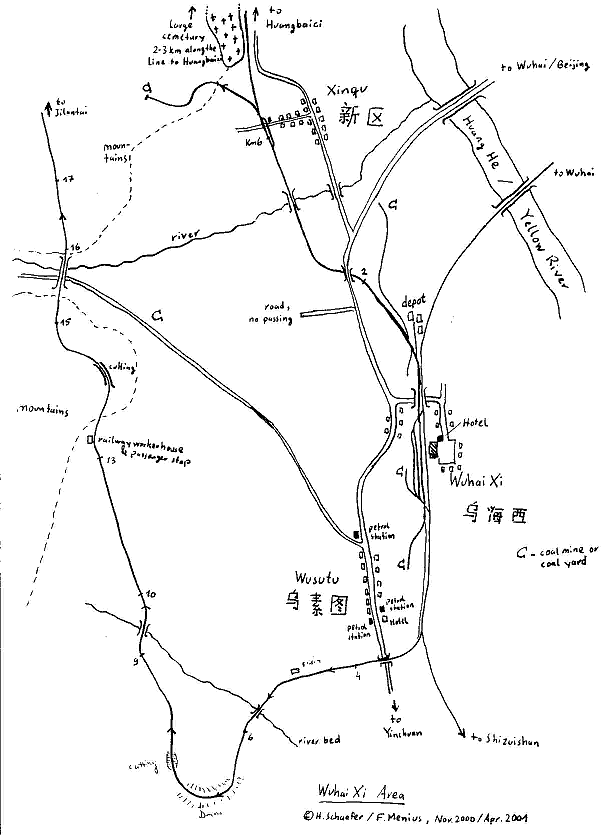
The map below is based on Hans Schaefer`s sketch map.
Steam Operation : Wuhai Xi - Jilantai : Due to the fact that the first possibility for crossing is more than 40 km away from Wuhai Xi at Heishatu with a traveltime of some 1.5 hours, a maximum of 6 trains during daylight are possible on this line. During my 4 days at Wuhai, I had between 3 and 5 trains per day.
Passenger / Mixed : The passenger/ mixed 47091 and 47092 between Wuhai Xi and Jilantai has been retimed significantly. As the complete timetable was published nowhere, I got only the timings for Wuhai Xi :
| 47091 | Wuhai Xi 19:20 - Jilantai appr. 23:00 |
| 47092 | Jilantai appr. 07:00 - Wuhai Xi 12:14 |
47091 usually left Wuhai Xi on time whereas the scheduled arrival time of 47092 is only a rough guideline. I observed this train arriving somewhen between 12:30 and 14:00. The engine that hauls 47091 to Jilantai arrives withthe return working 47092 the day after.
Freight trains : In addition to mixed 47092, I could establish two further sure freight paths :
| Mar 20th | 10:00 to Jilantai |
| Mar 21st | 08:30 from Jilantai |
| Mar 22nd | 06:00 to Jilantai |
| Mar 23rd | 07:00 to Jilantai, 10:00 to Jilantai |
The Line / Linesiding : Wuhai Xi-Jilantai : The line branches off the mainline to Shizuishan at km 2.5 south of Wuhai Xi. From here until km 10, there is a grade between 15 and 17%o. QJ hauled uphill trains with as few as 20 empty, flat wagons slow down to walking pace here. On the other hand, downhill loaded trains have 2 "braking stops" in order to ensure the fuction of the brakes. Between km 10 and the viaduct at km 15.7, the line offers a sequence of less steep smaller ups and downs (yes, even downhill sections !). The mountains are reached just after the railworker house at km 13.5. At the viaduct (km15.7) another 1 km long 13%o climb until km 17 starts. Between km 17 and km 24, there are some minor ups and downs again but no real "summit". Beyond km 24, the line was not visited but it leaves the mountains at km 22 again.
As reported before, the line to Jilantai is not accessible by road with the exception of the bridge at km 15.7 . Going along the road, the bridge is only 8 km distant from the village of Wusutu (see below). There are only few buses along this road. So you need either patience, a taxi or a truck that takes you along. The last bus in the evening from the bridge to Wusutu and Wuhai passes the bridge around 17:00. At 18:00 there is an sleeper bus, too, but I am not sure whether it will stop.
Wuhai Xi-Huangbaici Branch Line : In my December 2000 Report, I mentioned a coal mine between Xinqu and Huangbaici which could not be located. Correct is, that this coal mine has got a seperate 2.5 km long branch line leaving Xinqu station (km 5.0) to the north-west. It is steeply graded and crosses a line of hill behind whom the mine is hidden.
Bus line No.3 - which runs parallel to the Huangbaici branch line - starts in front of Wuhai Xi railway station. It operates 06:00-18:30. New buses (green ones) have been bought which no longer carry the line number. But No.3 is the only public bus stopping in front of Xi station.
Another useful bus connection is the minibus service between Wuhai City and Wusutu which runs along the Beijing-Yinchuan highway.
Wusutu : Wusutu is situated some 3 km south of Wuhai Xi where the Jilantai line branches off and the climb starts. Furthermore, the road towards Ruijigou and the viaduct at km 15.7 branches off the Beijing-Yinchuan highway here.
Wusutu has got lots of hotels/ lüdians. Nearly every second house along the main road is one. Though Wuhai Xi offers a good hotel next to the station, too, I think that Wusutu is a better place to stay. At Wuhai Xi, there is a police station next to the station (so, you are "under their control" whatever you do) with many policemen being present around the station. They are absolutely not amused about foreigners taking photos of steam locomotives around the station ! Furthermore, Wusutu has another advantage as it is close to the steep grade. This concerns the evening mixed 47091 to Jilantai which is unphotographable, of course. But you may walk the 500m from Wusutu to the line, sit down there in the sand and listen ... you will hear the train for more than 15 minutes when it crawls up the hill. A pleasant experience. Last but not least, the road junction towards the bridge is at Wusutu, too. Catching buses or lorries is easy and - if there is neither a bus nor a lorry that stops - Wusutu is 3 km closer to the viaduct than Wuhai Xi for walking.
Accomodation : Wuhai Xi : There are 3 hotels/ lüdians just right/north of the station : a hotel and 2 lüdians. I stood at one of the lüdians for one night. Though the room was large and I could see into Wuhai Xi yard from my window, it was both overpriced (50Y) and unconfortable (shower without hot water). Furthermore, the police station is just next door. When I looked out of my window after my arrival in the morning of Mar 20th, it took less than half an hour until the police "discovered" me and visited me in my room. When I arrived back in the evening, I had been transferred to another room in the meantime - quite strange happenings. I left this lüdian early in the next morning of course and transferred to Wusutu where I stood at lüdian being closest to the railway line. Double was 20Y. A hot-water shower is available, too for 3Y extra. So, for 23Y you get any comfort a "real" hotels offers and you do not have these annoying policemen everywhere.
| JS | 8012, 8014, 8265, 8330 |
| QJ | 6829, 6908, 7056, 7057, 7065 |
JS 8012, 8014 and 8330 were Wuhai Xi pilots all the time. JS 8265 was transfered to Jilantai (probably for exchanging the Jilantai pilot) on Mar 23rd doubleheading a freight with QJ 7065. QJ 7056, 7057 and 7065 were the regular engines for linework towards Jilantai with 6829 and 6908 usually standby engines at Wuhai Xi. But both latter ones were used on line work as well during my visit.
End of CNR Steam in 2001 ?
On the one hand, railway employees at Da`an Bei, Tonghua and Yebaishou all "confirmed" that steam will finish in August 2001. Chinese Travel Agencies added, that the JingHa - Mainline (Beijing-Harbin) is due to be electrified by this time. On the other hand I doubt whether this is true. Let`s have a look at the current situation of electrification works along the lines mentioned (based on
Duncan Cotterill`s Observations ,too) :
1) Shanhaiguan-Shenyang : impossible to be electrified by August. Along long sections, not even the mast have been errected yet.
2) Dalian-Anshan-Shenyang-Siping : impossible as well. In the Anshan area, there was nothing else than the masts with no electrification work under way. DC reports the same for Shenyang-Siping section.
3) Siping-Harbin : this is the only section that stands any chance to be ready until August. But as this section of the JingHa -Line is managed by "Harbin Bureau", there has not necessarily to be any impact on CNR steam. "Harbin Bureau" abondoned steam in December 1999. Nearly all remaining CNR steam locations are either in Shenyang or Huhehaote Bureau`s responsibility.
Or will it be new diesels ? Not very likely, too, I think. If dieselisation would have been the target, why have there been so few changes at Fuxin and Tonghua for example during the last 2 years ? It would require only some 100 further diesels to eliminate all remaining CNR steam in Shenyang Bureau for example. Based on my oberservations, the number of 1999 and 2000 built diesels is very, very low within Shenyang Bureau`s territory (maybe as few as 20-30 engines purchased per year).
I really do not know what this miraculous date "August 2001" will bring. We will have to wait - and hope. I would be very pleased if I was able to see some those great, scruffy Fuxin-QJs, the well cared Da`an Bei engines or the pretty fleet of high-deflectored JS at Tonghua again.
The Tour
It would be an exaggeration to call the tour succeful. Though I recorded a total of 128 steam engines under steam with 106 being CNR engines, there was very much frustration, too. Compared with March last, the weather was horrible this year. Out of the 43 days I spent in China less than 25 days had satisfying weather with only a handful being "best condition" - days. On the other hand, this tour probably was my last one to see CNR steam in China. What will remain if most of today`s great steam locations such as Da`an, YiXian or Wuhai have closed down ?
"Idiot hill" ? But is it really satisfiing to go there ? Everybody knows the shots there. You will find nothing new there, it is the same every time : QJ double-headed trains - without much variation. Reading German Railway magazins, you will find only reports about the JingPeng Pass if there are reports about China - with pictures of the same, well known spots every time. I can`t see them any more !
Industrial or Local railways ? Well, this might be a possibility. But then, you will have to have a different styled tour than an individual tour - a guide with official permit for the industrial complexes. And most of the so called "Local Lines" are nothing else than a "source of frustration" with low traffic levels. Are these lines really "rewarding" ?
A friend of mine once said : "I will not go to China in order to look for some shunting steam locomotives". But this will be the future !
Dresden, Mar 31sr 2001
Florian Menius
| Content Page | Trip Report Page |
|---|