Bottled Steam in Burma, 2009
This is the fourteenth part of our 2009 Burmese Odyssey. To read more about our 2009 bash which includes many non-steam items, please see Rob and Yuehong in the Golden Land 2009.
Some time ago Chris Hodrien of the ISSES wrote to me "The standard Marshall inverted vertical stationary bottle frame engine was certainly produced in huge numbers (many 1000's) in standard models (1.5 - 12 'nominal' HP) from c.1860 to c.1920, I suspect for longer at both ends. One of the most successful steam engine designs of all time - the 'Model T' of steam engines."
Despite this, we have found working examples very difficult to find on our travels, in fact the only one we have seen is at Olean sugar mill in Java. So when a report appeared of one in Mon State following a December 2008 FarRail tour of Burma, it immediately became a 'must do' for us.
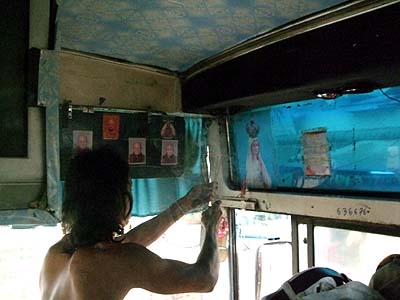
After a day out from Bago in which we made some interesting discoveries but not a whiff of actual steam, we have our fingers firmly crossed. We go early to the bus station after a full breakfast and board a bus for Mon state. Our driver isn't taking any chances, he gets his assistant to light some joss sticks and put on a CD of Buddhist prayer chants.
 |
|
As for us, we are awarded what we would dub in Java the 'suicide seats' at the front, but here they are the 'monk seats', perhaps they think they are blessed with miraculous powers of survival. So, when a monk turns up, a lady opposite has to move. We leave town very promptly, but as soon as we get to the Moulmein turn-off, the driver stops and disappears for his own breakfast, at least afterwards the music system blares out something more conventional. After Waw, the bus soon turns right onto a new road with a new river crossing, a significant short cut which is appreciated by Yuehong who is regretting her morning Java. The old railway bridge in the background is the one destroyed by the British in their WW2 retreat.

By 11.00, we have enjoyed a cup of tea at the Bilin crossroads, Han has enjoyed a hasty lunch and our big bags are parked in a tea shop. More importantly Han has hired a 3-wheeler to get us to Kokadaw some 20 minutes away. Given that this is our sole planned visit of the day, we are naturally worried whether the mill will be working but we are not disappointed, operations are in full swing. The family are most surprised to get their second set ever of foreign visitors in just two months, but Han explains about the internet and Yuehong passes over a large print of the engine from Bernd Seiler's original which helps a great deal.
Suffice to say, it's a lovely operation but it needs to be treated responsibly, please don't come here unless you are seriously interested in stationary steam engines or rice mills, there are plenty of others in the country to spread the load. The village headman turns up a little concerned and we give him photocopies of our passport which always helps in case higher officials get interested later. Bernd did not report on the maker of the engine, but as I had hoped the engine has a plate confirming it is a Marshall (6½ inches according to the owner who has had it for nearly 50 years), alas it has no number engraved:

Filming has always been a team effort with us and in a small mill like this, that means sometimes having to wait for the other one to finish.

This time, I have a long, long wait.
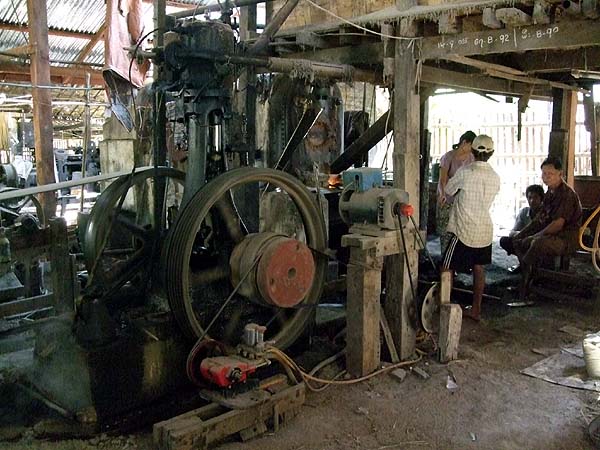

After filming to our hearts' content, we are treated to some fresh papaya from the garden and a couple of delicious fresh coconuts from the same source (but probably the best part of 60 foot off the ground).

As reported, the family own another mill nearby, operated by the next generation. It isn't working on the day of our visit, but will 'soon'. Asking about their small Ruston, Proctor, they are amazed when I work out it has come from one of the mills at Hninpale, I even describe how it was arranged in the mill.

Outside is what is presumably their previous engine - identical to the one we had seen at Peinzaloke yesterday - although in poor shape, the valve chest cover states it was made by Struthers Wells in the USA, another mystery is thus solved. The mill is also small and photogenic and it would be nice to squeeze it in later when we return from Moulmein.
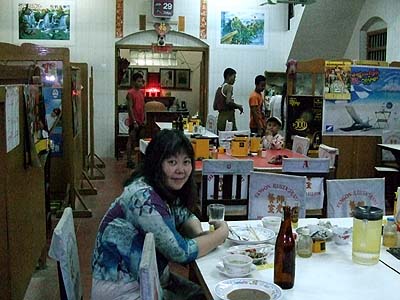
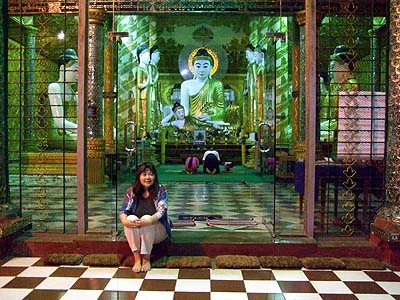
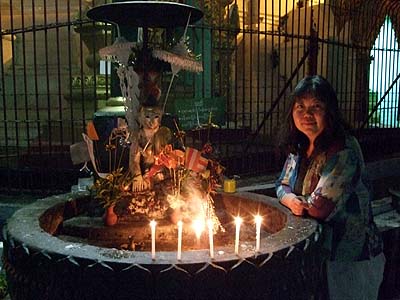
It has been a great day, afterwards we return to Bilin on our 3-wheeler, sink a beer and take a crowded but cheap pick-up to Thaton. In the evening we dine in a traditional south-east Asian coffee shop and go and say 'thank you' to the local spirits...
|
|
|
|
|
|
|
|
|



So far we have seen very few new working mills, but as in everything in life quality beats quantity every time!
The full list of 2009 trip pages is on:
-
Green to Gold, Rob and Yuehong in the Golden Land 2009, Part 2 - This includes more general reports of the trip (OK, a blog) as well as much stationary steam
-
Rob and Yuehong in the Golden Land 2009, Part 1 - This includes more general reports of the trip (OK, a blog) as well as much stationary steam
These are the individual (stationary steam) pages from the 2009 trip:
Our earlier explorations are described in pages linked from:
-
Temples of Steam 2007 - An update to our 2005 and 2006 reports
-
Temples of Steam 2006 - An update to our 2005 report
-
Temples of Steam 2005 - Introduction