Working for Peanuts, Burma 2009
This is the thirteenth part of our 2009 Burmese Odyssey. To read more about our 2009 bash which includes many non-steam items, please see Rob and Yuehong in the Golden Land 2009.
We travel down from Kalaw on the overnight bus, as expected the ghat section to Thazi is an abysmal experience, it takes half the time of the train but owing to the state of the road and the lack of internal ambience it scores 0/10 instead of the trains 10/10. We knew it would be crazy to continue on to Moulmein immediately so we have scheduled a day researching the rice mills north of Bago. I thought originally to stop off in Nyaunglebin and wait for a car sent from Bago but in fact the bus schedule is now such that we got to Bago at 03.00 and can snatch four hours sleep. Electricity has long been a problem here, it seems to have got even worse and we have no proper mains power at all during our stay except for an hour before departure on the second morning. Unlike other hotels of similar standard we have used, my old staging post the Myananda Hotel has a generator which can power only lights and the staff's noisy TV set. Given also that the water pressure is abysmal and the room less than clean, it is now time to look elsewhere. In fact, apart from being a handy transit point, Bago now has little to commend it; the heavy traffic on the main street outside the budget hotels grinds past day and night, the steam locos are all gone and even the wonderful signal boxes at the station will soon be no more.
I have long wanted to look around here for stationary steam and was encouraged by the FarRail report that stated that Pyuntaza has one working rice mill - a report that, in fact, erred on the optimistic side. In our day in the area we see just one regularly used engine, two which are effectively mothballed and another two which I would call well out of use. Two more mills tell us that they have sold their engines to mills in Irrawaddy division in the last few years.
Heading north out of town, we find a mill at Daiku which has a large late delivery 13" Tangye Birmingham engine (#12286). Owing to the poor economics of rice milling in the area currently it has not been used for several months at least, although it is covered and obviously in good condition.

This is me in 'Tangye' pose, checking the number.

Next we call on the mill owner in Pyuntaza - he is local chairman of the rice millers association, but is not really on the ball like other such people we have met because he is not actively milling any more. In fact his family owns both the mills on either side of the railway. His wife is in charge of the west one but is away and he can't (or more likely won't) find the key for us. Later on our way back I peer through the slats and establish that the engine is most likely one of those supplied by T. Shore of Stoke on Trent (UK) - click here for a picture of a typical example. However, he is happy to show us 'his' mill which has not been used since 1996 but has a real treasure in it:

The name E.R. & F. Turner Ltd of Ipswich (England) is a new one on me which will need checking when we get home, but their #1836 is a tandem compound of 10" & 16" x 20". It's only the fourth tandem compound we have seen in the mills here although we have seen one for sale in Yangon (and again in West Bengal, India later) and a friend of mine has also seen one in Yangon. Cross compounds are not common either here, we have seen just two at work and another in store.

We keep on going and in Peinzaloke find another mill which is best described as mothballed - the engine is immaculate and the owner would work tomorrow if there was any kind of profit margin to be had. It's an unusual design which we have seen in a couple of other mills, but apart from 'British Make' on the governor there is as usual no clue as to the builder. (Next day we found another of these engines, albeit well out of use, but it was clearly inscribed 'Struthers Wells' on the valve cover - another mystery solved!)

It is time to make my first return to Madauk since 1999. Then a YB or YC would work the branch train but those days are long gone. I had some good times here and some bad times too, most dramatically when my YC on the afternoon train spread the tracks and I had to walk out. It was also the site of my first ever visit to a rice mill, which had a delightful small Douglas and Grant engine and I was very much looking forward to making its acquaintance again even if it was unlikely to be working. Alas the mill had been swept away to make room for houses for those displaced by the flood alleviation scheme and the surviving mill on the list is elsewhere in the village. It turns out to be a rather unusual find, not so much for the 9" Tangye Birmingham engine (#12360) as to the fact that it no longer powers a rice mill (still in place but long out of use) but a peanut oil mill instead. Alas although the Wilson boiler (#5153/1929) is warm, it is not working; we have seen a peanut oil mill operated by an old Ruston Diesel but this really would have been a first and is marked down for a return visit (see below).


Not everything changes in Madauk, a small railcar with 4 wheeled coaches arrives during our stay:
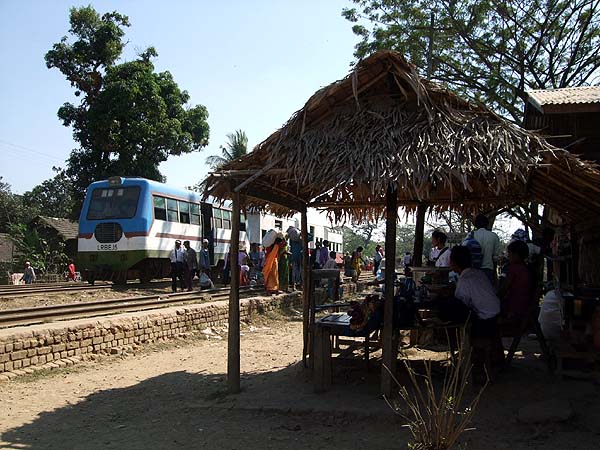
However, the biggest surprise of all was to discover that the small ferry across the Sittoung River has been replaced by a large bridge, so ugly it is best viewed through a glass rather hazily.

It's not been a great day out, but the lack of action is in more than some way outweighed by the interesting finds we have made. There will, no doubt, be better days ahead as we go south into Mon State, based in Moulmein.
After allowing us a very successful three weeks, the day after we return from Moulmein, fate (or more correctly the system) gets its total revenge. We are up for a rushed breakfast with the news that the peanut mill in Madauk is working all day. There are a limited number of buses from Bago directly to Madauk, some 60 miles away and we got the slowest one, it isn't uncomfortable but it takes over four hours. By the time we arrive after midday it is clear that 'all day' meant a few hours in the morning. Although the boiler is warm, the fire is well and truly out, the belts are off and the workforce is nowhere to be seen. Han has some relatives on the other side of the river who have gone out of their way to cook a lunch for us but the military who control the crossing refuse to countenance our going even the short distance to their home. In other words after producing some very special white rabbits out of a hat, the Gods have produced a particularly useless white hat out of a rabbit. So we sink a couple of expensive beers and jump on the return bus which would have done the journey much more quickly save for a small problem of a blocked fuel line. It has been a total zero of a day, it wouldn't matter that much if Burma was a cheap destination but every day here costs blood, not surprisingly I feel rather like packing up and going home, the only problem being that legally I haven't had one for 5 years and a return to base in China in February is hardly an attractive proposition. There is no choice but to stick things out for another week, knowing that experience suggests that we usually get lucky in the long run. But in the short term we have to return to Madauk, this time the action will be 'guaranteed'.
None of us was up for another 8 hours on the buses, so that means a taxi, which will be twice as quick and four times as expensive. And to make sure we are there for start up that will require setting off at 04.30. All goes well, we get our video and we are back in Bago ready to crash out by 12.30. If like me you know little about peanut technology and are keen to learn, read on...
In this area, the main crop is ready between February and April, perhaps this is the only steam powered mill. First the peanuts are passed through something which is clearly based on rice mill technology which gently crushes the shells and then separates them from the nuts, this is a sieve, most of the lighter shells have already been whisked away by a strong draught of air, those seen here in the sieve will be recycled through the system. This part is diesel engine powered.

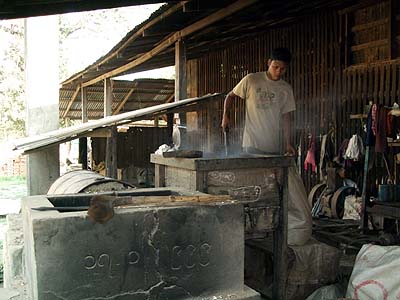
Both the shells and the (weighed) nuts are bagged, from observation, most of the nuts are trucked away. Steam for those to be processed for oil (about 35-40% of the nut) is oil raised by burning the shells:

Unlike the rice husks, they do not flow freely and a young man is employed to feed them into the boiler. Although the fuel leaves very little ash, vast quantities are needed and I would guess that traditionally such mills would have bought in rice husks, which may explain why we saw an old (inactive) one as part of a long row of rice mills in Pathein. Before the peanuts are crushed, they have to be heated to reduce the moisture content:
 |
 |
The mill has two oil processors, the larger one is shown above but was under repair. This is the smaller one with the engine behind, on the left is a cloth filter. The crushed peanut pulp is repeatedly fed through the grinding system and eventually bagged:

Note that the belt from the engine can be alternated between wheels - one is a dummy - which means that the engine does not have to stop for adjustments to be made:
|
|
|


The filters are clearly based on the same principle as the Kroogh filters we have seen in some of Java's sugar mills, it seems that the oil makes several passes through them before being pumped to a drum:
q
Finally, here to prove it was working is the Tangye, it seems to have a shortened stroke (the Jessops plate is almost hidden behind the disc crank) to allow it to run at higher speed than usual, certainly the engineer had to pay much more attention to it than in rice mills as the load varied according to the state of the peanuts during the crushing:

Although bullock carts bring in the raw material, the bagged peanuts which are not being processed are going out in a huge modern truck, an interesting contrast. As always the staff are very friendly but more than a bit bemused by the strange foreign visitors!
The full list of 2009 trip pages is on:
-
Green to Gold, Rob and Yuehong in the Golden Land 2009, Part 2 - This includes more general reports of the trip (OK, a blog) as well as much stationary steam
-
Rob and Yuehong in the Golden Land 2009, Part 1 - This includes more general reports of the trip (OK, a blog) as well as much stationary steam
These are the individual (stationary steam) pages from the 2009 trip:
Our earlier explorations are described in pages linked from:
-
Temples of Steam 2007 - An update to our 2005 and 2006 reports
-
Temples of Steam 2006 - An update to our 2005 report
-
Temples of Steam 2005 - Introduction