|
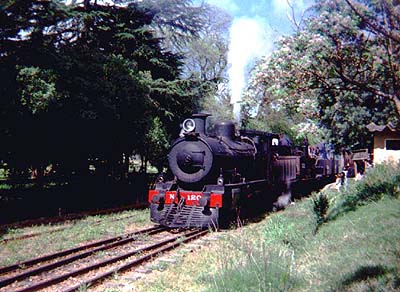
A Brief History of Engine Nº 120 (ex 119) |
|
|
Tabare Bordach emtb@adinet.com.uy has sent this account of this locomotive. Locomotive Nº 119 (120 between 1991 and 2005) belonged to the "Central Uruguay Railway" (CUR), a British Company which worked in Uruguay from 1876 to 1949, when all the railway companies were nationalised.
Eight examples were built for the CUR by Beyer, Peacock & Co., Ltd. in 1910 (maker's numbers from 5395 to 5402) which were numbered from 115 to 122. These engines belonged to Class "N1". This purchase was the result of the good performance achieved by the 21 Class "Ns" that had been acquired from Beyer Peacock between 1906 and 1907. They had the same driving wheel diameter, the same cylinder dimensions and the same class of tender, but Class "Ns" had Stephenson's valve gear (slide valves), a smaller boiler than that of Class "N1" and Belpaire firebox. Their tenders ran on eight wheels and were of small capacity because the turntables in Uruguay were not very large (50 to 60 feet maximum) in the early 1900s. These non-superheated Moguls worked on main-line and cross-country passenger, freight and mixed services, including steeply graded and sharply curved single track branches. The heaviest 3-cylinder Class "S" 2-8-0 and the German-built Class "V" 2-10-0 could not work on these branches, but the "N1" often did. Their outside cylinders and Walschaerts valve gear (piston valves) made their maintenance an easy task. From 1938 all the "N1" were converted from coal to fuel oil by the CUR. Nº 118 and 121 to "N2" type boiler, and Nº 115, 116, 117, 119, 120 and 122 to "N3", being the latter a bit bigger type of boiler than "N2". All of them were provided with superheaters. Preserved Nº 120 has been oil-fired since 1942. They could haul up to 15 wooden-coaches at speed of 45-50 mph on the "Phonoelectrical Excursions" during British railway days. These duties included several non-stop runs for over 80 miles without taking water, and they could often be driven with short cut-off and the regulator wide open for this tasks. Along the hard road between Paso de los Toros and Salto they worked main line trains for many years. In or from the North Western area of the old Midland Railway of Uruguay, they worked successfully all kinds of main line trains in the early era of National Railways, by 1950s, with 380 Tons gross behind the tender, which was the maximum for the Class "N3" on these routes. In the middle 1970s some of the last "N3" survivors worked on the northern region; but Nº 119 was assigned as stationary boiler at Dr. Carnelli Station, in Montevideo, Southern region. The CEFU thought she had been withdrawn and in a short time might be scrapped, notwithstanding that some three "N3" were still on the National Railways stock list as late as autumn 1983, Nº 119, 120 and 122. All the other "N3" had been already scrapped, except Nº 117 which worked as stationary boiler at AFE's Paysandu Works until 1993. In 1984, Nº 119 was repaired in Paysandu Works so she could haul a "special" form Paysandu to Salto (69 miles) fora group of British enthusiasts. In 1988, Nº 122 was condemned because her firebox broke down, but Nº 119 was still serviceable as shunter in Rivera station, and Nº 120 in Paysandu area. In May, 1991, Nº 119 returned to Southern region and headed the "Presidential Train" on the Centennial of Peñarol town, and for that event she was renumbered 120. Curiously there were two "N3" Nº 120 from 1991 until 119 returned to her true identity. In January, 1992, the "Circulo de Estudios Ferroviarios del Uruguay" (Railway Studies Circle of Uruguay), CEFU, actually the only railway enthusiasts institution in Uruguay, began to preserve her with historical purposes In March, 1993, the original Nº 120 was withdrawn and stored at Paysandu Works, and therefore our Nº 119 (120) is the last "N3" serviceable in our country. She is the last main-line steam locomotive in working order in Uruguay.
Click here for Technical Details of Locomotive 119 (120) Click here to return to the Railway Studies Circle of Uruguay (CEFU) |