|
Steam in Thailand 1999 |
|
|
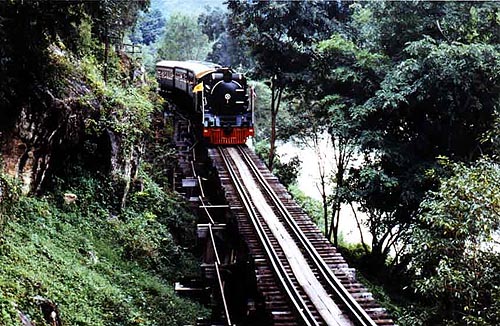
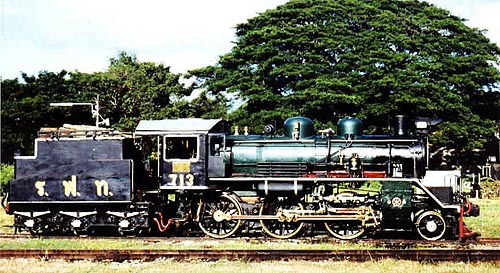
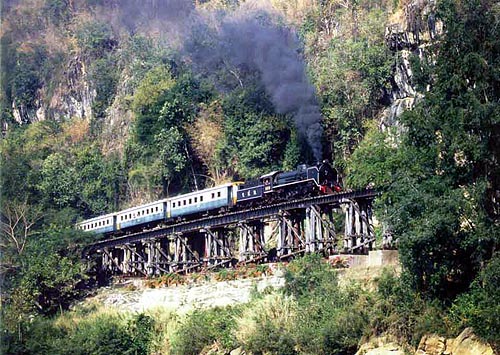
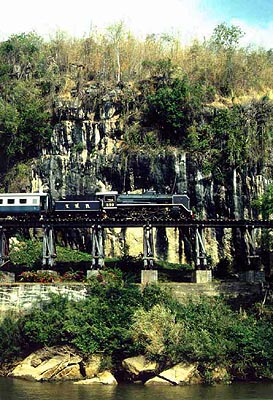
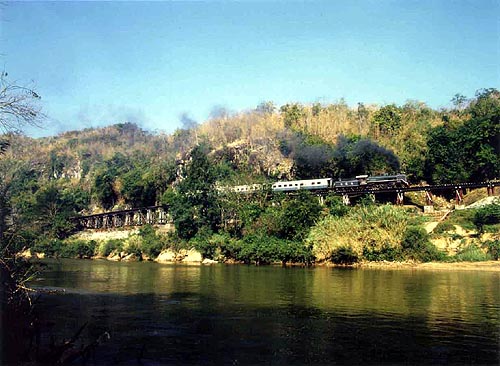
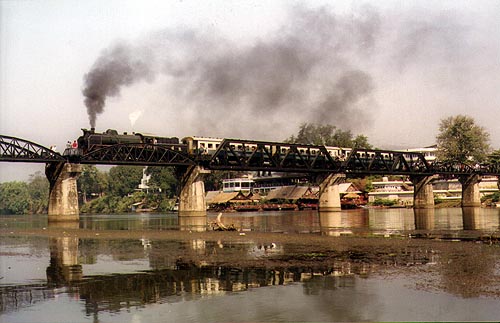
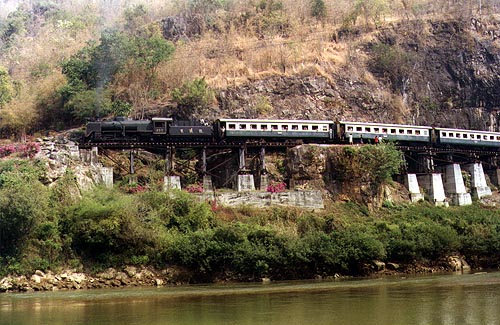
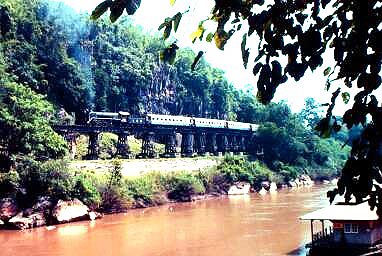
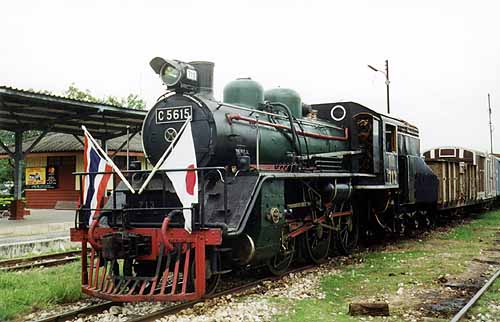
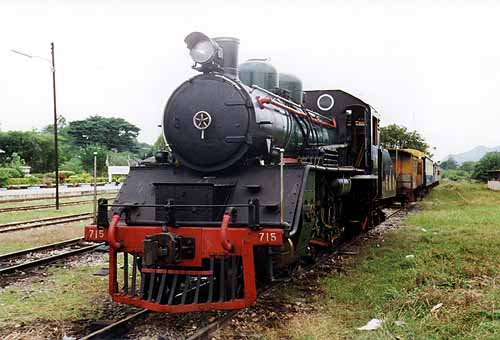
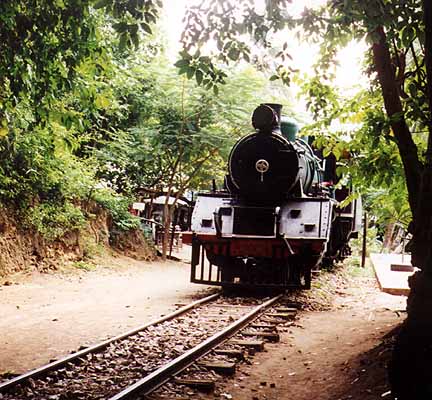
Click here for the Japanese C56 2-6-0 pictures (added 23rd December 1999), the Kwai pictures (added 19th March 1999) or Heinrich Hubbert's report. I have now added Heinrich Hubbert's pictures from late 1999. Courtesy of long term Bangkok resident John Baker, I was able to observe the Kwai steam train on January 23rd/24th 1999. With me feeling somewhat jetlagged, we arrived in Kanchanaburi late on January 22nd and checked in to one of the delightful riverside guest houses, soaking up the atmosphere and Singha beers.. The next day was not one of my greater achievements since my brain was barely functioning. Compared to a week earlier, immaculate 4-6-2 850 facing East had been replaced by rather more travel stained 2-8-2 953 which faced West. Bangkok station had insisted the train departed at 09.30, but local sources said 10.30 and they were right (this week). We photographed the well loaded train crossing the famous 'Bridge on the River Kwai', as it crawled across trying to avoid mowing down the innumerable tourists and photographers (at least two TV crews from the UK and USA were present too). Unfortunately at this point our directions to the end of the journey at Wang Pho proved insufficiently specific and the train beat us there. Those who might want to photograph the train at the Kwai bridge AND the wooden trestles on the same day might like to note that following the line is not a good idea. Simply follow Highway 323 west from Kanchanaburi and take the turn off for the SaiYok waterfall (approx. 45km). This descends to the valley just before Wang Pho station. Cross the railway and turn left. To get to the trestles just follow the road until it ends at a car park. To get to the south bank which has a much better photographic view of the train, there is an irregular ferry across from the jetty below here. Alternatively drive (or charter a motor bike) to the Kwai Jungle House (tourist bungalows). Take the right turn about 1 to km east of Wang Pho towards the trestles (as above). Cross the river and take the left fork at the Y junction. Go down this road a further km or two, following the tar road left where a dirt road goes straight on. Turn left down a dirt road to the Jungle House at the sign post, park and walk down to the river. While the train had departed at 15.30 the previous week, on both days it left at 14.30 (under a cloud on Saturday). Basically the train times seem to depend on local custom and the whims of the coach tour operators. Later we talked to one of the train crew who said that the loco (rotated at about 2 week intervals) was sent out light engine every weekend from Thonburi, the crew staying in vans at Kanchanaburi station. Incidentally, preserved in Kanchanaburi are 2-8-8-2 Garratt 457 at the main station (inaccurately described as the largest and most powerful metre gauge steam loco in the world), 2-6-0 719 and 4-6-2 804 at Kwai Bridge station and 4-6-0 175 outside the museum nearby. As the photographs show this is a really worthwhile trip. If you haven't been to the area before, be sure not to miss the War Cemeteries at Chung Khai and opposite Kanchanaburi station. There are also any caves (one is right next to the trestles) and waterfalls and the remains of some Khymer temples near Ban Khao not far from the railway. Compared to my first visit 25 years ago, there has been a tremendous development in tourist facilities in the area. Heinrich Hubbert went back to Thailand in March 1999 and: again later in the year. Amazing Thailand 1998/1999 After a short visit last January, a longer period was covered to feature three weekends of Thai Steam on the Death Railway. There are very few serviceable Thai steam locomotives and they have been rarely in use before, but there have been steam passenger trains running every weekend in Kanchanburi since February 1998 and the initial month of January saw even daily service. To give prospective visitors a comprehensive and hopefully effective guide, I have summarised my explorations in this report. The main news might be that the operation is limited to the currently running "Amazing Thailand 1998/1999"-tourism-stimulation-campaign and will end by the end of this year! (But I was told in December 1999 that the train would continue into 2000. RD) Patronage of the trains is not that good as departure is almost half an hour after the arrival of the daily morning passenger from Thonburi. Fortunately the rolling stock consists of three 3rd-class-coaches almost 50 years old, which are also still in use for the diesel hauled passenger-trains, some powered with the vintage two-cab GM-design. Kanchanaburi - Wang Po Photographic potential There are three engines working on this service: Pacifics 850 (chimney facing east) and 824 (chimney west) and Mikado 953 (chimney west). The line has potential - not only at Tham Krasae, the most exciting spot with the wooden trestle bridges. There is the "Chungkai-cutting" some 10 kms out of Kanchanaburi. This cutting needs separate attention as some climbing is necessary. With 850, a nice hillside-view with the river and cuttings can be obtained here. Further to the west, one will find a huge temple visible from the road, which is good for a side-shot. There is also a hillside golden Buddha-idol on the way and a Temple about 100 m from the track about 15 km out of Kanchanaburi, but this is tricky due to sugar cane-fields hiding the track. You cannot miss this place from the road as well. However, light is difficult with 824 on the morning train. Especially at Tham Krasae the light is at noon straight on the line from the wrong direction. Therefore, it is a pity that only engine 850 is in the right direction on my visit with the return in the afternoon which is in much better light. It is possible to get the train at several positions on the chase, as roads follow the line most of the way. At least four shots can easily be obtained with this as roads are available on both sides of the line, either the road north of the line in superb condition and that one south side, closer along the line. The former gives direct access to the Tham Krasae bridges, the latter follows more closely to the line or with dirt roads going beside, when the line is not visible. The service started in January 1998 with daily trips but was reduced to a weekly service from February. The entire operation is restricted to this and last year! From the beginning it was always intended to run the train only during the two years of the „Amazing Thailand 1998/1999"-campaign. (But I was told in December 1999 that the train would continue into 2000. RD) The better lit train with 850 in the afternoon was in service for only the middle one of my three weekends, so the engines were changed weekly. 953 was said to be in Makkasan workshops (or Bang Sue) for attention. Mr Niwat „Wat" Peansumrit, a local photographer, is delighted to take around enthusiasts from abroad, to share the experience of chasing the train with his Toyota Hilux (Pickup), re-engined with a Nissan 210 HP TwinCam (one trip for 700 Baht). Mr Wat can be contacted in the "Woof-Bar" at the "Jolly-Frog-Guesthouse" near the River, about 500 m from Kanchanaburi-Station. There are nice rooms for 150 Baht non-ac. "Sam's Guesthouse" is also nice. An alternative view of the famous trestles and 713 from late 1999:
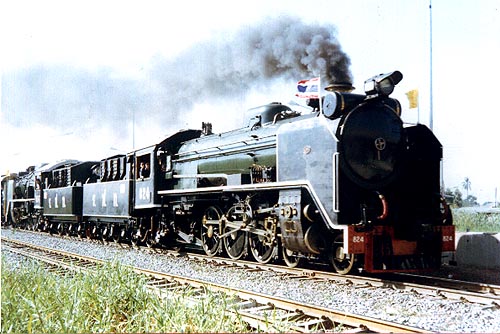
First here is a picture John took of the King's Birthday train near Rangsit in December 1998:
The next three pictures were taken by Heinrich Hubbert a week before I visited and show Pacific 850 on the train returning across the trestles near Wangpo.
The next two pictures are mine of 953 on the outward leg - the tender first return working was in much better light.
Hans Hufnagel has also been here:
Nick Lera was at Kanchanaburi during the annual festival at the end of November 1999, the only time the Japanese C56 2-6-0s can reliably be found at work. The third picture shows another 2-6-0 preserved further up the line at Hell Fire Pass.
|
|