|
The Siclau Incline |
|
|
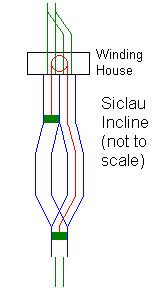
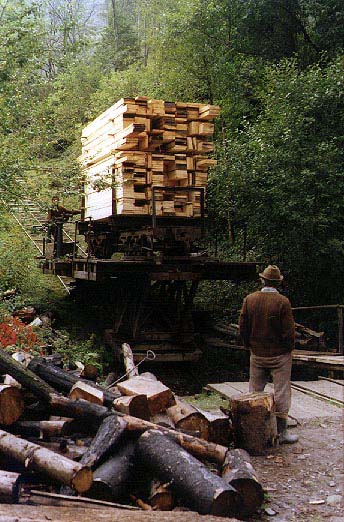
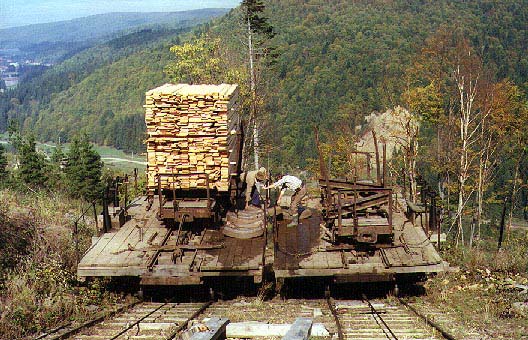
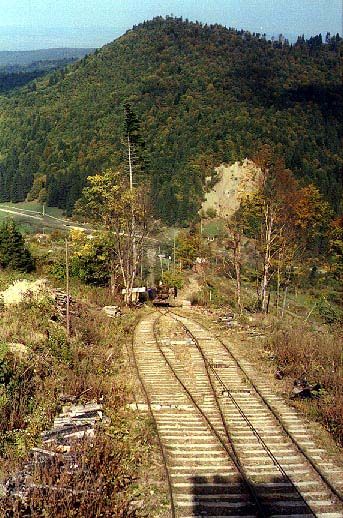
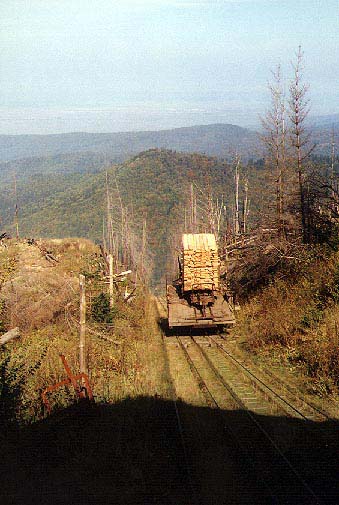
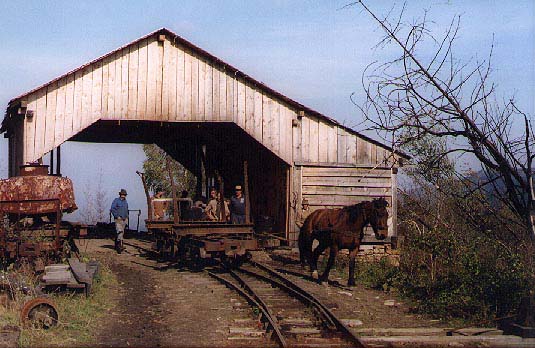
The two sections of the forest system at Covasna-Comandâu are separated by an inclined plane first opened in 1886. The plane is entirely worked by gravity, the heavier loaded wagons pull up the empties using a long steel cable and progress is controlled by braking on the drum in the winding house. Each wagon is loaded on to a trolley which keeps them horizontal during their journey, shunting being done at both ends by horses - during our trip the horse at the top was sent up with the first wagon each day. The lower section is steeper than the upper section and for this reason, the 'trolleys' are stopped half way and a number of metal weights transferred so the upper trolley is always heavier than the lower one. Each transfer takes about 20 minutes. (Click here for a historical account (in German) from Hans Hufnagel and now an English translation courtesy of Frank Savery.) The continued survival of the incline is quite amazing as it has suffered two recent disasters. In 1995 a storm devastated the forest around it, putting it out of action for a short while. In May 1997, the same area was swept by a fire which nearly destroyed the incline. Within a short time it had been rebuilt including the winding house and it is now 100% restored. It seems that it is recognised for its historic value and there are explanatory notices at the bottom and it is a point of interest for the many Romanian visitors who come to Covasna for the spas and mud treatments. Long may it continue, an extraordinary survivor of a bygone age.
Hans Hufnagel has sent me the following account - click here for the English version: "Die Standseilbahn in Comandãu Obwohl bei der Trassierung von Waldbahnen oft enorme Steigungen in Kauf genommen wurden, kamen die Techniker von Fall zu Fall in Situationen, in denen die Topographie die Fortführung der Strecke als Adhäsionsbahn ausschloß. In solchen Fällen half nur die Einrichtung einer Drahtseilbahn (funicular) oder, soferne die Geländeverhältnisse geeignet waren, die Errichtung einer Standseilbahn (plan înclinat). Manchmal kam auch ein Bremsberg zur Anwendung, bei dem die Wagen, ohne Zuhilfenahme einer Plattform auf eigenen Rädern zu Berg bzw. zu Tal rollten. Von den zahlreichen Anlagen dieser Art, die es in Rumänien gab, ist als einzige die Standseilbahn an der Strecke Comandãu/Covasna bis in die heutige Zeit erhalten geblieben. Die Daten der Anlage: Den Errichtern des plan înclinat kam zugute, daß die Last stets ins Tal zu befördern ist. Den beiden mit einem Seil verbundenen Plattformen genügt daher als Antrieb die Schwerkraft. Die Plattform mit dem beladenen Wagen zieht während ihrer Talfahrt über eine Umlenkrolle die zweite Plattform mit einem leeren Wagen bergwärts (Bremsbergprinzip). Das Maschinenhaus am oberen Endpunkt beherbergt neben der Umlenkrolle eine Bremsvorrichtung, mit der ein kontrollierter Ablauf bewerkstelligt wird. Die Verständigung zwischen den Stationen erfolgt über eine Telefonleitung und durch Klingelsignale. Auf halbem Wege, bei der Ausweiche, begegnen einander die beiden Plattformen. Hier werden vier Eisengewichte, jedes rund 50 kg schwer, von der talwärts auf die bergauf fahrende Plattform umgelagert. Offenbar dient das Manöver einerseits dem Ausgleich der unterschiedlichen Neigungsverhältnisse der beiden Sektionen, andererseits der Kompensation des Seilgewichtes. Auch das Begleitpersonal wechselt hier. Ein Führer befährt den oberen Abschnitt, der andere nur den unteren. Der Grund für diesen Wechsel ist: Die Manipulation der zu befördernden Wagen an den Endpunkten besorgen Pferde. Mann und Roß bilden ein eingespieltes Team. Jedes Roß trägt ein Geschirr mit einer Kette. Der Lenker hängt den am Ende der Kette befindlichen Haken in den Wagen ein. Ein leichtes Schnalzen mit der Zunge, und das Tier zieht den Wagen zur Plattform. Ist der Wagen auf der Plattform festgemacht, kann die Fahrt beginnen. Das Pferd bleibt zurück, der Mann fährt mit. Mit der gegenläufigen Plattform kehrt er wieder zu seinem vierbeinigen Partner zurück, der den eben mitgebrachten Wagen von der Plattform schleppen muß. Die Wagen mittels einer Lokomotive zu verschieben, wäre höchst unwirtschaftlich, da auf 1 Minute Arbeit rund 10 Minuten Pause folgen, solange etwa sind die Plattformen unterwegs. Vor einigen Jahren versuchte man den "anachronistischen" Pferde-Verschub zu modernisieren. Die versuchsweise installierte Seilzug-Anlage hat sich aber nicht bewährt, sodaß man bald zur alten, 100 Jahre geübten Methode zurückkehrte." "The endless rope haulage system at Comandãu During the planning of forest lines often enormous upward gradients were encountered, the planners had to tackle each separate situation as it came up. And sometimes it was impossible for the continuation of the line as an adhesion railway. In such cases the only answer was the use of a wire rope line (funicular) or, If conditions in the area were suitable the construction of an endless rope haulage system (inclined plane). Sometimes also an incline could be used, in which the cars were hauled, without the use of a platform, on their own wheels up the mountain and/or down to the valley. Of the numerous plants of this kind found in Romania, the endless rope haulage system on the Comandãu / Covasna line is the only one which has lasted to the present day. The statistics of the plant : The inclined plane benefits from the fact that the load is carried down into the
valley. Therefore the force of gravity is sufficient to provide the power for the two
platforms connected with a wire rope. The platform with the loaded car pulls the
second platform with an empty car during its downhill journey over a roller guide fitted
with a brake based on the same principle as a mountain railway. The turbine house at the
upper terminal contains a brake mechanism beside the guide roller, by means of which a
controlled operational sequence is managed. The communication between the stations takes
place by means of a voice pipe and via bell signals. At the half-way point , both the
platforms come alongside each other. Here a number of approximately 50kg weights are
transferred from the descending platform to the ascending platform. This operation serves
to reconcile the weight of the platforms with the different angle of the two sections of
the incline, and to compensate for the weight of the rope. Also the incline crew changes
over here. A leader operates on the upper section, the other one only the lower. The
reason for this change is: Horses handle the movement of the cars at the terminals, which
can be carried on the platforms. Man and horse operate as a team. Each horse carries a
harness with a chain. The handler clips the hook present on the end of the chain onto the
car. A simple click of the tongue, and the animal pull the cars onto the platform. Once
the car on the platform is fastened, the travel can begin. The horse stays, the man rides
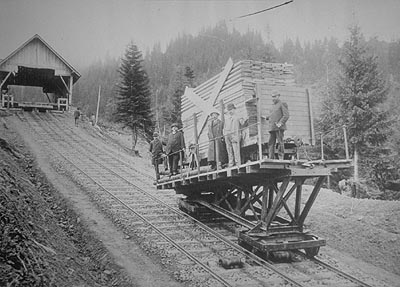
along. On the platform moving in the opposite directions the handler returns And in addition a very old picture ( about 1920 ... 1930 ) from the inclined plane. On
the platform you can see Mr. Gyula Horn ( on the right side ), one of the share holders of
the former Kovasna - Komandó - forest company. And in addition a very old picture ( about 1920 ... 1930 ) from the inclined plane. On the platform you can see Mr. Gyula Horn ( on the right side ), one of the share holders of the former Kovasna - Komandó - forest company.
Click here for my full Romanian Forestry Railway report. |
|