|
Steam in Kenya, November 2002 |
|
|
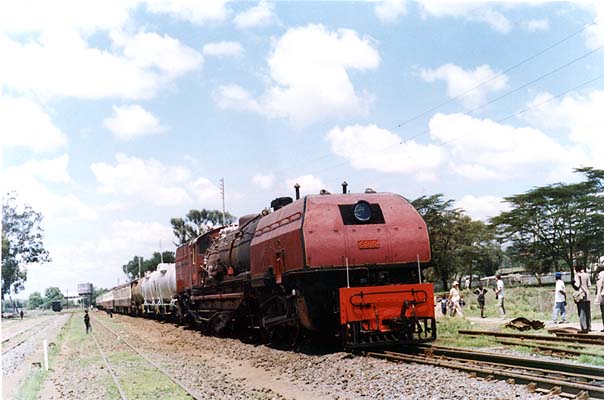
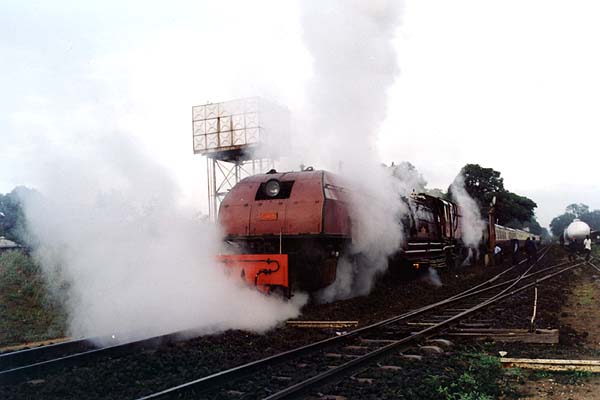
This is the first newsletter of East Africa Steam Safaris and includes a report on their first excursion with 5918: Click here for details of their second excursion in February 2003. "Moshi na Moto" East African Steam Safaris Ltd. was formed in Nairobi in November 2002 by Harjit Kelly, Kevin Patience and Roger Tanner to assist Kenya Railways with promoting and marketing the only operational 59 Mountain Class Beyer Garratt steam locomotive No. 5918 'Mount Gelai' on revenue earning passenger trips. 5918 was brought back into service in 2001 by the efforts of a group of retired railway employees with extensive steam experience led by Joseph Kamau. With the end of steam operations in 1979 the engine was placed on display for some years in the Nairobi Railway Museum before being steamed in 1988 for excursion runs to Naivasha. These massive articulated locomotives were without doubt, the most famous and heaviest ever built for the metre gauge railway by Beyer Peacock at its works in Manchester, England. The fleet of thirty-four of these oil fired locomotives were delivered to the then East African Railways & Harbours during 1955 / 1956. Although designed to haul mainly 1,100 ton freight trains in response to the ever increasing industrial needs of Kenya and Uganda, they were also used extensively on the passenger trains from the coast to Nairobi until the mid 1960s, when they were replaced by diesel power. They were restricted by their weight as far as Nakuru up to which point the track had been especially strengthened. From there through to Uganda, the lighter '57' '58' and '60' Class Garratts took on the passenger and freight services. Returning to the present day, this latest venture was the brainchild of the three long-time Kenya residents and railway enthusiasts all of whom have fond memories of the by-gone steam age when, in the past, they had travelled up and down from the coast behind a 59 Class Garratt. Early in 2002 their ideas for a steam safari were shown to the Corporation's Chief Executive Officer, Andrew Wanyandeh and General Manager (Technical), Engineer Jasiel Njue, and after some consideration the Corporation's workshop and engineering facilities were put to work to prepare the locomotive and rolling stock for the first 'Great Steam Safari' provisionally set for mid November. Time was of the essence, because there was only a three week 'window of opportunity' to put the whole thing together. Despite a number of setbacks, final preparations and the inevitable paper work were only just completed on the eve of the planned departure. That it happened at all was a minor miracle, which just goes to show what enthusiasm and dedication can do, given the will to succeed. After a number of meetings with Kenya Railways it was decided to advertise the trip for 23rd - 27th November 2002 from Nairobi to Mombasa and back. Coincidentally on the day of confirmation of the safari there was a tourist board promotion in progress in the Sarit Centre in Westlands, Nairobi. Kenya Railways had a stand together with a model of a 59 Class locomotive and we began marketing the safari and over the two days handed out over 400 flyers. It was a start. Within a day or so the phone rang and slowly bookings came in. Dozens of friends were rung and word quickly passed to people with internet railway interests. An enquiry came from the UK and another from the Netherlands. Kenya Railways were busy preparing the carriages, restaurant and kitchen car, and two 50,000 litre water tanks had been painted silver and a tanker loaded with fuel oil for the refuelling stop at Kibwezi. It was here that a night stop would take place to water the locomotive and two toilets had been put back into operation for passenger use while stationary. By 22nd November the last minute preparations were almost complete. Virtually a full complement of passengers enjoyed an unforgettable experience on the morning of 23rd when 5918 hauled the first daylight fare paying passenger train out of Nairobi for over thirty years. Given a ceremonial send-off at the railway station by Mr. Andrew Wanyandeh, Ms. Beatrice Buyu, Managing Director of the Kenya Tourist Board, and a gathering of VIPs and other fascinated by-standers, the train pulled out shortly after 10.45am on its way to Kibwezi, to the accompaniment of deafening blasts on the engine's two-tone whistles and clouds of steam. This giant locomotive, weighing 250 tons, was off on the first stage of a 540 kilometre iourney that had not been witnessed on a regular basis since 1979.
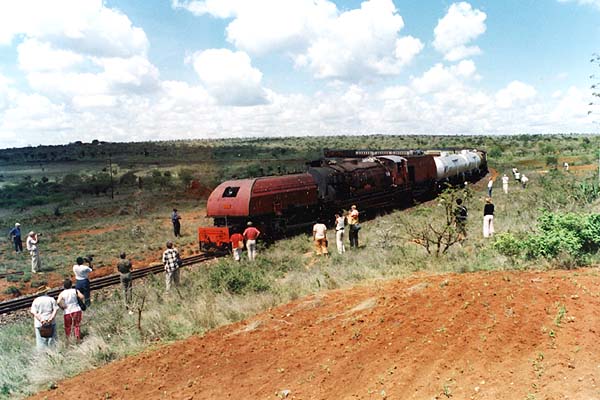
Special arrangements had been put in place on the Nairobi - Kibwezi sector whereby, the passengers were able to disembark for photo opportunities. The train stopped to let them off, before reversing back up the track and then gathering speed as it passed the onlookers and curious wananchi, blasting out steam and smoke and letting loose the inevitable whistle. It reversed once again to allow the passengers back on board before continuing on to Kima, where a second stop was made. It was here in June 1900, that Police Inspector Ryall was dragged from his carriage by a lion and eaten. The illustrated talk over lunch was complimented by the loan of the lion's claws from the Nairobi Railway Museum.
Kibwezi station had been especially renovated to receive its distinguished visitors on their overnight stop during which an excellent dinner was served. This was followed by an illustrated talk on the construction of the line from Mombasa to Kisumu between 1896-1901, and known originally as the Uganda Railway before becoming Kenya Railways in 1977.
Early next morning, '5918', named after 'Mount Gelai', a mountain that rises close to Lake Natron just across the Kenya border in Tanzania, was fired up and ready for the run to Mombasa, and a planned arrival in late afternoon after another photo stop at the famous bridge over the Tsavo river, where lions had brought the construction to a halt for three weeks in 1898.
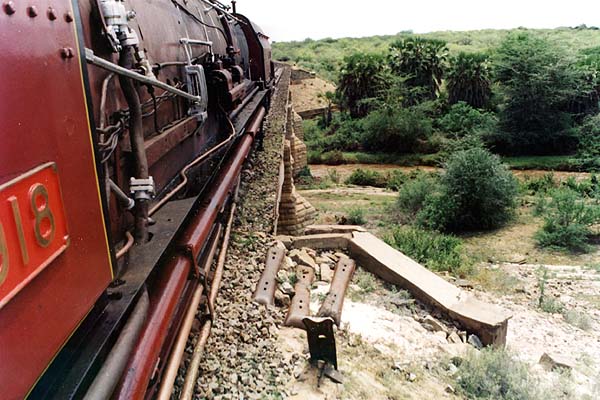
Although some minor delays occurred en route over refuelling and taking on
water, things were not much behind schedule until news reached the driver Ben Muoki that a
derailment down the line would cause a delay. No one seemed to mind, least of all the
enthusiasts, who saw it simply as an opportunity to prolong their once in |
|