|
Irish Narrow Gauge in the 21st Century |
|
|
James Waite reports on Tralee and Dingle Railway, the West Clare Railway and the replica Listowel and Ballybunion Railway (the latter not steam but very interesting)... I have now added James' 2019 pictures of the replica Lartigue locomotive at Panissieres in France (4th June 2019). The report below was written some time ago, James went to the West Clare Railway in 2010 but adds this footnote concerning the Tralee and Dingle operation: "The steam locomotive last ran in 2006 after which it was stripped down and the boiler lifted for an overhaul which never happened. The locomotive's parts were left standing out in the open for more than two years which can't have done them any good with the salty atmosphere. Eventually the operating company had its contract withdrawn and the locomotive's parts were moved under cover. After two years of closure the line reopened with a diesel but there's no sign of the steam locomotive being restored any time soon. The West Clare locomotive is currently the only working narrow gauge steam locomotive in the country." The Tralee line starts from a station on a new
site to the south-west of the town. Immediately west of the station it crosses a
bridge over the river, swings to the south and joins the old formation. It heads
due south along this for about half a mile and then turns to head due west and
crosses another stream on an original girder bridge from the old line. The
terminus at Blennerville is about half a mile further on. The engine shed is
here, at the end of a lengthy siding. The shed itself is a modern building but
the yard is alongside old farm buildings and is quite photogenic. The locomotive
comes
off shed usually about 10.00am and the first train out of Blennerville is at
10.45am. The light is best then as the locomotive faces towards Tralee and comes out
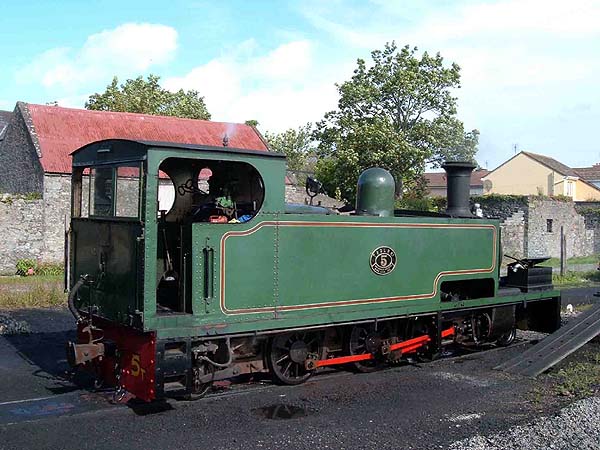
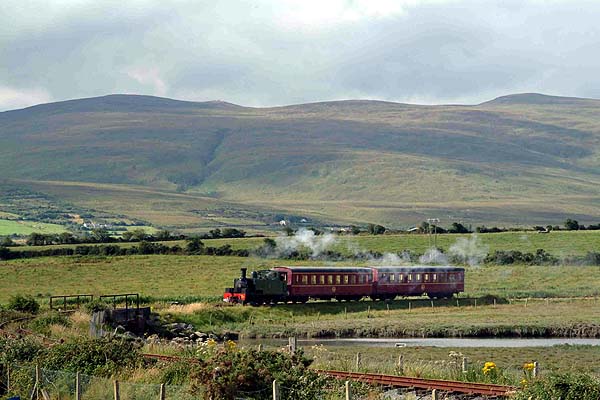
of the sun for much of the run from about midday onwards. No. 5 has just come off shed (the line from the left crossing the road) and is about to back into the station at Blennerville. The stone bridge on the right carries the main road from the Dingle peninsula into Tralee. The 11.45 train midway along the line with the Slieve Mish mountains in the background. The old line was about 30 miles
long. Much of its route is still intact, especially the steeply graded section
south west of Castlegregory Junction where it climbed south through the
mountains to reach the south coast of the peninsula - wild country and it's easy
to imagine how lonely it must have been working trains up to the summit in
stormy weather. Further west the old girder viaduct at Lispole, at the foot of
the gradient down from the mountains, is still there as are the main buildings
at Dingle station and the large water tank at Castlegregory Junction. It's worth
visiting the pub here - the footrests at the bar are made from old rail and
there are many photos of the line. If you carry on along the main road northwards from Listowel it's about a twenty minutes drive to the Shannon car ferry which runs every half hour or so in summer. The estuary must be a couple of miles wide or maybe even a little more. We were accompanied by dolphins for a part of the crossing, apparently not unusual as there is a large dolphin population in the estuary and offshore. Moyasta Junction on the preserved part of the West Clare Railway is about a half hour's drive from the ferry heading northwestwards and there are several other remains of the WCR at Kilrush and Kilkee. At present the half-mile line is diesel-worked but their 0-6-2T, one of the line's original locomotives, is coming to the end of a protracted overhaul at Alan Keef's works and should be at work there soon. There's a great deal of rail stockpiled at the station in connection with a planned extension towards Kilkee which would be an attractive run. (See James' 2010 update for more information.) In April 2019 James visited Panissieres in order to see the replica Lartigue locomotive there. It's about 40km north of St Etienne and was the terminus of the ill-fated Feurs to Panissieres Lartigue monorail line, the only other Lartigue line intended for public service other than the Listowel & Ballybunion. It was built in 1894 and 1895 but it was never allowed to open and was eventually scrapped in 1902. There were two locomotives, no 1 "Feurs" built in 1894 and no 2 "Panissieres" built in 1898. The builders were V Bietrix & Cie of St Etienne. Like the Listowel locomotives they were 3-coupled but there were many differences, most obviously because the Panissieres locomotives were tank engines whereas the Listowel ones had tenders. The Panissieres and Listowel councils entered into a twinning arrangement in 1991 to celebrate their unusual shared heritage and this replica of no 2 was built about the same time by a group of engineering students at the local college. Judging by photos of the original it's an accurate replica, especially in its drive and springing arrangement, save the there are no backhead fittings. Access to the cab was permitted and it was fun experiencing the gentle rocking movement when transferring from one side of the cab to the other! I guess that this would have been a necessary feature of travel on the line when it was running, otherwise I suppose there would be the potential for the driving wheels to be lifted off the central rail when the track wasn't perfectly aligned. |
|