|
Steam with “La Trochita”, November 2004 |
|
|
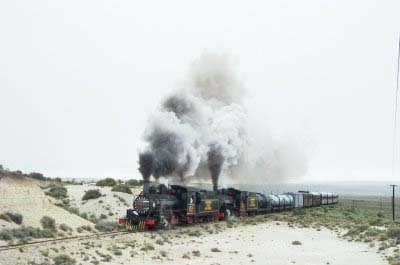
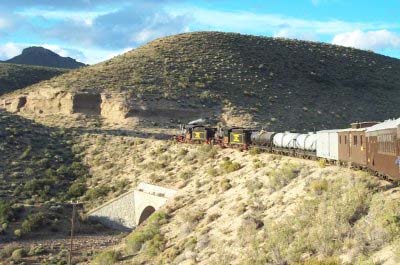
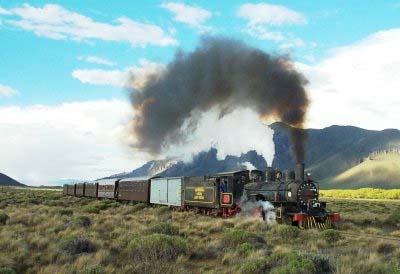
Cliff Schoff reports: As the main focus of a two-week tour in Argentina, Trains Unlimited Tours special trains covered the 750 mm gauge Esquel Branch (402 km) in Patagonia throughout over the period of November 2-7, 2004. The railway, known as “La Trochita”, runs in a southwesterly direction from Ing. Jacobacci on the broad gauge, passing through thinly populated country comprised of dry hills, interesting rock formations and grassy valleys with a few lakes and wetlands. Most of the area is semi desert, similar to parts of Colorado and New Mexico. The only trees were at the few ranches (estancias) and the small towns and railway settlements. We did not begin to see mountains until the second half of the line. Even those are only 6,000 to 8,000 feet high, the true Andes being further West. Most of the land is given over to grazing - some fine looking horses, much cattle and a very large number of sheep. This was spring, the equivalent of early May in the Northern Hemisphere and the bird life was incredible with many hawks and falcons as well as countless water birds (including flamingos) and other species. We planned to run Ing. Jacobacci-El Maitén (237 km) the first day, El Maitén-Esquel (165 km) the second day and the whole line the last day, with various excursions in-between. However, slippery track, long water stops, and locomotive breakdowns prevented the long distance parts from happening. Therefore, the coverage was done in relatively short sections, except that the relatively long stretch from El Maitén to Ing. Jacobacci was completed on the last day. This was the first revenue-earning trip on the northern part of the line in eight or nine years and one of the few trips of any kind over that period. The train departed from Ing. Jacobacci at 9:15 AM on Tuesday, November 2 with 13 cars (6 coaches, a refreshment car, a fourgon/caboose, a crew car, one box car and three tank cars – one fuel, two water) pulled by two beautifully cleaned and polished Baldwin 2-8-2s, Nos. 1 and 6 built in 1922. Unfortunately, the train soon ran into problems. Rain, snow and vegetation being crushed under the wheels made the rails very slippery and the train stalled many times. The grade just before Ojos de Agua had to be doubled and nonexistent or poorly operating water facilities gave problems all along the way. It took 12 hours to travel the 127 km to Cerro Mesa, normally scheduled for five hours. As if to try to make up for the difficulties, the weather improved considerably and the last few hours were traveled in beautiful low angled sunlight. Because the train was running so late, buses had been instructed to meet it at Fitalancao, another 47 km down the line. However, the need for repairs on one of the locomotives meant that the train was not ready to leave Cerro Mesa until 1 AM, by which time the buses had found the sleeping group. The passengers left their nice warm coaches (each one has a wood stove) for cold buses and arrived at the hotels at Esquel at 7 AM (November 3) just in time for breakfast.
After a little time for rest and relaxation, the group went by bus to El Maitén to resume the interrupted journey. The train had not yet arrived, so we explored the shed (Baldwin No. 16 was being rebuilt), inspected the many derelict locomotives and bought souvenirs. The train limped in at 3 PM and more locomotive repairs were needed. Sometime after 6 PM, the shortened train, pulled by No. 1, again headed South. Several photo stops were made, water was pumped from the stream near Leleque, then there was a good thrash up the hill to Lepá (73 km from El Maitén), arriving well after dark. The passengers then transferred to buses to return to Esquel.
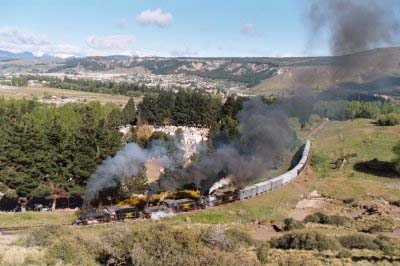
On November 4, the group took a double-headed excursion (Baldwin No. 1 and Henschel No. 105) to Nahuel Pan (19 km from Esquel) and a little beyond with many photo stops in mostly sunny weather. There is quite a climb from Esquel up to a series of loops just before Nahuel Pan with snow-capped mountains towering above. The day after that saw the first known triple header on the railway. A request had been made to run two trains, a passenger and a freight, within sight of each other with multiple photo stops. The railway refused based on a rule that trains must be one hour apart and offered a triple header mixed train instead. So, we had a triple header of Nos. 105, 6, and 1 blasting up the hill to Nahuel Pan with five box cars, seven coaches and a fourgon/caboose. Again, there were many photo stops. Henschel 105 left us at Nahuel Pan and returned to Esquel to be ready to pull the regular Saturday tourist train the next day. Nos. 6 and 1 continued on with the train, less four of the box cars, stopping at La Cancha and at a stream near Mayoco for water. The passengers got off at a road crossing near Lepá, but the train kept on to El Maitén.
On Saturday, there was a leisurely excursion from El Maitén to Lepá with Baldwin No. 6 and eight cars. There was a water stop (pumping from the stream) by the Leleque estancia and a delicious barbeque lunch at Lepá. Late in the afternoon, the locomotive turned on the wye and headed back toward El Maiten. The passengers detrained near Leleque, the locomotive and cars continuing on to El Maitén. The final day (Sunday, Nov. 7) saw the tour leaving from El Maitén about 7:30 AM with Baldwins Nos. 6 and 1 pulling 9 cars. The spirited departure was a good start for the long climb to the highest point on the line (1206 m) North of Fitalancao. Time was lost due to a very long water stop at the bridge near Norquinco and the need for work on one of the locomotives at Cerro Mesa. The whole town of Cerro Mesa turned out to see the train and many empanadas, pastries and souvenirs were purchased by the passengers. The train arrived at the junction with the broad gauge line after 14 hours, but had to wait for the Tren Patagonico Bariloche-Viedma train to pass before proceeding to Ing. Jacobacci. We arrived with great whistle blowing for the last kilometer or two to find an enormous crowd, part of it to see us arrive and part seeing people off on the train to Viedma. The elapsed time was 15 hours for the 237 km from El Maitén. Even with all the problems, it was a great trip! |