|
The Best of Times, the Worst of Times, Dakhondaing 2010 |
||||||||||
|
This is the twelfth part of our 2010 Burma Crusade. Click here for the index. My somewhat morbid assessment of the situation at Dakhondaing and links to earlier reports are on a separate page. Roughly 125 years ago, a young Chinese immigrant called "Su" from Fujian Province (a Hokkien) arrived almost penniless in Burma. The exact details have been lost in the seas of history, but he pitched up in Mudon and set about clearing scrub and forest in the area to the south which is now the village of Dakhondaing. It turned out that it was suitable for growing rubber and he was able to sell the land on profitably. He prospered and about 100 years ago he was able to build a large mansion in the village. Below is what it looks like today, we have been past it many times, Yuehong has often speculated about its history and this year we heard it.
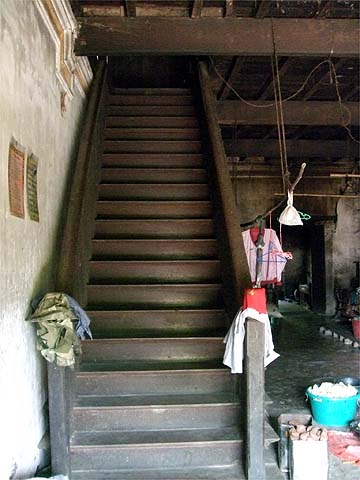
What followed shows why my best friend in Penang describes the Overseas Chinese as "The Jews of Asia". As time went by, he and his descendants invested their money wisely, eventually they owned at least 1000 acres of productive paddy fields which were rented out to tenant farmers. In other words they had become classic "Land Owners" and it was a natural investment to establish a rice mill to process the local harvest. They had worked hard and now they must have had a very good life. Such people in China itself were the biggest losers when the communists came to power - the fact that the system there has now turned full circle brings a wry smile to my face. While the family survived the Japanese occupation and escaped the post World War II horrors in their home country (such a land holding there would have been a death sentence), retribution for their success was lurking. In 1962, the then Burmese government confiscated their land without compensation and redistributed it to the tenants as part of a series of economic reforms. The family continued to own and operate the rice mill, but by 1987 they felt the need to sell what was their last major asset except for the house. As I have recorded elsewhere, Daw Ei Ma sold half of her own land and used the cash to buy the rice mill - in effect it was an exchange of assets. Unfortunately for the Chinese family, shortly afterwards the government demonetised the low denomination notes which she had passed on to them in good faith and they were penniless again. Judging from what we saw, the extended family never recovered from the shock. Bluntly, the place is more than half way to being a ruin, you don't have to be a property surveyor to work that out:
Yuehong wandered in, imagining for some reason that it was Indian inspired and instead found a Chinese family which had almost entirely lost its roots. She tried talking to them in Chinese but got just a blank stare, so she tried English and didn't get very much further. They didn't even know their Chinese family name and only when they took her upstairs was she able to help them learn this. All other traces of their Chinese culture have been lost:
It's a personal altar to the present occupant's great grandfather who must have died at least 50 years ago, before the bad times came.
It seems that most likely he had two wives, one a Chinese ('Chen'), the other a 'foreigner', presumably Burmese/Mon. He had three sons, their names are indecipherable, any daughters (if any) are naturally not mentioned. Today, one of his descendants lives here while the house crumbles around him and his family, they seem to eke out a living mending bicycles. Here Han listens to their story and passes on what information Yuehong has gleaned from the altar.
|