|
Once upon a time, long ago, |
|
|
Wilson Lythgoe has been circulating friends with some steam pictures taken some time back and with his permission and encouragement they are reproduced on these pages and will be added to from time to time. Click here for the index. Burdwan, India
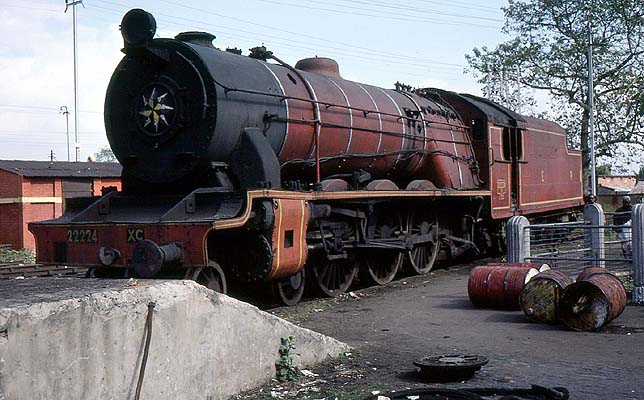
To continue with my letter home: '.......so disconsolately wandered off to the broad gauge shed about half a mile away. Found the Loco Supervisor's office and was greeted with "You're just in time, I finish work in ten minutes so can show you round then you can come home with me for lunch." As I had nothing better to do agreed - he got engines moved into a better position for me, men posing or completely out of the picture.....' I can't recall whether XC22224 was part of the working fleet or had already been withdrawn from service. Either way the large 4-6-2 made an attractive sight. Built by the Vulcan Foundry in 1929 it was designed to haul heavy passenger trains and was from a class of seventy two engines.....not many by Indian standards, I suppose.
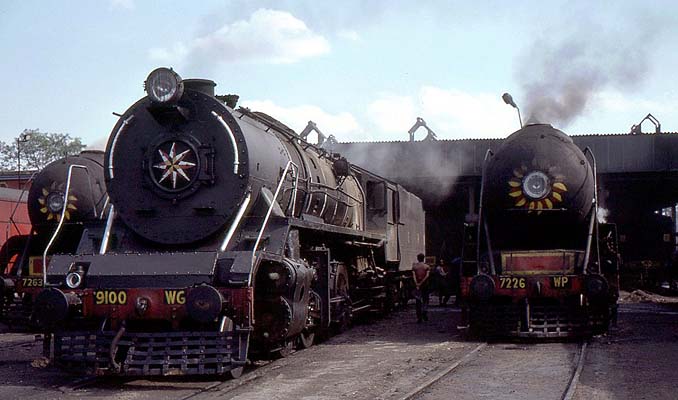
To a New Zealander Eastern Railway engines looked like real steam engines should..... a grimy black with just a little decoration. From the left WP7263, WG9100 (Baldwin built in 1955) and WP7226. The two WP were from a batch of 299 built in 1949 by either the Baldwin, Canadian or Montreal Locomotive Works. According to Indian Locomotives Part 4 by Hugh Hughes the actual builder of each loco is unknown.
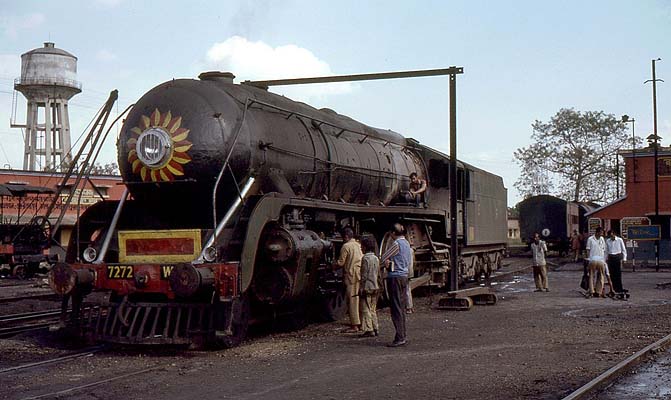
My host keeps an eye on what the fitters are doing to WP7272.....another of that 1949 batch of locos of unknown origin.
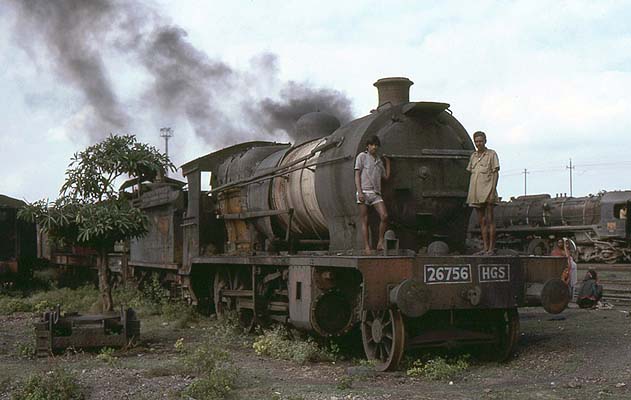
Sadly derelict and probably that way for a number of years now HGS26756 poses for its photo. Built by William Beardmore & Co of Glasgow in 1920, a builder I hadn't heard of until researching this episode, 26756 was a 2-8-0 designed for heavy goods traffic on main lines. According to Wikipedia William Beardmore & Co were an engineering and shipbuilding conglomerate based in Glasgow and the surrounding area. The company was active between 1890 and 1930 and at its peak employed about 40,000 people. Beardmores hit hard times after WWI and attempts were made to diversify the business with one diversification being steam locomotive building.
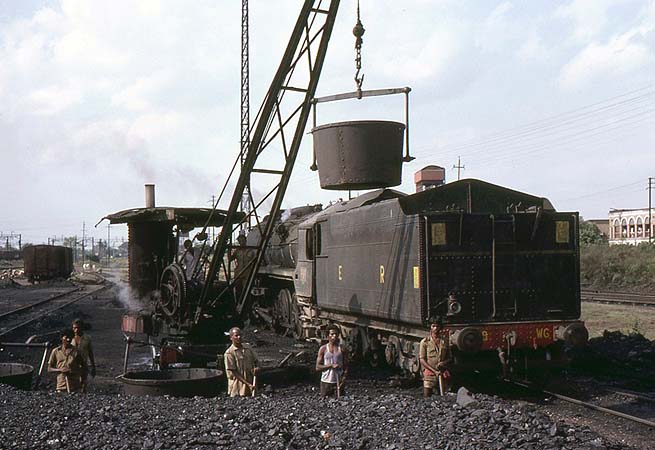
If it takes four men to fill a bucket with coal then how many buckets does it take to fill a WG tender?
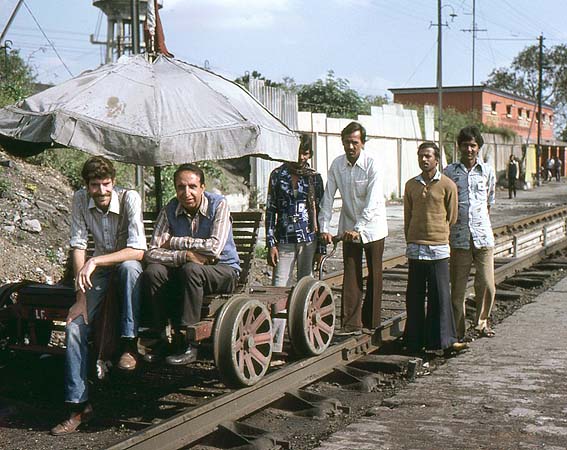
My host was obviously a man of some importance in the local railway hierarchy warranting his own 'company car': an inspection trolley complete with sun umbrella and a five manpower pushing team to take the two of us through the yards to a point close to his home. It was too good an opportunity not to have one of the pushers act as photographer!
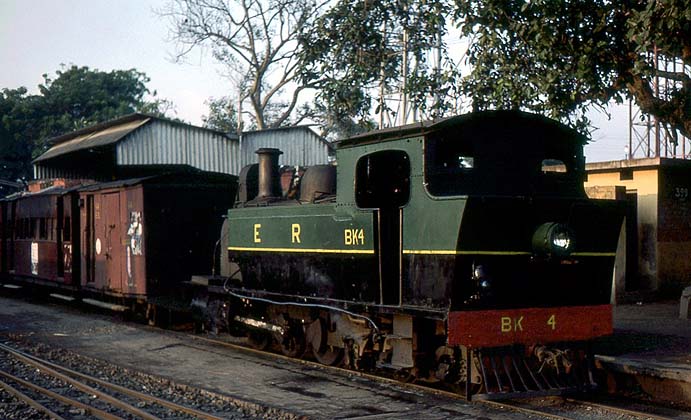
I was treated to an absolutely delicious vegetarian lunch.....and after that it was time for the family snaps to remember the occasion by. Later that afternoon I just made it back to the ng station in time to see BK4 arriving with a passenger train. BK4 was a 0-6-4T built by Bagnall in 1914 and the sole steam engine I'd managed to see on the Burdwan - Katwa - Ahmadpur ng line......but then again I hadn't tried particularly hard, had I?
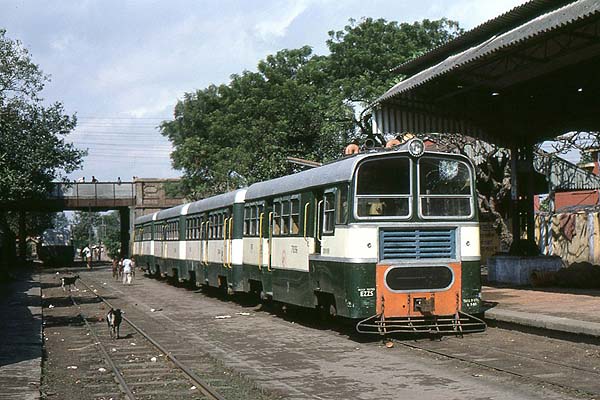
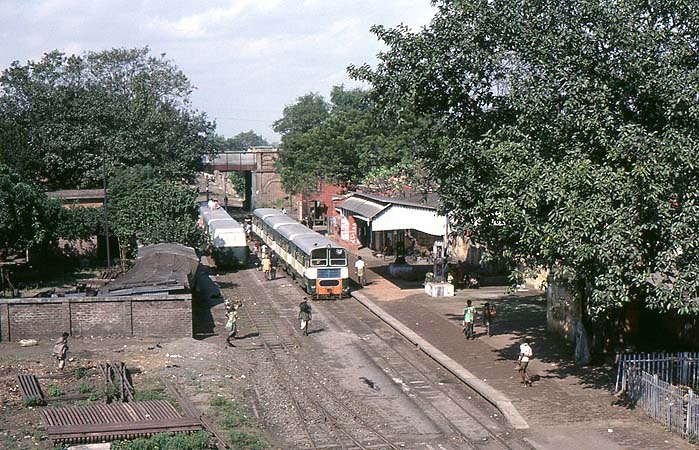
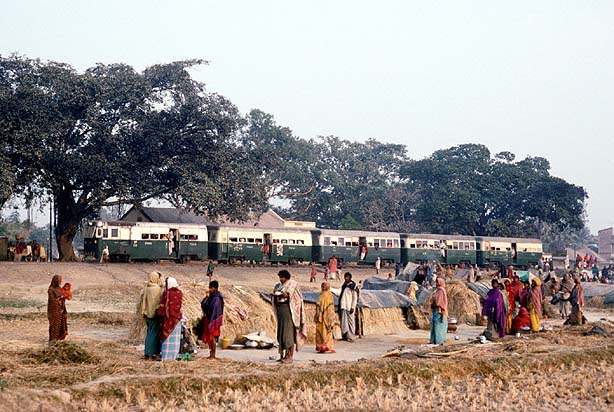
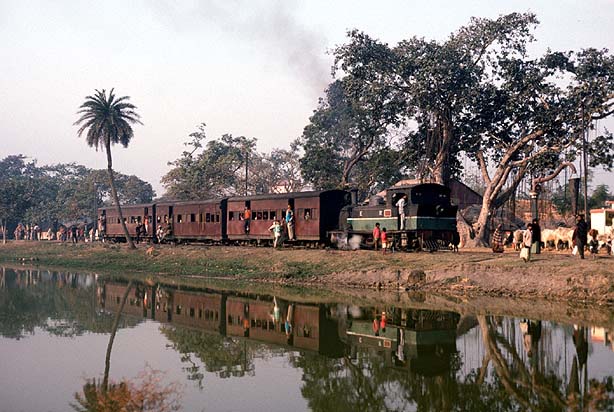
The next day I flew out of Calcutta and onto Rangoon.....a much warmer place, better food and within a couple of days I was back to feeling AOK! PS I (RD) visited the line in December 1994, it was still almost exactly as Wilson found it, there were four of us so we could afford an Ambassador taxi to chase the trains. In fact with rather plain countryside, the stations were often the best place to photograph them. These two pictures will give a flavour of what we found.
4 months later I made a brief revisit and all the steam locos were out of use. I was again in Burdwan in 2006 and the line was much as before with the little diesels in charge. However, time marches on and http://en.wikipedia.org/wiki/Burdwan_Katwa_Railway reports that it is slated for conversion to broad gauge. Of course, it will have been a 'political' railway and will never carry the traffic to justify the money invested, this is rural West Bengal with no industry save a few small rice mills (which was the reason I was there in 2006). A report in 'The Statesman' stated: Burdwan bids adieu to vintage narrow gauge trains |