|
Click here
for the 'Those were the days' index page.
Ketanggungan Barat was actually a former sugar
mill, a collecting point for cane which was gathered normally in its estate and
then sent overnight to Tersana Baru. These trains frequently ran late, sometimes
very late and provided an excellent opportunity to photograph trains in the
daylight.
Click on a thumbnail to see a larger 750x500 (or
similar) image then use the back button or links to return here.
|

|
My first visit to Ketanggungan Barat was on
14th June 1978, the day after I had visited Tersana Baru where operations
had been disrupted by a derailment. As such all trains were running many
hours behind schedule. I was able to travel on no less than three loaded
trains in turn and on the way I passed Maffei 0-8-0T #7 on some empties.
At this stage although all the steam locomotives were burning oil every
one was kept immaculately clean.
|
|

|
Here DB 0-8-0T #11 thrashes
along in the late afternoon sun on the same day, behind is another train
which I dropped off to photograph later!
|
|
|
By and large Ketanggungan Barat's steam
locomotives worked only as far as the former mill at Luwung Gajah where
there was a triangle and some servicing facilities. However, on occasions
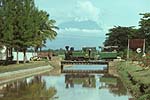
they worked all the way through to Tersana Baru. In August 1992, Hanomag
0-8-0T #10 is doing the full return journey, seen mid-morning passing a
small bridge with Gunung Cireme behind.
|
|

|
On 25th August 1994, larger
Maffei 0-8-0T #6 was working the empties back near Luwung Gajah.
|
|

|
There were two large viaducts
and several smaller bridges on the run - it was the failure of one of
these after the 2001 season that ultimately led to the end of this service. Here
DB 0-4-4-0T #5 crosses without disturbing the washerwoman on 27th July
1994.
|
|

|
On 30th July 1996, I dragged my
old pal and first time Java visitor Tony Wardobe (and the rest of the tour
group) out of bed some time before 05.00 and took them to a remote spot
east of Luwung Gajah. The gamble was well rewarded as #5 came past just
after dawn, closely followed by a second train.
|
Click here
for the 'Those were the days' index page.
|
|