Kebonagung is
a large modern mill, sister to Trangkil, which kept its field lines more or less
intact until the end of the 1999 season. "Save the Best for Last",
this was quite simply by far the best mill in Java for varied action
photography... In fact all that was missing was the possibility of silhouette
shots at sunset as the mountains to the west were not only too close but
frequently cloud covered. The city council considered the trains antiquated and they had to
go, the fact that their passing will have led to even more clogged up traffic
would have been totally lost on them.
Click on a thumbnail to see a larger 750x500 (or
similar) image then use the back button or links to return here.
|

|
Virtually all movement out from the mill
(with the exception of a few lightly used lines to the south-west) had to
cross the Malang - Blitar main line. Henschel 0-8-0T #6 goes out on the
south lines to collect a train on 9th July 1997.
|
|

|
Kebonagung power parade as OK 0-8-0Ts #10, 2
and 5 head for the fields to collect their trains on Independence Day,
17th August 1996.
|
|

|
Classic traction! #5 waits for the bullocks
to assemble its train, 18th August 1996.
|
|

|
This was the mill's mud train with OK 0-8-0T
#3 on 13th August 1992 on the south-west lines. Soon afterwards this
operation finished and the mud was trucked out.
|
|

|
OK 0-10-0 #7 was limited to lines nearest
the mill on the east side of the system. On 13th August 1986, it waits on
the turning triangle at Tutut while the following #5 takes empties on the curve to
the former Sempalwadak system - where #7 was delivered many years
ago.
|
|

|
With #7 effectively limited to the Buring
line which ended on the outskirts of ever spreading Malang, it wasn't
surprising that the mill decided not to fund expensive firebox repairs.
Before it was retired, #7 brings an afternoon train gently down to the
Tutut triangle on 21st August 1988.
|
|

|
There were some notable bridges on the
system as rivers had cut deep gorges in the soft volcanic rock in the
area. What I think was the most impressive was that at Tanjung Sari behind
Bululawang near Krebet sugar mill. #10 takes a train across it on 6th
August 1995.
|
|

|
The south-eastern part of the system was
taken over when Sempalwadak mill closed many years ago. Nothing remained
of that mill except for a few sidings where road cane used to be
trans-shipped. OK 0-8-0T #9 takes out a train load on the morning of 9th
August 1994.
|
|
|
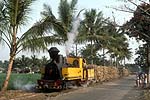
Henschel 0-8-0T #4 roars through Tutut on
25th August 1991. Whether it was the locomotive or its regular driver or
both, this was by far the most satisfying member of the fleet soundwise.
|
|

|
My favourite spot on my favourite mill
system was Bumiayu village where the line ran straight down the middle of
the main street and on to a narrow bridge. Although it is 15th August 1990
and Independence Day two days away, the decorations are out for #9.
|
|

|
At sunset on Independence Day, 17th August
1996, #5 waits for clearance at the start of the village. The sound and
light show as trains went through here in the half light was an
unforgettable experience for anyone lucky enough to have been there at the
right time...
|
|

|
This one is a video clip from my guest video page, which
you may have experienced already. Everything came together one wonderful evening in the village of Bumiayu on the outskirts of Malang in East
Java when two trains came in for Kebonagung mill within a few minutes of each
other in the early evening in August 1997. Who says lightning never strikes
twice? I recommend turning up the sound to maximum and if you never went to Java
to see sugar steam in the 20th century then eat your heart out when you see and hear
this. My tour groups had gone home and I could relax and enjoy the splendour all
on my own....
|