Great Dorset Steam Fair 2022
Working Steam
This is one of a series of pages which I have uploaded to illustrate facets of steam rallies we have attended in the UK. Such events occur all over the country in the summer months, they are easily found by using your favourite search engine and may have anything between a handful of steam engines and hundreds (as at the Great Dorset Steam Fair which could probably be fairly described as having an excess of riches). Click here for the GDSF 2022 main index and click here for the overall 2022 index.
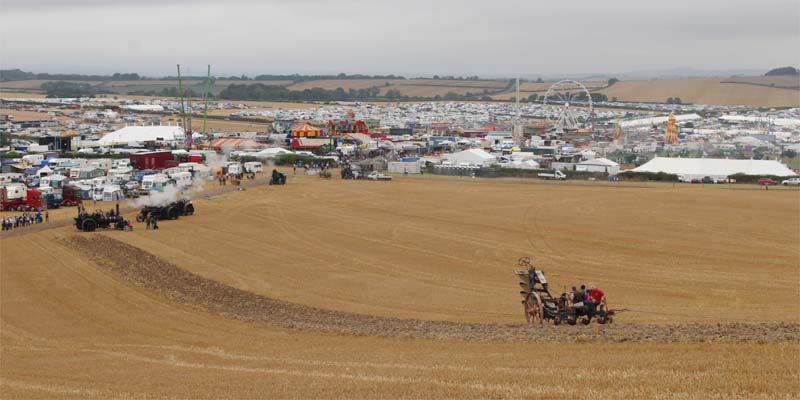
Strip away the glitz of the showman's engines lined up and the huff and puff of engines flogging themselves on the 'Hill', some at least with near authentic loads, the heart of GDSF is the working demonstrations. They vary in their ease of coverage and degree of being photogenic, some are more helpfully arranged than others...
Steam Yachts and Steam Gallopers


Road Making


Steam Sawing


Steam Threshing
If I had a single GDSF wish, it would be that the main threshing area would be rotated by 180 degrees. Maybe if the section organiser were to see these pictures, he might understand why. If there is a good reason for things to be organised as they are, it's not obvious to me...

|

|
Allchin 1499 was working a Foster thresher. The only way to get the nicely lit picture of McLaren 1160 was to come early and ask nicely before work started for the day, The thresher behind is from Foden. |

|

|
The next three pictures show the same engine from the public viewing area a couple of hours later. |

|

|
I think the portable behind was Robey 40892, equally badly positioned
for photography. There is an early morning picture of it from the sunny
side in the portable engine section.
Next we have Marshall 37690 with a thresher whose maker I didn't record but the only other one listed in the programme was a Ransomes. |

|

|
The thresher had an additional attachment, a 'reed comber' which the programme suggests was made by Murch of Umberleigh. The purpose of this is to neatly remove the stalks from 'wheat reed' so they can be used for thatching. The grain produced is very much a by-product, but no doubt it has a value, not least for planting for the next year's crop. For more details, see my report of one working at the South Moulton steam rally in 2014. |

|

|
Also working a Ransomes thresher here was the replica Wallis and
Steevens "The Hamster" built by Foreman.
Wallis and Steevens 2694 was working yet another Ransomes thresher, for a change, both pictures were perfectly lit in the late afternoon. The programme proudly reports that this is the only steam exhibit that has attended every GDSF. |

|

|
A nice touch was having a small scale thatching demonstration in the working area. It's a skilled and labour intensive task and while extremely attractive, a thatched roof does not take kindly to neglect. |
Steam Ploughing


