|
How Many Engines are there in New Zealand? |
|
|
Click here for a footnote concerning surviving traction engines in New Zealand (added 22nd March 2013). Click here for a footnote on the report of stationary steam in the Gore area, South Island (added 24th March 2013). The article suggests there are some 300 road steam engines, a number confirmed by the New Zealand Traction Engine register published in 1987. There are a number of these illustrated on this site. The following article appeared in the International Stationary Steam Engine Society Bulletin 17.2 in mid 1995 (this journal is referred to as IB below). . It is therefore necessarily dated in some respects, I have made no amendments beyond those which are strictly necessary which are indicated and broadly cover the inclusion of links to known relevant web pages. This is reproduced by kind permission of the society. Please visit their web site for more information (https://isses.org). I visited some of sites below during my New Zealand Steam holiday in October 2002. See also http://www.nzmuseums.co.nz for general information. These notes are by Brian Hilisdon (address below) who would I am sure still welcome additions comments. See that from Chris Little on the subject of the tug Aucklander (3rd February 2004). North Island The report in IB 16 on the two heavy lift floating cranes in New Zealand prompted me to go through my notes to identify other engines known to survive in that country. I found that even though I have been collecting such information for over twenty years, little detail seems to have come from N.Z. On the plus side, there are now a relatively large number of enthusiasts not only interested in but actively salvaging and restoring engines in N.Z. and I hope that more information may be forthcoming.(1) Here is a summary of information on engines found in other publications or received direct from N.Z. to date. The only beam pumping engine known to survive in N.Z. is preserved in situ at the Museum of Transport and Technology just north of Auckland. It was established in 1963 in the former Western Springs Pumping Station where, by chance, the engine had survived: although it had stopped work in 1928. The four Lancashire boilers were scrapped in 1937 and the chimney was dismantled in 1948, the bricks being used to build a private dwelling. The engine consists of two pairs of compound cylinders, on the Woolf principle, driving a common crankshaft with the flywheel in the centre. The piston rods are guided by guide bars rather than the more usual parallel motion. The engine developed 300 hp at 14½ rpm on steam at 60 psi. The flywheel is 20' 6" diameter and weighs 16 tons. The engine had a pair of bucket and plunger pumps with 17" plunger, 24" bucket and a common stroke of 4'. They displaced 70 gallons per stroke. According to a recent publication(2), the engine and boilers were built in 1876 by John Key & Sons, Whitebank Foundry, Kirkcaldy, Scotland. The engine house also now contains a collection of small engines and pumps that are steamed when the museum is open to the public. It is also stated that the main engine can be turned but whether by steam is not stated explicitly. The Museum also has some traction engines and runs a 3' 6" gauge steam tramway with a Baldwin designed 0-4-0 ST tram locomotive. In the far north-west tip of N.Z. is situated the Kauri Milling and Transport Museum at Kerikeri. Here they have a steam sawmill and operating steam railway. On the north coast at Coromandel is a steam engine collection of some kind and in the centre of North Island near Repora is another steam sawmill museum, also with some locomotives. Near Palmerston North, in the southern part of North Island, is the
Tokomaru Steam Engine Museum. This is a large private collection gathered and restored by
Colin Stevenson. There are at least 35 stationary steam engines on display and several
more in store. The majority are U.K. built with four of American origin and only two built
in New Zealand. Many of these are capable of being operated and one can be run in anger to
provide power for the site. The largest engine in the collection is a horizontal tandem
compound engine built in 1916 by Filer & Stowell Co., Milwaukee, U.S.A. This has
Corliss valve cylinders of 16" and 32" bore by 48" stroke and developed 335
hp at 60 rpm on steam at 160 psi. It drove a Ball ammonia compressor to make 200 tons of
ice in 24 hours. The oldest engine in the collection is a 50 hp horizontal duplex built in
1869 by Appleby Brothers, London and supplied to the patent slip at Evans Bay, Wellington.
This saw a century of service and could haul ships up to 2,000 tons up the slip. Another
notable engine is a Tangye horizontal duplex from a sawmill in Whakarara. This was built
in 1904 (No.s 10390 & 10391) with cylinders of 14½" bore by 28" stroke and
developed 138 hp at 85 rpm on steam at 100 psi. There are several high speed enclosed
engines including examples by Belliss & Morcom; Browett, Lindley; W.Sisson;
W.H. Alien
& Son: E. Reader and Howden. Electricity to light the Museum can be supplied by
Belliss & Morcom compound No. 6118. This is a 225 hp machine supplied in 1916 to
Waingawa Freezing Works, Masterton. They also have Belliss & Morcom C4 compound No.
5932 with cylinders 7½" & 12" x 6". This was supplied to a meat
freezing plant in 1915. Also here are a compound marine engine built in N.Z. by the Otago
Foundry and a variety of traction engines, locomotives and a steam fire engine. See also
this website To continue with North Island, a number of steam ships are known to be in existence. The twin screw tug Aucklander, built as late as 1958 by Fleming & Ferguson Ltd., Port Glasgow, is hopefully still around, either in service or preservation. The Auckland Maritime Museum have the crane ship Rapaki, with 80 ton lift capability, as reported in IB 16.1. Also in the Auckland area is preserved the twin screw tug William C. Daldy, built in 1935 for the Auckland Harbour Board by Lobnitz & Co. Ltd., Renfrew. She has two triple expansion engines. Retired in March 1977, she was leased to the William C. Daldy Preservation Society who keep her in working order and steam her regularly. The following websites may help: http://www.daldy.com. Chris Little adds (3rd February 2004) - "As far as I know the Aucklander is still around and has a bit of history behind it. On April 10 1968, the inter-island ferry T.E.V. Wahine with 733 people on board ran into severe difficulty in Wellington harbour during the worst recorded storm in NZ, eventually capsizing with the loss of 51 passengers and crew. The tugboat Tapuhi battled mountainous seas to attempt towing the Wahine to the wharf. While it failed in this mission, Tapuhi managed to rescue 174 people. Today there is a memorial to Tapuhi at Oriental Bay in Wellington. There is a floating restaurant named "Tugboat on the Bay" which is housed on the tug Aucklander, which has been renamed Tapuhi ll in honour of the work Tapuhi did during the Wahine tragedy." Just 60 miles south-east of Auckland, at Paero is the Historical Maritime Park with a steam boat collection, the gem of which must be the only surviving paddle steamer that I have so far heard of in New Zealand.(3) This is Kopu, built in N.Z. in 1897 and having a wooden hull. After being sunk and submerged in thick silt for an unspecified number of years (possibly in excess of 50), she was raised and salvaged in 1981. She was fitted with a two cylinder non-condensing engine of 5 nhp. This drove the paddle shaft via spur gears. Restoration is planned but has yet to start and the vessel is claimed to be in poor condition. Further details on the engine and its builder would be most welcome. About 90 miles south-east of Auckland the Tauranga Museum Society have preserved a former second world war Empire tug. This was built in 1944 by Alexander Hall & Co. Ltd., Aberdeen as the Empire Jane, and renamed Taioma on being sold to N.Z. in 1947. She has a 900 ihp triple and is now preserved ashore. The other known vessel in North Island is the crane ship Hikitia as reported in IB 16.1. South Island Moving to South Island, fewer sites are known and these will be listed from north to south. Near Nelson there is a large privately owned collection that is open to the public but no other details are known. At Marshlands there is a flax mill of c. 1888 vintage. This has been disused since 1963 but retains a 25 hp two cylinder steam engine and associated machinery. At the Fiordland Vintage Machinery Museum at Te Anan can be found locomotives salvaged after being buried during the 1920s for coastal erosion protection, and hopefully some stationary engines. A little further south, at Gore there may be two engines still at work; although it is possible my sources have confused different reports of only one engine. One of these is claimed to be a Corliss engine in a flour mill, this was known to be at work as recently as 1991. The other is a horizontal single cylinder uniflow in the sawmill of Fleming & Co. This was built in 1936 by Newton, Bean & Mitchell, Dudley Hill, Bradford, England as their No. 679. The cylinder is 20" bore by 24" stroke and it was built for 200 ihp at 140 rpm. The flywheel is 10' diameter and it drives an alternator by a chain. This plant was described in Light Steam Power, Vol. XXVII, p460, 1978. It was believed to be still in operation during the 1980s. (This seems to have been incorrect, see footnote and picture below. RD) The list of steam ships in South Island must be headed by the relatively well known Earnslaw, a twin screw passenger ship on Lake Wakatipu. Built in N.Z. in 1911 she has two triple expansion engines and two coal-fired locomotive type boilers. She runs tourist cruises each summer from December to March. Her slipway, on which she resides during the winter, is reputedly operated by a set of 1869 paddle engines salvaged from another steamer, possibly an earlier vessel on the lake. See also http://en.wikipedia.org/wiki/TSS_Earnslaw. Other ships known on South Island are the Lyttelton, a twin screw tug owned and steamed by the Tug Lyttelton Preservation Society, built in 1907 by Ferguson Bros. of Port Glasgow with two compound engines 20" & 40" x 27"; and the Tewhaka, a grab dredger built in 1910 by Ferguson Bros. Ltd., and acquired during 1994 by the Tewhaka Maritime Heritage Trust of Dunedin from the Lyttelton Harbour Board. Note how the majority of the larger surviving vessels were built in Scotland. The various Clyde yards already mentioned supplied N.Z. with almost all its tugs, dredgers and floating cranes. New Zealand is also home to nearly 300 traction engines, portable engines, road rollers and steam wagons, and an as yet unknown number of locomotives at sixteen operating steam railways and other sites with static exhibits. Footnotes 1. If any readers have details of any steam engines, of any type, in New Zealand, I would be grateful if they could write to me and supply as much detail as possible (site addresses, serial numbers, type, etc.). Lists of ail the auxiliary engines on the various vessels would be helpful. This will help me compile a list for possible publication. The address for correspondence is:- 72 Marlborough Road, Ashford, Middlesex, UK TW15 3PW. 2. "AN IRON ESSAY" - A SHORT HISTORY OF THE BEAM ENGINE AND WESTERN SPRINGS WATERWORKS AUCKLAND, L. Wilson (1994), Auckland. 3. According to International Register of Historic Ships, N.J. Brouwer (1993), Oswestry, a further paddle steamer does survive. This is Waimarie, a side-wheeler currently owned by The Wanganui Riverboat Restoration & Navigation Trust. She was built in 1900 by Yarrow & Co., Poplar, London and remained in service until 1949. She was due to be restored in 1993 after sinking at her berth in 1952. (Editor) This boat is now (2002) active. (RD) There are many surviving road vehicles (traction engines) in New Zealand, Olwyn Whitehouse has sent me a list of some tractions engine related pages from his website (http://www.rootsweb.ancestry.com/~nzlscant/site_index.htm):
His site also contains an article which includes information on the Timaru steam crane. There are a few pictures of engines from my own 2002 visit to New Zealand on this site There are numerous annual traction engine rallies in New Zealand as evidenced by the pictures on this page - http://www.flickr.com/photos/branxholm/sets/72157621858570779/detail/, finding out about them is another matter altogether. From a quick internet search there seems to be no all embracing site that covers the scene there, indeed finding permanent websites for recurrent festivals is a challenge!. So, please check out these major players and my apologies to those left out. Frankly the typical quality of their websites is poor (OK, crap) and giving up and using a Facebook page which is impenetrable to outsiders is a complete cop out. North Island
South Island
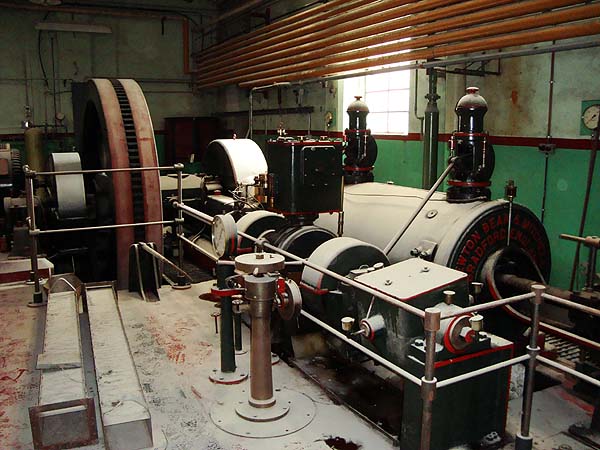
There is a magazine 'Vintage Scene' - website www.vintagescene.co.nz. Finally, this UK website has a record of all the 79 engines which attended the New Zealand Burrell Special Rally in 2006 - http://www.steamscenes.org.uk/events/2006/new-zealand/engines/. Robert Dyason visited Gore in early 2013 and tracked down a Newton, Bean & Mitchell stationary engine which is in the premises of the former Fleming and Co oat mill. It is a Uniflow engine with drop valves and not Corliss valves:
In the light of this, he suggests that the report above is inaccurate and this is the only surviving engine in the district. He adds that "The steam engine, boiler and electrical plant are in the large building and now appears to be owned by Sgt. Dan's feed milling. It is unused, not generally available for viewing, and is heritage listed as is the whole building. We gather it is in excellent working condition, being oiled and turned monthly." |