|
Some of the biggest challenges faced by railway builders
through the years have been presented by hills and mountains. Splitting
trains, multiple
locomotives, tunnels, curves, even horseshoes and spirals are all
commonplace in my book, sometimes it needs something a little more
interesting... For some general coverage in Wikipedia, see a
short list of relevant articles at the bottom of this page to get
started there. These pages instead highlights outstanding currently open (and
relatively recently closed) examples especially
outside Europe and North America, particularly where reports exist on this
website.
By and large there are three solutions for when the problem
gets really serious,
each one reflecting a more extreme need to climb, these are covered in these
pages:
I would like to thank James Waite for not only suggesting
the creation of these pages but also doing a lot of the spade work both in the
field and virtually. I would welcome further pictures to illustrate this
page.
I have also included notes on some rack railways which
survived into the second half of the 20th century, because people like me
'of a certain age' will have enjoyed visiting some of them and maybe will
like to learn something of 'the ones that got away'.
The main Wikipedia article http://en.wikipedia.org/wiki/Rack_railway
also includes excellent descriptions of the various types of rack systems.
This website contains a list of rack railways, I know much
of the Indonesian information is wrong, so, like Wikipedia, the further the
railway is from Europe the more the data should be treated with suspicion, http://www.stadtinfoseiten-deutschland.de/z/cgi-bin/njw.pl?Query=Zahnradbahn
(German language, link broken by December 2021). Of course, I have also relied on web sources and will
also, no doubt, have introduced errors in what follows.
Updates:
Greece (19th
November 2016) - Picture (and report) of restored DK 8001at work.
Switzerland
(24th March 2016) - Pictures of both generations of SLM locomotives on the
Brienz-Rothorn Bahn
Spain (8th August
2015) - Vall de Núria Rack Railway report.
Germany (22nd
June 2015) - Drachenfelsbahn report
Slovakia (11th
October 2014) - First trains up the rack line.
Switzerland (30th August
2014)
Slovakia (21st
July 2014) - Tisovec – Pohronská Polhora ready to return to steam, (9th
August 2014) picture of test run.
New Zealand (5th April 2013)
picture of Fell loco added.
Australia (30th March 2013)
James Waite's visit to the
Mount Lyell Railway and (6th February 2013)
Mount Lyell Railway's economic problems
USA (28th September 2012) Pike's Peak
locomotive steamed.
Austria (24th August 2012, Achensee
Bahn photoreport)
USA (30th January 2012) - Pike's Peak
loco at Colorado Railroad Museum
Lebanon (19th December 2009) -
extra link and photograph added.
USA (26th October 2011) - Mount
Washington Cog Railway report.
Africa
I know of no current rack railways in Africa, the 1067mm
(3' 6") gauge Benguela Railway had a Riggenbach rack section at one
stage it is described briefly in http://mikes.railhistory.railfan.net/r011.html.
This is the late Basil Roberts' picture of former Esslingen built rack
loco 0-6-2T #12 in use as the works pilot at Nova Lisboa in April 1970:

Americas
Argentina / Chile
Of historical interest only, the Transandino was a
metre gauge line with an Abt rack and adhesion section in its highest parts.
Although electrified, it was closed by the mid 1980s for mainly
political reasons but is currently being rebuilt with a summit tunnel
which will eliminate rack working. It was notable for having had Kitson-Meyer
steam locomotives for the rack sections in early days.
Wikipedia - http://en.wikipedia.org/wiki/Transandine_Railway
Brazil
The tourist railway from Cosme Velho in Rio de Janeiro
to the summit of the Corcovado Mountain (famous for its statue of Christ
the Redeemer) is an electrified metre gauge Riggenbach rack line.
Website - http://www.corcovado.com.br
Wikpedia - http://en.wikipedia.org/wiki/Corcovado_Rack_Railway
The 1600mm (5' 3") São Paulo Railway, latterly Estrada de Ferro Santos-Jundiaí,
faced a steep climb from Piassagüera to Paranapiacaba on its route from
Santos to São Paulo. For many years this was operated as a cable
railway with its famous 'brake locomotives' but it was converted to an
electrified Abt rack system in the 1970s. The engine house and immediate
area at Paranapiacaba is now a superb museum - see this
page on this site
for photographs and links.
Wikipedia - http://en.wikipedia.org/wiki/S%C3%A3o_Paulo_Railway
This is James Waite's 1977 picture:

Panama
The canal locks have traditionally used electric
'mules' running on a rack railway:
Wikpedia - http://en.wikipedia.org/wiki/Panama_Canal_Locks#Mules
USA
The 1422mm (4' 8") near standard gauge Mount Washington Cog Railway in New Hampshire was
the world's first in 1869, using the Marsh system, and exclusively steam powered with locomotives
from mainly the Manchester Locomotive Works (and even home made) until very
recently. Now the line is being modernised to reduce costs and home made
diesels work most of the trains. One of the steam locomotives in working
order was offered for sale on EBay in 2009 for USD 100,000 but failed to
make its reserve.
Official website - http://www.thecog.com/
Wikipedia - http://en.wikipedia.org/wiki/Mount_Washington_Cog_Railway
James Waite was here in 2011 and managed
an experience almost the opposite of Peter Mosse's below (26th
October 2011)
It's always been an idiosyncratic line,
a sunny departure can end up in a very misty arrival at the top as
Peter Mosse's pictures from September 1980 show.


The standard gauge Pike's Peak Cog Railway in Colorado
(originally Abt rack system, converted to Strub system by 2021) has been dieselised for a long time:
Official website - http://www.cograilway.com/
Wikipedia - http://en.wikipedia.org/wiki/Manitou_and_Pike's_Peak_Railway
However, in September 2012, #4 was steamed again,
see http://www.nathanzachman.com/Trains/Pikes-Peak-Cog-Railway/25616093_JNK4KF#!i=2114445206&k=bX99sjg,(Link
broken by May 2023)
this is Nathan Zachman's picture (added 28th September 2012)

This is James Waite's picture of #1, currently
(2011) at the Colorado Railroad Museum:

Asia
India
The Abt system metre gauge railway from Metupalayam to
Coonoor is one of the great steam railway journeys of the world although
the 'modernised' oil burning locomotives would never win a prize in a
'black beauty contest'. The 0-8-2RT (X Class) were supplied before and after
World War 2.The line on to Udhagamandalam (Ootacamund, Ooty) was
originally worked by the same steam locomotives but has been dieselised
for some time.
Wikipedia - http://en.wikipedia.org/wiki/Nilgiri_Mountain_Railway
Unesco Listing - http://whc.unesco.org/en/list/944
Pictures of steam in its original form
An unusual day out at Ooty
I took this picture in 1976:

Indonesia
There were historically two rack railways in Indonesia
both 1067mm (3' 6") gauge using the Riggenbach system, both survive
and are used for tourist operation only:
Ambarawa was a former Dutch military town served by a
former standard gauge branch from the Semarang - Solo line from
Kedungjati which closed in the 1970s. The line south towards Yogyakarta
closed to regular traffic at about the same time but the adhesion
Ambarawa - Jambu and rack Jambu - Bedono sections were kept active for
occasional charters. The railway is now part of the Ambarawa railway
museum and two of the five 0-4-2RT supplied by Esslingen are serviceable
with a third preserved nearby.
See the unofficial website:
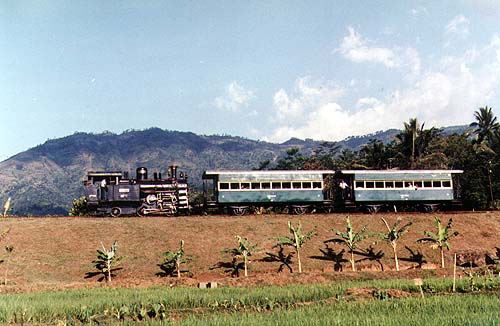
In West Sumatra, there was once an extensive system.
The 'main line' up from the coastal plain at Padang changed to rack at
Kajutanam and climbed through the spectacular Anai Valley to Padang
Panjang. From here the line divided, one section climbed to its summit
at Kota Baru before descending to Bukit Tinggi and the other descended
to Lake Singkarak where it changed back to adhesion for the run to
Sawahlunto where there was a large coal mine. The Bukit Tinggi line
closed in the 1970s and the remaining rack section was dieselised in the
1980s. Services were withdrawn when the mine closed in 2003, but a
museum has been established at the old coal mine and tourist trains are
currently running between Padang Panjang and Sawahlunto at weekends
(effective mid-2009). E1060 was sent to Ambarawa and restored to action
in 1998 but has now returned 'home' where it runs short trips between
Sawahlunto and Muarakalaban at weekends. There are odd notes on the web
but nothing of any substance - it's on my list of 'things to do' as I
knew it well in steam days. Here are three nostalgic pictures, one
from each section, taken from our
Incredible Indonesia CD-ROM. I can safely say that none could be
taken during a 21st century charter!


Japan
The Ōigawa Railway Ikawa Railway is an
electrified 25km 1067mm (3' 6") gauge (part) rack line (Abt system)
which is mainly used by tourists.
Wikipedia - http://en.wikipedia.org/wiki/Ikawa_Line,_Oigawa_Railway
Website - http://www.ikawasen.jp/
(Link dead by May 2023) (Japanese language)
Lebanon
(extra link and picture added 17th December 2009).
Now of historical interest only, the 1050mm gauge line
from Beirut to Damascus featured Abt rack operation, it also had reversing
stations at Chouit-Araye and Aley. There is very little information on this railway on the
web save:
Introduction - http://almashriq.hiof.no/lebanon/300/380/385/railways/index.html (Link
dead by May 2023)
Pictures of survivors at Riyak in 2002 - http://almashriq.hiof.no/lebanon/300/380/385/railways/stock/riyak/index.html (Link
dead by May 2023)
Extracts from Hughes' Middle East Railways published
by the CRC - http://almashriq.hiof.no/lebanon/300/380/385/railways/resources/middleeast/
(Link dead by May 2023)
Tourret's Hedajz Railway ISBN 0-905878-05-1, despite
its title, has a lot of information on this railway.
Undoubtedly the last active 'rack' steam survivor is
805 (SLM 845/1894) which I photographed without its rack equipment in
Damascus (Syria) on 23rd September 1997:

Vietnam
Now possibly of historical interest only, the 84km
Thap Cham to Dalat section of the metre gauge Vietnam Railways featured
16km of Abt rack operation. There were nine original rack locomotives
and in 1947 four more were bought from the Furka Oberalp Bahn (FOB) after its change from steam to electric traction.
In 1990 the four FOB locomotives were returned to their original railway
plus two of the originals. According to http://www.angkor.com/2bangkok/2bangkok/forum/showthread.php?t=3428
(link broken 1st November 2019) the entire railway will be restored between 2008 and 2015 - what they
will do about the rack section is unstated, the steam locomotives
assumed left at Dalat will hardly be 'ready to run'.
Historical article - http://vnafmamn.com/tracing_shangrila.html (link
not working 26th April 2014)
The FOB in 2009.
This is John Alexander's picture of 2-6-0RT 31-201 dumped half in and half out of the shed at Da Lat on 6th October
1987, and below is James Waite's picture of it running on the FOB in
2009:


Australasia
Australia
Further to what is written below, a local
newspaper, the Mercury, reported in February 2013 states that the line is in serious economic
difficulty and faces a service suspension -
(thanks to Wilson Lythgoe for this, 6th February 2013). James Waite made a big
effort to visit during March 2013 and was
well rewarded (30th March 2013). It has since been taken over by the state.
In the last few years, the former Mt. Lyell Mining and Railway Company's
Abt rack line from Strahan has been progressively relaid for 34km up to
Queenstown and operates as the West Coast Wilderness Railway. Three of the
original locomotives have returned to service, steam passenger trains operate over
the completed section from Queenstown.
Official website - http://www.wcwr.com.au/
(updated 20th May 2015)
Wikipedia - http://en.wikipedia.org/wiki/West_Coast_Wilderness_Railway

The Skitube Alpine Railway is a standard gauge
electrified 8km Lamella system rack line in the Snowy Mountains:
Website - http://www.perisher.com.au/winter/transport/skitube.html
Wikipedia -
http://en.wikipedia.org/wiki/Skitube_Alpine_Railway
New Zealand
The Rimutaka Incline in North Island used the Fell system
which is not so much a rack as a friction system with wheels to grip a central
rail. It is just be a memory now but the Fell Railway Museum has the world's
only surviving Fell locomotive - http://en.wikipedia.org/wiki/Fell_Engine_Museum
and http://www.fellmuseum.org.nz/.
This picture (added 5th April 2013) is from Wikimedia (Optimist on the run):

As always Wikipedia is some help
in a specialist subject but when 'push comes to shove' you soon find gaps in
the coverage, not to mention things which are downright wrong... Worse
still are the 'Look Alike' sites which lift material from Wikipedia in a bid
to make money from advertisements and thereby foul up the search engines.
Hill Railways in General - http://en.wikipedia.org/wiki/Hillclimbing_(railway)
(link corrected 26th April 2014)
Mountain Railways - http://en.wikipedia.org/wiki/Mountain_railway
Rack Railways - http://en.wikipedia.org/wiki/Rack_railway and
http://de.wikipedia.org/wiki/Zahnradbahn#Liste_der_Zahnradbahnen
- look for conflicts!
Reverses - http://en.wikipedia.org/wiki/Zig_zag_(railway)
Funiculars - http://en.wikipedia.org/wiki/Funicular
There are many sub-links within these pages, some to
specialist technical information, others to items on individual railways.
|
|