I saw my first Mallet in Indonesia in 1975, I have been
through my extensive archive to produce this summary. I confess that many of
these pictures appeared in my 'Those were
the Days' feature, but here they are presented in a way that will allow
a full appreciation of the type in service in Indonesia over the years.
All locomotives on this page are 0-4-4-0T and of 700mm gauge unless stated
otherwise.
Borsig
The few Borsig Mallets seem to have been either unsuccessful or unlucky because
none lasted at work beyond the mid 1980s.
Lestari #6 was working on
28th May 1978. It
was a shame the light was all wrong then because I never saw it again...

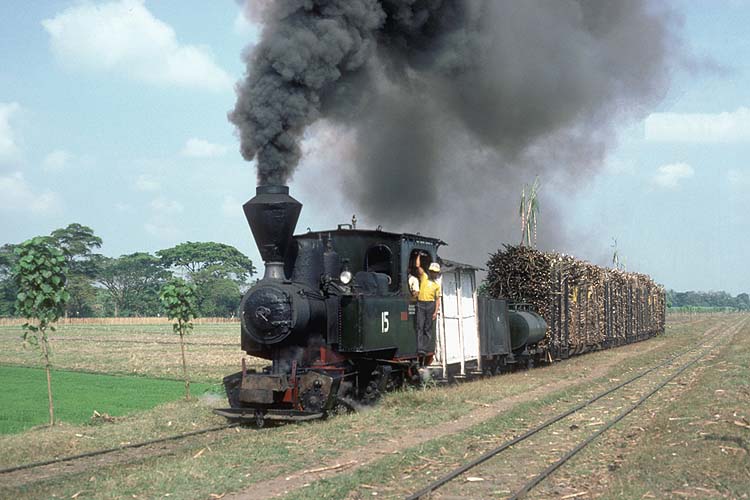
Semboro #31 was near the end of its working life on 1st
August 1984.
Jung
Jung Mallets were distinctly different and elegant
compared with the others.
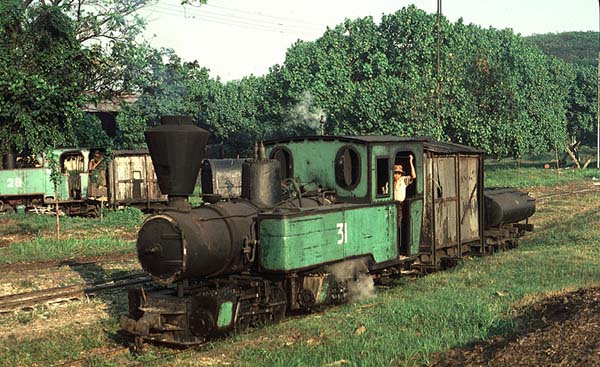
Tersana Baru #9 was at work on 13th
June 1978, but was withdrawn from service shortly after.

Ceper preferred to run its Mallets backwards.
750mm gauge #5 was returning to the mill on 23rd August 1986 in glorious afternoon light.
It is now preserved in the UK.

Jatibarang #9 was one of only two 600mm gauge
Mallets that survived by the time I got to Java. I caught it in the glorious last sunlight
on 29th August 1996. It is now preserved in the UK.
Du Croo & Brauns
In comparison to the three other builders covered here, DB
were late entrants to the field because they only started to build steam
locomotives after WW 1.
By 2nd August 1997, there was
nowhere in Java where you could hope to see more than one working Mallet
except Pesantren. #216 was at work with several sister locomotives
then at the new Pesantren mill.

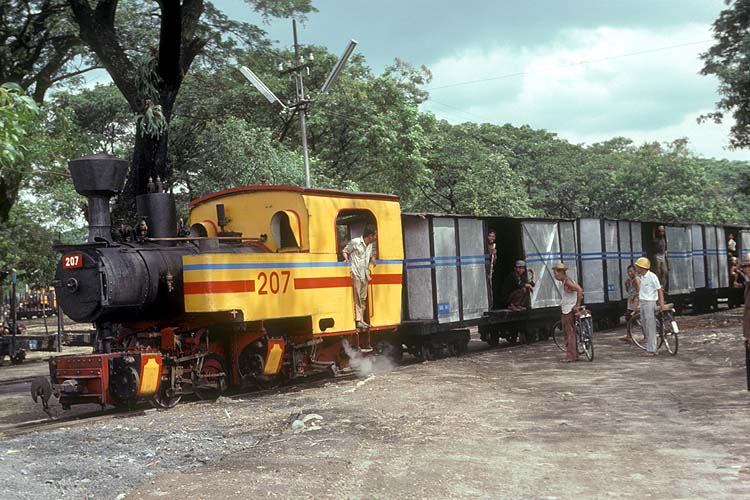
Ngadirejo #207 was working a processed sugar train
on 2nd June 1978.
It seems that the mill was short
of box vans for production cane by 3rd
August 1984 and a flat car was in use as well, the
riders behind #224 were no doubt employed to load and unload
the bags of sugar.

Ketanggungan Barat #5 came past just
after dawn approaching Luwung Gajah on 30th July 1996.

The last mill with 'real' Mallets was
Pesantren, but they decided they could do without them at the end of the
2003 season, this was my 2001 picture:

Orenstein and Koppel (OK)
There were more OK Mallets in Java than all other builders
put together, but, to be honest, they were inferior to that builder's Klien
Lindner 0-8-0T. I haven't checked carefully but I think they were all fitted
with OK's patent valve gear. Simple it may have been but it was inferior to
the Walschaert's version carried by the other builders' Mallets. Apart from
Gending #4 and Pakis Baru #5 preserved in Europe, Krebet Baru #3 is
preserved in Australia.
The oldest Mallet I saw working in Java was Pakis Baru #5. Here it runs round the front of the mill
during the last year of operation on 9th August 1999. It is now preserved
in the UK.

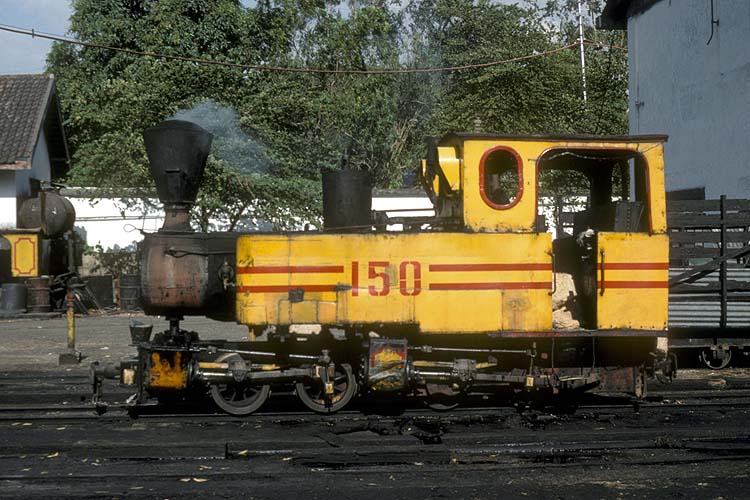
Ex-Ngadirejo OK Mallet
was #150 was seen sitting outside the shed at the old mill at Pesantren on 21st August
1983.
Tiny 30HP 600mm gauge Gending #4 ready to roll on 1st June
1979. Of course, in 1997 this was sent to the
Frankfurter Feldbahn Museum in Germany -
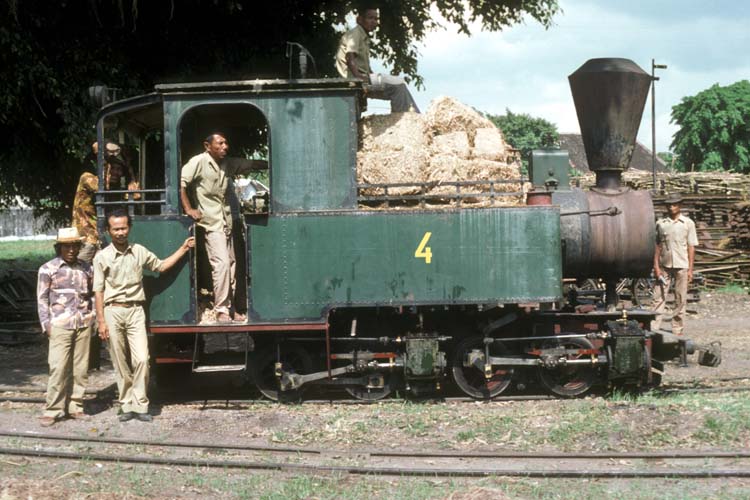
On 3rd
August 1984, Ngadirejo #175 was shunting the delivery yard

The remaining locomotives in this section were delivered
after World War 1.
Mojopanggung #10,
photographed on 2nd June 1978 later became Gempolkerep
5.

Jatiroto 92 had a large fleet of OK Mallets. On 29th May 1979, there
wasn't much activity but 92 was brewing up outside the shed.

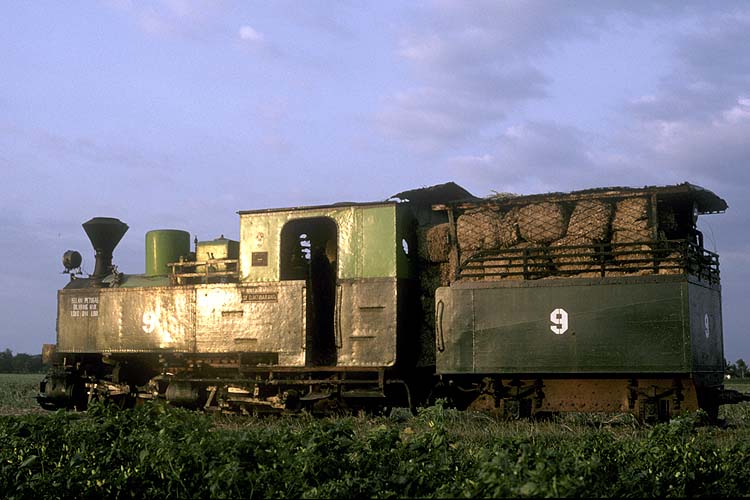
The later Mallets seen above were 80HP machines, Semboro
by contrast had smaller 60HP Mallets, #15 was coming in at speed with a loaded
train on 1st August 1984