|
As with my other solo trip reports, this account is primarily intended to encourage and assist others who may wish to travel |

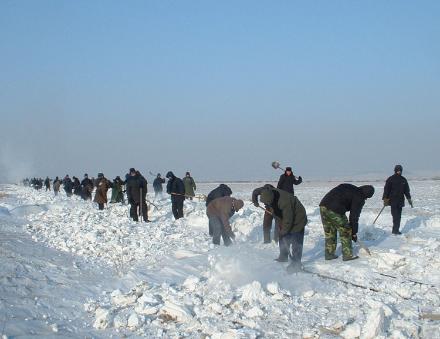
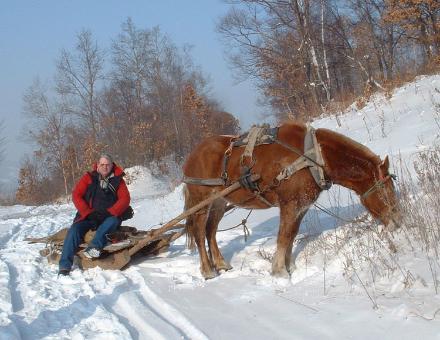
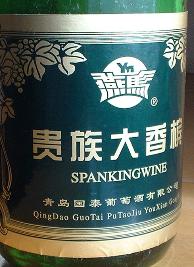
| With deep snow on the ground there was no chance of taking a motorbike taxi to the summit of the line and beyond and so it appeared that the only alternative was a 20km hike to Li Xin and back. I was unwilling to do so for several reasons - firstly the difficulty of walking in deep snow, secondly the potential danger of being out alone in such extreme conditions and thirdly my generic laziness!! However my hosts had alternative plans and having photographed a Huanan bound loaded train shortly after 9.30am on Christmas Day the alternative transport arrived! (see above) The sledge driver took me firstly to the horseshoe curve where it was possible to hear a train climbing all the way up the grade from Tuoyaozi. Due to the nature of the line here it was possible to make two shots of the train as it snaked around the bend. We then continued up and over the summit towards Li Xin. The whole endeavour was then rewarded with a banked train of eight loaded wagons which climbed away from Li Xin and up to the summit, the banking engine then returning to Li Xin to continue to take its own train of empties onwards to Hong Guang. The journey up to the summit had been leisurely as my driver was well aware of the time that the train of empties would reach the summit. However the return journey was a much more lively affair with the snow flying and the horse undertaking a brisk canter for most of the way back down the hill. All in all it was a totally memorable way to spend a Christmas Day in China and given my apparel it was impossible to avoid a few seasonal "Ho! Ho! Ho!"s on the way!! The weather on the 26th took a turn for the worse, with snow clouds and ice crystals filling the air. The sun shone all day although it was somewhat hazy and visibility was considerably less than on previous days. Three more trains ran on the 27th - arriving at Tuoyaozi from Li Xin at 10.25am and 2.20pm and from Huanan at about 11.20am. After a poor start to the day on the 27th - my camera shutter freezing and then totally distorting - the traffic took a sudden dive. Only one steam-hauled train ran in daylight hours - a loaded train from Li Xin at about 10.50am. In the afternoon I met Florian Menius who had arrived on the railcar from Huanan - a ride which had cost two Japanese rail fans Y200 each and for which Florian had been forced to pay Y100. This is clearly a rip-off and can only be avoided by taking a bus to and from the village although these only run to Tuoyaozi in the afternoon and to Huanan in the morning. Taxis cost about 100Y for the journey although this may be negotiable. I left Tuoyaozi on the morning of the 28th. Traffic levels again looked disappointing with the railcar passing through the village at about 10.30am - thus seriously limiting the chances of much steam-hauled action. I therefore wished Florian the best of luck and returned by taxi to Huanan. Once in Huanan it was necessary to visit the supermarket in order to purchase a bottle of wine which had caught my attention earlier in the week. Whether this is simply a case of mistranslation of 'sparkling wine' or something far more interesting is something which I sadly I may never know since I dropped the bottle at check-in on my departure from Beijing!! If anyone is visiting Huanan in the near future and would care to buy and transport back to England another bottle, then my girlfriend and I would love to hear from them!! I caught a bus from Huanan back to Jiamusi and then travelled overnight on Train 1391 (d.17.30) to Siping. The hard sleeper cost Y175. My original plan had been to connect onto Train 4281 to Meihekou. This would have meant a four hour wait at Siping and so I decided to negotiate a taxi instead. After some bargaining this eventually cost Y300 - expensive but allowing me an additional day in Meihekou. Meihekou - December 29th to 31st (Photos) Rather than staying in Meihekou and commuting daily by taxi to the railway, which is some 15 - 20km south of the city, I acted on information provided by Andy Fisher and stayed instead in the surprisingly good Binguan Zhuanyong at Yijing. This is no more than a five minute walk from the main yard and provided an ideal base at Yijing. My room cost Y140 with en-suite facilities although hot water was only available in flasks. The shower had a large water heater which appeared to work but had no water supply. However sufficient flasks were forthcoming when I indicated that I wished to have a bath and they provided a personal guide to the nearest wang-ba. About half way to the station, on the right hand side, is a rather nice family run restaurant - nothing fancy - where the nephew speaks excellent English. The restaurant is located down a small alleyway just before you reach a staircase which runs out into the street. Amongst other things which I learned was that no one would pay more than Y20 for a taxi to and from Meihekou!! To my delight the diesel which arrived in Meihekou in August was out of action and the system was 100% steam with four SY's in use each day. Most traffic seemed to be between Yijing and the mines to the south with only one train seen arriving from Sijing over the three day period. On each of the three days there were two trains a day during daylight hours to and from the exchange sidings at Heishantou. The pattern of working described in Florian's report of December 2003 was not being replicated at the time of my visit and trains seemed to run simply when required. The narrow gauge electric railways were an interesting diversion and at no time was I asked to leave any location. Buses run between the various mines and can be identified by simply holding up the number of fingers to indicated the appropriate mine. Care of course should be taken when wishing to catch a bus to Erjing!!! All locomotives were in the good order indicated in Florian's report and during the three days SY 0791, 1216, 1217 and 1564 were used each day. SY1662 was undergoing maintenance on the depot and SY1445 appeared to be abandoned outside the depot. I enjoyed Meihekou enormously - more so then Nanpiao which I visited last year as photographically the light is better (all locos face south) and there seems more going on. Whilst trains are not as long as at Tiefa and there are less locomotives the action is more concentrated and visitors chosing to stay around the yard at Yijing will rarely be out of sight of at least one or two of the engines. From Yijing I took a taxi to Meihekou and then an overnight hard sleeper to Huludao. Meihekou could not provide me with a sleeper ticket so I simply took a hard seat on Train K75 (d.20.35) and upgraded once on the train at a total cost of Y121. The train took me to Huludao, arriving at 3.43am!! Huludao - Yangjiazhangzi Limestone Railway (Jinxi) - January 1st On arrival in Huludao I booked into a hotel opposite the station (there are several) and took a single room at Y88. After a few hours additional sleep I hired a taxi for the day at Y200 and set out for the Bohai Cement Factory. Simply showing my driver a picture of an SY was enough to get me there and I found SY1415 being prepared for the day. Then we drove to Yangjiazhangzi, having been previously assured by Florian Menius that the fact that it was a public holiday would not affect workings. The CNR crossing keeper at Yetun indicated a train from Huludao at about 11.30 and I used Bernt Seiler's excellent map of this line to locate the summit (although I suspect the turn-off is at Km36.5 and not Km38.5) However my enthusism began to wane after waiting over two hours for a train and eventually I returned to the level crossing south of Sierpu where, following a long phone call, the crossing keeper confirmed there was no service. I retured to the Bohai Cement Factory where JS6243 was stood outside the shed. A visit inside the shed revealed SY0513 (cold) and JS6307 (also cold). Also in the shed was JS6305 in very damaged condition. The tender showed signs of a serious rear end shut and the running plate on the right hand side of the engine was severely fractured and bent. There was also a considerable amount of collateral damage. When I pointed to the Chinese word for 'accident' there ws much shaking of heads. However when I pointed to the damage I was good-naturedly ushered from the shed into the open air. Almost certainly I was asking too many questions. All the evidence suggests a runaway at some time in the recent past. I saw no evidence of JS 8207. On returning to my hotel I decided to purchase my ticket for Train 2177 to Beijing. To my horror I was told that no tickets were available on this train and no other train would get me to Beijing in time for my flight the following morning. Having enquired as to buses (left at 1.30pm) there was no other option than to seek a ticket at Jinzhou (the correct one - see last year's trip report!!) A taxi to Jinzhou Nan cost Y70 and from there I was able to obtain a ticket on Train T94 (hard seat - Y70) which deposited me in Beijing shortly before 10.00pm. Conclusions Although the arrival of diesels at Jing Peng has been a major blow in 2004 there still remains much to see and enjoy in China - particularly if one enjoys contact with Chinese people and their culture. Their kindness, help and general friendliness was universal. A final anecdote - as my train neared Beijing on January 1st the conductor handed me a small piece of paper. On it an unknown hand had written, in English, "It's time to get off the train. This is Beijing Station. Have a good trip! See you next time. Bye!" How can one possibly resist such an invitation? Acknowledgements As always I would like to thank all those whose contributions to the internet helped me in planning and executing my trip and to Duncan Peattie for his work in translating the Chinese Railway Timetable. My especial thanks goes as always to my mage, guide and spiritual advisor, Doctor Rob Dickinson, for arrangements which he made for me at Huanan. I hope he and Yuehong enjoy the cheese and stuffing for the duck!! Also to Florian Menius for his advice and help - particularly with regards to Huludao! - and for assisting me in drinking my beer whilst in Tuoyaozi! It was a pleasure to meet you for the first time Florian and I hope we will meet again soon. To anyone considering a solo trip to China I have one final thought. The total cost was under £750 for two weeks including air fares. Compare that to any of the organised trips offering steam in China. Thinking about going solo? Do it!! |

| ANOTHER SOLO TRIP TO CHINA DECEMBER 2004/JANUARY 2005 Hegang, Huanan, Meihekou and Huludao |