| www. SY-Country .co.uk |
Content | Welcome | News | Trip Reports | Steam Lines | Locomotive List | Travel Tips | Links |
Tonghua, Da`an Bei, Shuangyashan, Jixi, Beipiao, Tongliao, Tongchuan, Pingshi
Florian Menius
reports on a 5-week-steam tour to China between March 5th and April 9th.
The first three weeks, my brother Stephan accompanied me. The rest of the
time I travelled on my own. During the whole trip, we had no guide. In
total 139 steam locomotives were seen working or at least under steam,
most of them CNR engines. Total costs for five weeks in China (including
flights Berlin-Beijing/Hong Kong) were some 2200DM (flight : 1000DM, on
land 1200DM) or about 1100 U$ per person. I do not want to know, what an
equivalent "guided tour" would have cost ...
Introduction
Question : Is it possible that there is a depot housing some 50 QJs in China in the year 2000 and this place is not Daban ? I think, 98 % would say "No ! ". But the correct answer is "Yes" ! It is Da`an Bei.
Summary :
| Tonghua : | fine JS mainline action |
| Da`an Bei : | paradise of steam !! |
| Shuangyashan : | QJ hauled passengers + coal trains |
| Jixi : | no CNR steam, SY and JS in use in different coal mines |
| Beipiao : | still steam, but low traffic levels |
| Tongliao-Xinlintun : | 30-40 % of freights still QJ hauled |
| Tongchuan : | further dieselisation, 4 DF7 present now !! |
| Pingshi : | still 100% steam |
Tour Details :
March 5th, Sunday
I arrived at Beijing Capital Airport on board BA 39 from London Heathrow
at 10:35 .Stephan should have arrived some one and a half before on board
KL 897 from Amsterdam. But KLM arrived some 2 hours late around 11:00 due
to baggage problems in Amsterdam (seems to be KLM`s major problem nowadays
: when he flew back to Germany his baggage was forgotten at Amsterdam ...).
We took the airport bus to the International Hotel (fare 16 Yuan) and
walked to Beijing main station.
At the "foreigners ticket counter", we had no problems to get hard
sleeper tickets (164 Yuan/ person) for train 537 to Tonghua, departure
17:20. Before sunset (around 18:15), no steam was seen. After darkness,
neither at Jinzhou and Dahushan nor at Huanggutun, any steam was visible.
March 6th, Monday
After sunrise (around 7:00) - some 40 km beyond Siping : the same as before : absolutely no steam between Siping and Meihekou and on the line towards Tonghua. Sun was shining, snow covered fields and hills, but sadly no steam.
At 11:32 we arrived at Tonghua where we were greeted by 3 JS (8154,
8158, 8201) waiting at the depot or shunting in the station. We checked
in at the GuoMaoHotel, situated to the right opposite to the station. Double
was 120Yuan.
Tonghua still has got a fleet of some 20 JS. All "old" JS (5xxx series)
seem to have big deflectors whilst the "new" locomotives (8xxx series)
have either no (8154, 8155, 8211, 8231, 8233, 8234) or high deflectors
(8158, 8201). The deflectorless engines are predominantly used as pilots
at Hunjiang and Tonghua or for tripping locals freights e.g to Dongtonghua,
Xintonghua or to Hunjiang power plant. Line work is in the hand of deflectored
engines. Each 3 days north and south of Hunjiang showed the following pattern
of working :
Tonghua-Hunjiang : Both freight and passenger trains
have a quite unpredictable mix of DF4, DF5 and JS. In general some 50 %
of freights are JS worked. In the early morning, there is a tender first
working from Tonghua (leaving between 6:00 and 9:00) towards Hunjiang serving
the local factories and mines, e.g at Daoqing and Guyuan along the line.
This train arrives at Tonghua between 12:00 and 14:00 (engine funnel first).
Another quite reliable steam hauled train is an afternoon freight from
Tonghua to Hunjiang, leaving around 15:30. In the afternoon there are fewer
freights than in the morning. The 15:30 freight is often the only steam
hauled freight between noon and sunset.
Passenger workings are quite unpredictable. Some trains were diesel
worked every day during the visit. Unfortunately, these trains are in the
best light around noon. For details see table below and Tonghua
Timetable . Two general rules :
Trains on the line towards Ji`an are quite unlikely to be steam hauled
with the exception of T791/792 Tonghua-Guosong-Tonghua.Trains having a
stop of more than 7 minutes at Hunjiang can change locos. But sometimes
there is no change of engines, too. T 803 for example has a pause of 14mins
at Hunjiang, but does not change loco.
In addition to the trains published in the current CNR timetable, trains
665/666 Shenyang Bei-Tonghua start and terminate at Quanyang (Hunjiang-Baihe
line) now. T665 has been retimed between Shenyang and Tonghua, too.
T 665 : Shenyang Bei (appr.7:30 - 8:00) - Tonghua
(appr.17:25) - Hunjiang 18.52 - Quanyang ?
T 666 : Quanyang ? - Hunjiang 10.12 - Tonghua 11:52
- Shenyang Bei 20:37
Tonghua departures :
(If nothing different indicated : diesel = DF5)
|
|
|
|
|
|
|
|
|
|
|
|
|
|
|
|
|
|
|
|
|
|
|
|
|
|
|
|
|
|
|
|
|
|
|
|
|
|
|
|
|
|
|
|
|
|
|
|
|
|
|
|
|
|
|
|
|
|
|
|
|
|
|
|
|
|
|
|
|
|
|
|
|
|
|
|
|
|
|
|
|
|
|
|
|
|
|
|
|
|
|
|
|
|
|
Tonghua arrivals :
|
|
|
|
|
|
|
|
|
|
|
|
|
|
|
|
|
|
|
|
|
|
|
|
|
|
|
|
|
|
|
|
|
|
|
|
|
|
|
|
|
|
|
|
|
|
|
|
|
|
|
|
|
|
|
|
|
|
|
|
|
|
|
|
|
|
|
|
|
|
|
|
|
|
|
|
|
|
|
|
|
|
|
|
|
|
|
|
|
|
|
|
|
|
|
Most scenic section is the area between Daoqing and Guyuan (8 km south of Daoqing). Furthermore, both river bridges some 2 km south and north of Dongtonghua are photogenic.Dongtonghua-Shuidong section is quite nice, too but not very spectacular. When going to Dongtonghua, take Bus No. 3 (leaving in front of Tonghua station). Fare is 0.6 Yuan. Bus No. 3 operates between 06:00 and 18:30. Daoqing can be reached by bus (Tonghua-Baishan(Hunjiang) ) or by passenger train.
Hunjiang-Songshuzhen-Baihe : North of Hunjiang, nearly all freights are steam hauled, some of them double headed. But every day, one DF5 was on freight duties, too. No DF4 was seen hauling a "real" freight, but hauled the mixed Songshuzhen-Hunjiang train in the morning. As reported previously, there is a very reliable freight departing from Hunjiang between 08:00 and 08:30. Freight arrivals and departures at Hunjiang are to be (+/- 30-60 min):
Trains indicated (L) are local trains to Sanchazi or Zazi and arrive
tender first at Hunjiang. Other trains go further on towards Dayangcha/
Songshuzhen, but keep in mind that at least one of these trains will be
DF5 hauled !
Worst case is, when the 08:15 (classic) departure has got a DF5 due
to the fact, that the 16:00 returning (in the best light) will have the
same engine, too.
Passengers : During daytime, there are 4 passenger trains each direction. T 955/956 Hunjiang-Songshuzhen are not published in CNR timetable.
Apart from the "classic" Hunjiang spot at the river bridge just north
of the station good photo possibilities can be found some 6 km north of
Hunjiang and along the following 4kms to the station of Zazi. To get there,
take one of the frequent buses running over the new "highway" and leave
the bus at the tollgate near the road tunnel.
Furthermore, the "classic" locations around Dayangcha (27kms north
of Hunjiang) offer great photo spots. Take one of the buses northwards
and get off at Sanchazi. North of the "city" of Sanchazi, the road to Dayangcha
leaves the "highway". About every 60 - 90 min, there is a minibus to Songshuzhen.
Alternatively catch a taxi at Sanchazi.
Back to the tour (March 6th) :
After a little pause, we went out to explore. At first we visited the western end of Tonghua station near to the depot and the junction of the branch line to Xintonghua. JS 8154 (nd) was shunting there. Then, we walked to the eastern end of Tonghua station and further on the 8 km to Dongtonghua.The following trains were observed :
| T646 | 14:30 | DF4 4125 | sb, to Shenyang Bei |
| G | 14:55 | JS 5751 | nb |
| G | 15:00 | JS 5480 | sb |
| T806 | 15:15 | DF5 5009 | sb, to Tonghua |
| T652 | 15:50 | DF5 1256 | sb, to Tonghua |
| T803 | 15:50 | DF5 1194 | nb, to Songshuzhen |
At Dongtonghua, SY 0311 and GK1 0028 were serving the steelworks while
JS 8211 (nd) was CNR shunter. Temperature was down to some -10°C, but
a strong wind blew. By 16:30, sunlight failed. So we decided to give up
and walked back to the road to catch bus No.3 back to Tonghua. While waiting
for the bus, an unidentified JS passed through Dongtonghua station hauling
a freight towards Hunjiang.
Around 17:00, we arrived at Tonghua. We had planned to have a look
at T 791 (Tonghua-Guosong, dep. 17:25 according to CNR timetable), but
we had to realise, that it now leaves 30 min earlier at 16:55 (and had
left Tonghua a few minutes before our arrival).
March 7th, Tuesday
We left the hotel at 6:30 and walked to the S-bend north of Tonghua station. Again some -10° C, clear sky and sunshine in the morning.
| T 792 | 07:05 | JS 5751 | sb, from Guosong |
| G | 07:20 | DF5 1194 | sb, from Hunjiang / Ji`an |
| T 804 | 08:00 | JS ? | sb, from Songshuzhen |
JS 8155 (nd) was pilot at the northern end of Tonghua station. We took Bus No.3 to Dongtonghua. At the river bridge some 2 km north of Dongtonghua, we started our linesiding session. During the day, we walked to Shuihe (8kms from Dongtonghua) and return. The following trains were observed :
| T 645 | 09:00 | JS ? | nb, to Baihe |
| G | 09:10 | DF5 ? | nb |
| G | 09:30 | JS 5751 (tf) | nb |
| T 801 | 11:00 | DF4 4124 | nb, to Quanyang |
| T 666 | 11:05 | DF4 4160 | sb, to Shenyang Bei |
| G | 11:25 | JS 5485 | nb |
| G | 11:35 | DF5 5010 | sb |
| G | 13:15 | JS 5480 + JS 6366 (tf) | sb |
| G | 13:30 | DF4 4033 | sb |
| G | 14:15 | JS 5751 | sb |
| T 646 | 14:30 | DF4 4125 | sb, to Shenyang Bei |
| G | 14:45 | DF5 1695 | nb |
| G | 15:30 | JS 6360 | nb |
| T 806 | 15:50 | DF5 1193 | sb, to Tonghua |
| T 803 | 16:00 | DF5 5010 | nb, to Songshuzhen |
| T 652 | 16:30 | DF5 1516 | sb, to Tonghua |
| T 802 | 17:20 | DF4 4232 | sb, to Tonghua |
As said above : After 14:00 no steam except of the 15:30 departure. We arrived at Dongtonghua station at 17:45. Today, JS 5751 was Dongtonghua pilot; the steelworks had GK1 0036 and 0091 in use. Furthermore, JS 8211 was waiting in the station, heading a Dongtonghua to Tonghua local freight. Sunset around 17:45; back to Tonghua by bus No.3.
March 8th, Wednesday
Dull light all the day. Heavy wind in the afternoon, combined with some snowfall and rain. Another morning at Tonghua northern end :
| T 792 | 07:05 | JS 5480 | sb, from Guosong |
| G | 07:20 | JS 5731 | nb |
JS 8155 was shunting again. JS 6271 was waiting at the platform for
its wagons. It hauled Fast 645 to Baihe (dep. 08:41). We bought tickets
to Hunjiang. Unfortunately, due to a misunderstanding, we got tickets for
T 651 (Tonghua-Dalizi, dep. 08:13) instead of those ones for T 645. The
lady at the counter did not understand, why we wanted to get tickets for
the later train ... Ten minutes late, at 08:23, T 651 left Tonghua, hauled
by DF5 1193, while JS 6271 was waiting next to us ...
On the way to Hunjiang, T Y257 (JS 8158) and T 803 were crossed at
Dongtonghua and Tonghua respectively. At Daoqing, JS 5751 was waiting (light
engine); at Hunjiang Xi a DF5 hauled freight was crossed. Arrival at Tonghua
at 09:33 (still 10 min late). The hotel just outside the station refused
to give us a room. So we had to go to Baishan Shi Binguan, situated near
the city centre of Baishan some 3 km south of Hunjiang station. A taxi
is 5 Yuan. Taking Bus No. 1 is the cheaper option (0.6 Yuan) It operates
between 06:00-18:00. Leave the bus, after you have crossed the river. Walk
some 100m back and you will find the hotel. Comfortable double is 200 Yuan.
Expensive, but good.
At 11:00, we left the hotel and walked back to the station and further
on towards the river bridge. First steam locomotive, we saw at Hunjiang
was JS 8234 (nd) returning light engine from the power plant at 12:00.
The about 1 km long branch line to the power plant starts at the northern
end of Hunjiang station but leaves the northern part of the station to
the south. About half way, there is a river bridge followed by a some 300m
long steep grade. After this grade, the power plant`s yard is reached.
The power plant has got a GK diesel as pilot. The power plant is served
several times a day. Maximum number of full coal wagons is 12 wagons. So
most trains have to be split. The power plant is served by the northern
end Hunjiang pilot (it was JS 8234 every day). Furthermore there is a hump
yard pilot (JS 8233) while a third engine (JS 8231) is shunting and serving
the factories at the southern end of Hunjiang station. At the river bridge,
the following trains were seen :
| G | 12:30 | JS ? (tf) | sb |
| T 801 | 12:40 | DF4 4232 | nb, to Quanyang |
| G | 13:10 | JS 6104 (tf) | sb |
| T 646 | 13:30 | DF4 4125 | sb, to Shenyang Bei |
| G | 13:40 | JS 6271 | nb |
The departure of JS 6271 (obviously, it had left T 645 at Hunjiang)
was the only photo of the day with sunshine ... After this, we walked back
to the yard, where the three pilots (JS 8231, 8233, 8234) plus JS 8158
(hd) were present. The crew of JS 8234 invited us to the cab. At first
we pushed back some 12 wagons to the very northern end of Hunjiang yard.
The coal wagons were dedicated for the power plant. Then, Stephan was invited
to go to the regulator ... The first time driving a JS on his own, he had
to climb up the grade to the power plant hauling a maximum-weight-train
of some 1000 t ... Quite impressive ! I should have been outside and taken
a video of the scene ... The following two hours, we spent on board of
JS 8234 shunting at the power plant`s yard, collecting some empty wagons
at the power plant, returning to Hunjiang, serving a factory at the northern
end of the station and then a second time tripping 12 coal wagons to the
power plant. In the end, JS 8234`s crew was quite impressed, how soft Stephan
coupled the engine to some wagons ... Normally, Chinese crews drive until
hearing the "ruuummms".
While serving the power plant for the first time, a high-large-deflectored
combination (JS 8158 [hd]+ JS 5731) left Hunjiang hauling a freight in
direction to Baihe (15:00). Being at the power plant for the second time,
T 955 (Hunjiang 15:43-Songshuzhen 18:16) left the station, hauled by JS
6104.
After our "driving session", we walked to the crossing between the
station and the locomotive service area south of Hunjiang station. Four
JS came along within 15 min (all light engine) : "our" JS 8234, 8231, 8233
and 5751.
March 9th, Thursday
In the morning, we took a taxi to the river bridge (10 Yuan) where we arrived just at the moment when the 8:15 freight left the Hunjiang yard. Running up the hill, we just got the train.
| G | 08:15 | JS 6366 | nb |
After that, we started walking along the track towards Zazi. Sadly, the T 956 mixed was DF4 hauled :
| T 956 | 08:50 | DF4 4033 | sb, Songshuzhen - Hunjiang |
| G | 09:00 | JS 5731 | nb |
Some 2.5 km north of the river bridge, the track joins the "highway", where we picked up a taxi to Dayangcha (50 Yuan). Journey time was about 45 min. We arrived at Dayangcha at 10:10. The day was spent walking down the 9 km to Sanchazi :
| T 645 | 10:50 | DF4 4158 | nb, to Baihe |
| G | 11:40 | JS 6271 | sb |
| T 646 | 12:50 | DF4 4125 | sb, to Shenyang Bei |
| T 801 | 13:20 | DF4 4232 | nb, to Quanyang |
| G | 14:05 | JS 6104 | nb |
| T 802 | 14:30 | DF4 4124 | sb, to Tonghua |
| G | 14:50 | DF5 1695 | nb |
| G | 15:40 | JS 5731 | sb |
At Sanchazi, JS 5855 was shunting and served two branch lines to coal mines. Both lines leave Sanchazi station to the north. Each of them is some 2 km long. Then :
| T 955 | 16:20 | JS 5731 | nb, to Songshuzhen |
At 17:00, sun disappeared behind the mountains. So we went back to the "highway" and caught a taxi back to the hotel (20 Yuan). From the taxi, we saw a freight heading for Dayangcha arriving at Sanchazi (17:10) and JS hauled T 803 (Tonghua-Songshuzhen) near Hunjiang.
March 10th, Friday
Got up early at 05:15. Local bus No. 1 starts not before 06:00. So we had to take a taxi to the station (5Y). We took T 804, departure 06:05 and went to Daoqing (2 Yuan). T 804 arrived JS hauled (tender first !) at Hunjiang, but motive power was changed to DF 5 5010. Arrival at Daoqing at 06:42.
| T 807 | 07:15 | JS 5858 | nb, to Linjiang |
| G | 07:35 | JS 6306 (tf) | nb |
| T Y258 | 07:45 | JS 6366 | sb, to Shenyang Bei |
JS 6306 was shunting some 30 min at Daoqing and collected some wagons. It served the 500m long branch line to the coal mine south of the station, too. After its departure in the direction to Hunjiang (around 08:10), we left Daoqing. The rest of the day was spent on the 8 km - long section Daoqing - Guyuan. The summit is situated about 3 km south of Daoqing, but the steepest section just south of the summit - featuring a grade of 1.9 % - is treated by poles and nearly not useable if you want to take photos. 2 km south of the summit, there is a river bridge, whereas the following 3 km to Guyuan are unattractive.
| T 808 | 08:45 | DF5 1695 | sb, to Tonghua |
| T 651 | 09:00 | DF5 1193 | nb, to Dalizi |
| T 645 | 09:30 | JS 8158 | nb, to Baihe |
| G | 10:05 | JS 5858 | sb |
| G | 10:20 | DF5 5010 | nb |
| T 666 | 10:45 | DF4 4160 | sb, to Shenyang Bei |
| G | 11:00 | DF4 4124 | sb |
| G | 11:15 | JS 6306 | sb |
| T 801 | 11:40 | DF4 4033 | nb, to Quanyang |
| constr.train | 11:50 | 2 railbuses | sb |
| G | 12:20 | JS 6366 | nb |
| G | 13:05 | DF5 1695 | nb |
| T 646 | 14:10 | DF4 4125 | sb, to Shenyang Bei |
| T 652 | 15:25 | DF5 1193 | sb, to Tonghua |
| G | 15:45 | DF5 5010 | sb |
| G | 16:15 | JS 5858 | nb |
Again : No steam train between 12:20 and the 15:30 freight ex Tonghua.We took T 803, departure 16:28 back to Hunjiang. To our surprise, it was steam hauled (JS 5485). At Hunjiang the JS was not replaced. So, JS 5485 must have hauled T 803 all the way from Tonghua to Songshuzhen.
March 11th, Saturday
We took the bus to Hunjiang station and bought hard sleeper tickets for T 220 (Hunjiang 20:13-Changchun 05:03) for the evening (79 Yuan). Today, all passenger trains were 20 to 30 minutes delayed. Again, a morning session at the river bridge :
| T 808 | 07:57 | JS ? | sb, to Tonghua |
| G | 08:25 | JS 5731 | nb |
| T 956 | 09:20 | DF4 4231 | sb, from Songshuzhen |
| T 666 | 10:15 | DF4 4160 | sb, to Shenyang Bei |
| T 645 | 10:25 | DF4 4158 | nb, to Baihe |
| G | 11:10 | JS 6306 | nb |
We walked along the track to the scenic section near the road tunnel. Some 3 km north of river bridge, where the road and the railway are parallel to each other, you can see the (electrified) Hunjiang narrow gauge railway winding around the hill to the west of this place. Sightings :
| G | 11:45 | JS 5855 (tf) | sb |
| G | 12:30 | JS 5485 | sb |
| T 801 | 12:55 | DF4 4124 | nb, to Quanyang |
| T 646 | 13:45 | DF4 4125 | sb, to Shenyang Bei |
| G | 14:10 | DF5 1695 | nb |
| G | 15:00 | JS 5855 | nb |
| G | 15:20 | JS 6271 (tf) | sb |
| T 802 | 15:35 | DF4 4232 | sb, to Tonghua |
| T 955 | 16:00 | JS 5485 | nb, to Songshuzhen |
| G | 16:40 | JS 5731 | sb |
| G | 17:00 | JS 6366 | nb |
| T 803 | 17:45 | JS 5858 | nb, to Songshuzhen |
After T 955, we started walking back to Hunjiang. T 653 arrived behind DF5 (19:40). It went round and headed T 220 back to Tonghua, dep. 20:13.
Engines seen at Tonghua :
| JS | 5480(ld), 5485(ld), 5731(ld), 5751(ld), 5855(ld), 5858(ld), 6104(ld), 6271(ld), 6306(ld), 6360(ld), 6366(ld), 8154, 8155, 8158(hd), 8201(hd), 8211, 8231, 8233, 8234 |
| DF4 | 4033, 4124, 4125, 4158, 4160, 4231, 4232 |
| DF5 | 1167, 1193, 1194, 1256, 1516, 1695, 5009, 5010 |
| SY | 0311 (Dongtonghua steelworks) |
| GK1 | 0028, 0036, 0091 (all Dongtonghua steelworks) |
March 12th, Sunday
Arrival at Changchun at 05:03. Bought hard seat tickets for T 825, departure 06:30, arrival at Da`an at 11:24. T 825 got fuller and fuller and arrived overcrowded at Da`an.
On the way from Changchun to Da`an, a DF4 hauled freight was crossed at Kai`an (07:15), T Y272 at Nong`an (DFH3 0446, 08:00), two further freights at Wangfu 09:11 (DF4 1503, QJ 3179) and T 212 (DFH3 0184, 10:02) at Qianguo. At Qianguo, two high deflectored steam locomotives were shunting. Qianguo has a small depot west of the station, where a QJ (standard deflectors) was waiting. Some 4 km west of Qianguo a branch line extends south to refinery. At the junction to this branch line, there is a large yard, too. At Tongtu (10:20), a QJ+QJ double headed tanker train was crossed. East of Changshantun station, a branch line extends to a large factory. Changshantun station has got a yard, too and is destination for some freights, too. At the western end of Changshantun station, there is a servicing area (water cranes, coal supply). There is even a turntable there ! About 1.5 km to the east, a nice river bridge can be used as photo spot. Next to the bridge, there is a derelict building. Climbing onto the ruins, you have the best linside spot of the whole area ...
The city of Da`an is situated next to the station of Da`an whereas Da`an
Bei station (Da`an North station) is situated some 3 km south-west ( !
) of Da`an. We checked in at the Da`an Shi Binguan (double 200Y for the
first two nights, the third night was 100 Yuan ). Just around the corner,
there is a second hotel but it was not checked.
At Da`an Bei station, there are three lüdians : the grey building
just right outside the station is the first one. If you turn right the
two further buildings showing the CNR symbol are the two other ones. Single
room is 30 Yuan there. Between 06:00 and 18:00 there is a frequent bus
service between Da`an Bei and Da`an City (Bus No.5). It stops directly
in front of the Da`an Shi Binguan and terminates at Da`an Bei. In the streets
of Da`an you will find plenty of restaurants offering grilled meat-sticks.
Together with Jiaouzi (available everywhere), home made noodle soap and
11% beer a wonderful possibility for having dinner.
Da`an Bei shed is situated north of the station. Between the shed and the station, there is a crossing : a perfect place for watching trains and steam movements.
Da`an Bei has got a fleet of some 50 QJs and some 5 JS
. Predominantly, they haul freights between Ranghulu, Da`an Bei and Taipingchuan.
On both lines, you can expect about 15-20 QJ hauled freights during daylight
hours. But expect up to 4 goods trains DF4 hauled. Hardly any freight has
less than 40 wagons with 42 to 45 wagons being "standard". If loaded, that
means trains of more 3000t ! Most trains are single headed. During
6 days of observation, only 3 double headed trains could be noted.
Da`an Bei`s green DF4s are built between 1989 and 1990. Probably, they
have been cascaded to Da`an from elsewhere. Orange DF4s can be seen, too.
They are Tongliao based and even older than the green ones : 1986-1988.
Furthermore, Baicheng based DF4 and DFH3 from Changchun can be seen at Da`an
Bei.
Traffic on the line to Qianguo/ Changchun is slighter : about 5 to
6 freights each direction between Da`an Bei and Changshantun can be expected.
The line to Baicheng hardly will see more than 2-3 freight trains each
direction. Interesting detail : each line seems to have its "own" locomotives.
So you will nearly see the same engines on a particular line every day.
Occasionally, there seems to be a lack of QJs. As of this reason Da`an
Bei`s "monster trains" sometimes have to be hauled by JS, single JS, of
course !! Have you ever seen a JS trying to accelerate a 3000t tanker
train ? Wow !
If working on the line the JS are predominantly used on the line to
Qianguo/Changchun or towards Baicheng but in one occasion, a JS was seen
heading a (loaded) freight towards Taipingchuan, too. In direction to Baicheng
and Qianguo, JS can be seen hauling passengers trains, too. The five wagon-tourist
train Y267/Y268 Qianguo-Baicheng is quite likely to be a JS duty. Furthermore,
JS are used as pilots at Da`an Bei (2 engines) and probably at Qianguo,
too. The JS are either high deflectored or have no deflectors.
In addition to the freights, there is also a number of passengers
(QJ, sometimes JS, too) :
The line towards Qianguo/ Changchun offers only
two trains (but they were steam hauled every day) :
Amazing : You are not allowed to buy tickets and to board these trains at Da`an Bei.
The line towards Ranghulu has 2 pairs of passengers, both quite likely to be steam hauled (but can be DF4, too). Timings for Da`an Bei are :
Most steam passengers can be found on the line to Baicheng. Steam departures observed :
The line to Taipingchuan has only three pairs of passengers at all : Out of them, both the nb and sb express trains Hangzhou-Qiqihar run during the night (DF4 hauled), whereas T 703/704 Qiqihar-Tongliao are DF4 hauled south of Da`an Bei (orange Tongliao based DF4). The only steam hauled passengers are T 951/ 952 Da`an Bei-Taipingchuan. They operate as mixed trains (3 YZ at the end of the train) with longer stops at some intermediate stations (Qian`an for example). T 951 leaves Da`an Bei early in the morning at 06:05. The same engine arrives back at Da`an Bei at 20:19, hauling T 952.
Major problem around Da`an is the lack of photo possibilities
combined with unfavourable weather conditions : All four lines radiating
from Da`an Bei have poles on both sides. There is a (fine) old style telegraph
pole normally in a distance of some 30 metres to the track. But the telegraph
poles are not the problem. It is the 3-wire-telephone pole. The telephone
poles are nearly everywhere immediately next to the track and normally
on the other side of the track than the telegraph poles. On the line Ranghulu
to Taipingchuan line, the telegraph poles are normally on the eastern side
of the line, the telephone poles to the west. So, the morning would be
the best time for photography, when you can use the 30 metres spare place
between track and the telegraph poles.
But : There seems to be a strong wind from the west nearly at any time.
And the direction of the wind seems to be constant, too, as all trees are
cambered to the east. So, the exhaust ever goes to the west, and this is
exactly where you have to stand in the morning ... In the morning, the
trains are hidden behind the engine`s exhaust, in the afternoon behind
the telephone poles ...
Furthermore, the landscape is absolutely uninspiring. There are hardly any bends. Straight line for up to 20 km is not unusual. Maximum grade, I noted, was 0.4%. This "climb" can be found some 5 km south of Da`an Bei and is against northbound (empty) trains.In general, you can find not more than 4 different motifs :
The big river bridge some 5 km north of Da`an Bei is hardly not photographable, too. It is a positive (iron made) bridge and heavily guarded. Probably the best photo spot in the area is the bridge west of Changshantun, where you can find two bends plus some rows of birches one kilometre further west ...
Back to the tour (March 12th) :
After having refreshed at the hotel, we left the city to the northwest as we thought Da`an Bei station would be somewhat north of the city. Soon, we had to realise that it is southwest of Da`an city ... In the end, we arrived at "the Da`an Bei" crossing not before 15:00. This crossing is situated exactly between the station and the depot north of the station`s yard. JS 6237(hd, 1982 built), QJ 6367 and QJ 6882 were waiting next to the shed`s entrance. Decorated, deflectorless JS 6239 shunted at the northern end of Da`an Bei (southern pilot was high deflectored JS 6096). QJ hauled freights every 30mins ! Where else in China can you see such an spectacle !
| G | 15:25 | QJ 6112 | to Ranghulu |
| G | 15:30 | QJ 6554 | from Qianguo / Changchun |
| G | 16:00 | QJ 7173 | from Ranghulu |
| G | 16:05 | QJ 6367 | to Ranghulu |
| G | 16:30 | JS 6237 | to Qianguo / Changchun |
| G | 16:55 | QJ 7113 | to Ranghulu |
The departure of JS 6237, accelerating 44 loaded tank wagons was the
most spectacular sight, I have ever seen !
In the meantime, several engines went in and came out of the shed :
DF4 3316, QJ 6554, QJ 6143(d), QJ 6825, QJ 7113, JS 6096
We went back to the hotel using a three-wheeler (5Y).
March 13th, Monday
Having seen the amount of trains on the line to Ranghulu, we decided
to visit this line. So we took T705 Da`an Bei-Ranghulu, dep. 06:20 ( DF4
hauled ). At Tashihai and Xinzhan, QJ hauled freights were crossed, another
one overtaken at Xinzhan. We went to Taiyangshen, 56 km north of Da`an
Bei. The whole day was spent between Taiyangshen and Lizhi, the next station
to the north. Measured by Da`an`s standards, the line is "highly spectacular"
here. There is a big salt lake just west of Taiyangshen. Furthermore, there
is a wide bend 1 km north of Taipingshen, followed by a cutting, then rows
of birches, Grades of up to 0.3% and 2 level crossings. After 3 km straight
line, a second bend is reached.
But the very best there is, that due to the bends, the telephone poles
are some 10 metres away from track and sometimes even hidden behind the
birches ! Sightings:
| G | 08:20 | QJ 7113 | sb |
| G | 08:25 | DF4 3284 + DF5 1763 | nb |
| G | 08:50 | QJ 6852 | nb |
| G | 09:20 | QJ 6484 | nb |
| light engine | 09:45 | QJ 6924 | nb |
| G | 10:00 | DF4 3283 | sb |
| T 581 | 10:10 | DF4 6075 | nb, to Qiqihar |
| T 704 | 10:40 | QJ 7081 | sb, to Tongliao |
| light engine | 10:55 | QJ 6586 | nb |
| G | 11:15 | QJ 6554 | sb |
| G | 12:50 | QJ 7173 | sb |
| G | 13:40 | QJ 6112 | nb |
| G | 13:50 | DF4 3315 | nb |
| G | 14:05 | DF4 1098 | sb |
| G | 14:35 | QJ 6887 | sb |
| G | 14:50 | QJ 6367 | nb |
| T 703 | 15:00 | QJ 7081 | nb, to Qiqihar |
| G | 15:20 | QJ 6809 | sb |
| G | 15:45 | QJ ? | nb |
At 15:50, we took Fast train 548 back to Da`an Bei. QJ 6809 was overtaken at Taipingshen (waited there), QJ hauled trains were crossed at Taipingshen (unidentified, rolled in behind QJ 6809`s train), Xinzhan (QJ 6847), Jianmen, Tashihai and Da`an Bei. After arriving, we went to the crossing to the north again. We hoped for QJ 6809, hauling a complete train loaded with wood (must have been a whole forest ! 46 wood-loaded wagons !). But sadly, it did not appear before sunset (17:45). Instead of, JS 6096, 6239, QJ 6379, 6368 and 6571 were noted. T 211 Changchun-Baicheng arrived behind DFH3 0184 (17:20).
March 14th, Tuesday
A second day was spent on the Ranghulu line. We went to Xinzhan, where
a flat bridge can be found some 2.5 km north of the station. It crosses
a salt lake. A bridge is the only photospot, which cannot be found at Taiyangshen.
But the telephone poles (to the west side) are very, very close to the
track here. Combined with the wind, morning photography is ruined, too.
We took Fast T 581 Dalian-Qiqihar, leaving Da`an Bei at 9:06 arriving
Xinzhen at 09:35. At Xinzhen, you can hire horse-powered "taxis" outside
the station waiting for the arrival of trains. Sightings :
| G | 10:35 | QJ 6554 | sb |
| G | 10:50 | DF4 3315 | nb |
| light engine | 11:10 | QJ 6361 | nb |
| T 704 | 11:30 | QJ 7081 | sb, to Tongliao |
| G | 11:45 | DF4 3283 | nb |
| G | 12:40 | QJ 6887 | sb |
| G | 12:55 | QJ 7173 | nb |
| G | 13:20 | DF4 3284 | sb |
| G | 13:40 | QJ 6361 (tf) | sb |
| G | 13:50 | QJ 6847 | nb |
| T 703 | 14:30 | QJ 7081 | nb, to Qiqihar |
| G | 14:50 | QJ 6484 | sb |
| G | 15:15 | QJ 6809 | sb |
| G | 15:30 | QJ 6554 | nb |
| G | 16:05 | QJ 6887 | nb |
| G | 16:30 | QJ 7113 | nb |
Again, we returned to Da`an Bei on board Fast T 548 Harbin-Ulanhot, dep. 16:39 (half an hour late). A short visit to Da`an Bei`s "Northern Crossing" showed : JS 6096, 6239, QJ 6086, 6143, 6280
March 15th, Wednesday
Originally, we had planned to visit the Baicheng line. We had wanted
to ride the Y267 tourist train, dep. 07:38 to Guang`an. Arriving at the
station, we realised, that the Y267 train was neither listed on the board
nor the ticket counter sold tickets. But : on time - at 07:33 - Y 267 arrived
and it was hauled by deflectorless JS 8045. But we were not allowed to
enter the train !
So we decided to have a look to the southern end of Da`an Bei`s yard
where a new road overbridges the railway. There, we observed both the lines
to Taipingchuan and Baicheng :
| T 212 | 08:35 | DFH3 0065 | from Baicheng |
| G | 08:50 | QJ 7119 | from Taipingchuan |
| G | 09:30 | QJ ? | from Baicheng |
| G | 09:30 | JS ? | to Taipingchuan |
| G | 09:55 | QJ 3287 + QJ 6825 | from Taipingchuan |
It was obvious, that the line towards Taipingchuan would offer more trains. So we walked down some further 3 km towards Jianshe. Here - in direction to Jianshe - a 0.4% grade against northbound trains begins, whereas southbound trains leaving Da`an Bei station are worked hard to accelerate the trains until this point. So to say, this is a kind of "summit" here. Furthermore, the telephone poles are installed some 15 metres away from the track here, sometimes hidden behind the birch rows and - although only for a few hundred metres - to the east side of the line together with the telegraph poles.
| G | 10:50 | QJ 6086 | sb |
| G | 11:35 | QJ 3251 | nb |
| T 704 | 12:35 | DF4 0670 | sb, to Tongliao |
In the meantime, we saw the exhaust of a steam engine leaving Da`an Bei towards Baicheng at 11:45. This must have been T 825 Changchun-Baicheng. So, we decided to watch the return working T 826 and walked back to the Baicheng line.
| T 826 | 13:30 | QJ 6848 | from Baicheng |
Rest of the day was spent at the Taipingchuan line again :
| G | 13:45 | QJ ? | nb |
| G | 14:20 | QJ 7102 | nb |
| G | 14:45 | QJ 6586 | nb |
| G | 15:05 | QJ 6156 | sb |
| G | 15:20 | QJ 7119 | sb |
| G | 15:50 | QJ 6825 | sb |
| G | 16:10 | QJ 6571 | nb |
| G | 16:50 | QJ 3251 | sb |
Now, we had arrived back at Da`an Bei station :
| T 548 | 17:00 | QJ 6848 | to Baicheng |
| G | 17:10 | QJ 6891 | to Taipingchuan |
JS 6096 was the southern end pilot. The crew invited us to the cab and
we spent the next hour hump shunting at Da`an Bei. After telling the crew,
that Stephan had driven a JS before, he was allowed to drive JS 6096. This
time, he had to accelerate one of those 45 wagon-freights (I do not know
whether loaded or not, but according to the maximum speed of some 2 km/h
and permanent wheelspin, it must have been a loaded one ...) But even JS
6096`s crew did not reached a higher speed with this train. Compared with
JS 8234(Hunjiang) JS 6096 was in worse condition : the regulator did not
work well. You could open it half way, but nothing happened. Instead of,
the engine had to be driven using a maximum regulator`s amplitude of some
2 centimetres somewhere around the middle position of the regulator. At
18:30, we left JS 6096. While walking back to the station, JS 8045 arrived,
hauling tourist train Y268 to Qianguo.
After dinner (meat sticks and jiaozi, the same as the 2 days before)
we picked up our luggage at the hotel and went to Da`an Bei station, where
we took T 547 (Ulanhot-Harbin Dong), dep. 22:57. Hard sleeper was 61 Yuan.
Engines seen at Da`an :
| JS | 6096 (hd), 6237 (hd), 6239 (d), 8045(Baicheng) |
| QJ | 3115, 3179, 3251, 3268, 3287, 6086, 6112, 6143, 6156, 6280, 6281, 6361, 6367, 6368, 6379, 6435, 6484(d), 6554, 6571, 6586, 6773, 6809(d), 6825, 6847, 6848, 6851(d), 6852, 6882, 6887, 6888, 6891(*), 6924(d), 6926(d), 7081, 7086, 7102, 7113, 7119, 7173 |
| DF4 | 0670(Tongliao), 1098, 1549, 1699(Baicheng), 2120(orange, Changchun), 2162, 2175, 2178 (all orange, Tongliao), 3283, 3284, 3287, 3315, 3316, 3317, 3985, 6075 |
* QJ 6891 has got two square shaped headlights instead of round ones
March 16th, Thursday
Arrival at Harbin at 04:31. Bought hard seat tickets for T 439 Beijing-Jiamusi,
departure 05:54. This is an air-conditioned train and because of this reason,
it is nearly double-priced : 64 Yuan one person!
T439 was DF4D hauled and arrived at Jiamusi at 14:09 . During the whole
journey no active steam was seen. Only dumped QJs were
noted :
At Jiamusi, we bought tickets for DFH3 hauled T 241 (Jiamusi 17:06 - Shuangyashan 18:50) to Shuangyashan (7 Yuan). At Shuangyashan outside the station, there is a good hotel but we went to a lüdian to the left side of the station. Double was 50Y.
March 17th, Friday
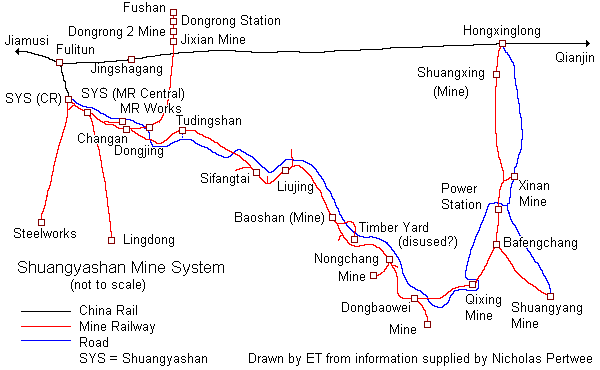
This industrial system has been described by Ted Talbot. As Ted Talbot
described, the Shuangyashan coal railway has both QJs and SYs in use. In
general, there is a mainline towards the southwest of SYS and a long branch
line to the north. The mainline goes to Shuangxing, the branch line terminates
at Fushan. The branch line leaves the mainline some 5.5 km away from SYS
CNR station. The junction is called Changan. Both lines are steeply graded
(up to 2.1%), have a summit only a few kilometres away from SYS and offer
both coal freights and QJ hauled passenger trains. Passenger trains consist
either of 9 or 11 coaches. All engines leave SYS funnel first. So, all
loaded coal trains and passengers returning to SYS are tender first.
The "depot area" is situated west of the CNR railway station, the line
itself leaves SYS railway station to the south as extension of the CNR
branch line Fulitun- Shuangyashan. Immediately to the south of the station,
the CNR "depot" or better service station can be found, but we never saw
any locomotive there. CNR pilot is GK 0335, CNR passengers feature DFH3,
freight trains DF4.
To the southwest, a branch line to the power plant leaves the station,
whereas the "mainline" swings to the east a few hundred meters south of
SYS. After some 1.5 km, the mine railway`s passenger station is reached.
It is called "Zhongxin" (Chinese characters for "middle" and "heart") and
is situated approximately in east-west direction. A branch line extends
to the west. Furthermore, there is a footbridge in the middle of the station.
Passenger trains over the coal railway start and terminate here. The line
now swings to the south again. At km-post 2.5, a branch line extends to
the south leading to the wagon repair shop whereas the mainline now extends
in south-east direction. Some 2 km further on, a road overbridges the railway.
Here, the climb starts. The mainline climbs up the hill and passes the
passenger stop of Changan (not all uphill trains stop here). Immediately
after the station, the some 400m long 2.1 % section starts. The following
2 km offer grades between 1.6 - 1.9 % until the summit is reached in some
8.5 km distance from Shuangyashan.
The branch line to Fushan leaves the "mainline" immediately south of
Changan station`s platform and swings north there. Although there is no
platform, the passenger trains stop immediately after the junction. The
lines crosses the valley leading onto a dam (nearly not graded). About
1 km after the junction, the next passenger stop (Dongjing) is reached.
Dongjing has got a siding, too but no platform. It is situated just before
the beginning of a some 500m long 1.6 % climb leading to the summit of
this line. Watching a QJ, accelerating the 9 YZ-wagon-train in this
grade is a quite spectacular sight. The same spectacle is offered on the
"mainline", where passenger trains normally consist of 11 coaches.The lines
were not investigated beyond the summits, but some further climbs can be
expected there.
Access to the line is quite easy. Being at Shuangyashan CNR station,
just walk up the street (right angle to the railway), until you reach "Shuangyashan`s
Major Place". Take bus No.1 and go until the very last station. It is situated
next to Dongjing station on the line to Fushan (see
Coal Railway Map) . Fare is 0.6Y. If you want to go further on along the mainline,
you can take one of the frequent minibuses to Baoshan. They use the same
route as bus No.1`s to Dongjing but go further on. If you want to go to
the road bridge, where the climb begins, you can also take Bus No.8.
Compared with Ted
Talbot's description ( November 1999 ), freight levels were very low
in Mid March (1 and 3 freight trains a day respectively). Probably, you
will have to come earlier.
Nevertheless, a visit to Shuangyashan will be worth it at any time.
At least, you will have the passenger trains ( and they are worth it ).
In Summer, you can see up to 6 funnel first passengers. For details see
Shuangyashan Passenger Timetable . The timetable
board at Zhongxin station showed four lines, served by passenger trains.
Three lines start at Zhongxin (to Shuangxing , Fushan and Lingdong ). Lingdong
is at the branch line to the south passing the wagon repair shop. The fourth
line acts as a branch line of the Shuangxing "mainline". It leaves the
mainline at Bafenchang and terminates at Shuangyang.
Although Ted Talbot recorded a DF7 diesel in November 1999, the system
was 100% steam during our visit.
Back to the tour (March 17th) :
We did not get up before 08:30. The hard seat journey from Harbin to SYS had knocked out us. At 09:15, we arrived at the CNR service point south of CNR station. QJ 3593 was shunting there and serving the power plant`s branch line. At 09:30, QJ 3459(tf)+QJ3598(tf) arrived from Zhongxin station - the latter one being out of steam. Now we started to walk down the "mainline". At Zhongxin station, SY 0632 was shunting. We walked along the mainline to km8 near the summit. We observed :
| T 72 | 10:20 | QJ 6806 (tf) | Fushan - Shuangyashan |
| T 82 | 10:35 | QJ 6808 (tf) | Shuangxing - Shuangyashan |
| T 32 | 11:05 | QJ 7017 (tf) | Bafenchang - Shuangyashan |
| T 83 | 12:45 | QJ 6806 | Shuangyashan - Shuangxing |
At 14:00, we could see the passenger on the northern branch line (hauled by QJ 6808). The "mainline" offered the first (and only) freight of the day at 14:10 :
| G | 14:10 | QJ 6805 | to Shuangxing |
| constr.train | 14:30 | railcar | to Shuangyashan |
| T 21 | 14:50 | QJ 7017 | Shuangyashan - Dongbaowei |
Now we walked back to Zhongxin station, where QJ 3135 was preparing T 51 .
| T 51 | 17:00 | QJ 3135 | Shuangyashan - Xinan |
| T 74 | 17:13 | QJ 6808 (tf) | Fushan - Shuangyashan |
Although the passengers themselves are worth the journey to Shuangyashan, we very disappointed about freight levels.
March 18th, Saturday
We had planned to watch the 06:57 passenger departure to Fushan (T 71).
But when we stood up, we realised, that there was heavy snowfall outside.
Some 15cm snow had fallen during the night. Snowfall did not stop before
11:00.
Although photography was absolutely impossible, we left the lüdian
at 07:00 and went to the coal mine railway`s loco service area west of
the CNR station. QJ 6806, SY 0632, 0568, 1045 and SY 1486 were waiting
there, but all of them under steam. Later SY 0632 left the service area.
SY 1045 is supposed to be the 10th SY at Shuangyashan, Ted Talbot had not
seen in November. After about half an hour, we decided to go back to our
room and wait for the end of snowfall.
Perfectly timed, snowfall stopped at 11:00. So, we had some 1.5 hours
to get out on the line the watch the passenger trains, leaving Zhongxin
at 12:40, 13:40 and 14:40. We took bus No.1 to the very last station and
walked through the snow-covered field to the south-western line :
| T 83 | 12:55 | QJ 6806 | Shuangyashan - Shuangxing |
Afterwards, we changed to the line to Fushan :
| G | 13:30 | SY 0632 (tf) + QJ 3593 (tf, banker) | loaded, to Shuangyashan |
| T 73 | 14:00 | QJ 6808 | Shuangyashan - Fushan |
At 14:05, a QJ (light engine, probably QJ 3593) was seen on the mainline, heading towards Shuangxing. Back at the mainline, we had to watch a QJ hauled freight (14:30), going towards Fushan over the northern branch line. The mainline saw :
| T 21 | 14:55 | QJ 7017 | Shuangyashan - Dongbaowei |
| G | 15:15 | QJ 3593 (tf) | loaded, to Shuangyashan |
We walked down to the road bridge. QJ 3459 was waiting inside the factory
just west of the northern line's junction. From the road bridge, we took
Bus No.1 back to SYS. A second visit to the "depot area" saw SY 0632 and
SY 1045 waiting there in the last sun of the day (around 17:00).
We took T 872 (dep. 17:21) and left Shuangyashan. Arrival at Jiamusi
: 19:35. The lady at the ticket counter refused to sell hard sleep tickets
for T 850 to Linkou (although hard sleepers were still available). When
I went to another ticket counter, she gave order to all her colleagues
to sell no hard sleepers to the "waiguoren" ! So, we had to buy hard seat
ticket (and upgraded on board of the train). T 850 (Jiamusi-Mudanjiang)
left Jiamusi at 20:21.
Locos seen at Shuangyashan (all under steam) :
| QJ | 3135, 3459, 3593, 3598, 6805, 6806, 6808, 7017 |
| SY | 0568, 0632, 1045, 1486 |
March 19th, Sunday
T 850 arrived at Linkou at 02:50 where we were welcomed by the station`s policemen who insisted on checking our luggage before we were allowed to buy tickets for T 603 (Harbin-Hulin) to Jixi. T 603 left Linkou at 04:01. Happily, the CNR station chief of Linkou organised, that we could sit in the restaurant car : the train was overcrowded. At Didao, a SY was seen shunting. Arrival at Jixi : 06.30.
CNR steam at Jixi ended last year (in October 1999, if I understood
right). So, with Jixi retiring its last QJs in October, Bei`an and Suihua
in November and Jiamusi in December 1999, the whole Harbin bureau district
was free of CNR steam by the end of 1999 ! Only local, industrial and forestry
railways are left in the far north.
In the area around Jixi, there are a number of collieries. Many of
them use steam locomotives. Four different coal mine railway
systems were seen, using steam but there may be further ones :
With the exception of the system at Hengshan, it is quite senseless to go to Jixi without guide and official permit to enter the coal mines as the steam engines are normally inside the coal mine's area. Exception is Hengshan, where the engines are stabled at the mine railway`s stabling point situated to the west of the CNR yard. It is freely accessible, staff very friendly.
Accommodation: There is a very good hotel near the station. When leaving the station, turn left. The third building on the left side (wearing the CNR symbol) is the Long Fu Binguan. Prices are between 100-260 Yuan, suites up to 588Y.
Back to the tour (March 19th) :
After arriving, we checked in at the LongFu Hotel (200Y until the following evening). We had to relax, enjoyed a bath and the fine beds, before we left the hotel around 10:00. We walked to the Jixi-Hengshan line in hope for QJs. But when we reached the line, we were disappointed : the trackbed had a clear message : apparently no recent use of steam, but many diesels. A typical sign for usage of diesels are fresh oil leaks between the rails whereas steam locos predominantly produce oil leaks outside the rails. 2.5 km south of Jixi, the line passes a coal mine where SY 0408 could be seen under steam but did not move. Then, it proved that the trackbed was right :
| G | 11:10 | DF4 3512 | sb, to Hengshan |
| G | 11:45 | DF4 ? | nb, to Jixi |
Now, we decided not to walk to Hengshan all the 12kms but to take a
bus. The Jixi-Hengshan line itself is quite spectacular. It offers a summit,
steep grades in both directions including a horseshoe bend on the Jixi
side. It must have been great to watch QJs here, hauling the freights.
We went to the nearby road and caught one the frequent minibuses to
Hengshan (1.5 Y). At Hengshan, DF4 3512 was shunting the CNR yard whilst
SY 0804 waited at the stabling point to the west. SY 0804`s crew was having
lunch at the station building. When they came out and realised the two
"waiguoren", they invited us to the cab. They offered us a cabride to the
coal mine. A few minutes later, we were on the way to a coal mine situated
approximately 3 km soutwest of Hengshan. SY 0804 (tender first) was hauling
6 empty coal wagons. At the mine, SY 0804 left the coal wagons and returned
light engine to Hengshan. Staff told us, that the 6 wagons would be loaded
manually (using shovels) and this would take at least half a day ! Furthermore,
we were told, that Hengshan has got a total of 6 SYs. When we arrived back
at Hengshan, SY 1369 was at the stabling point, having worked in some loaded
wagons from the other branch line west of Hengshan. A third SY was waiting
within the area of one of the coal mines at the east side of Hengshan but
did not come out. After some smalltalk, we left Hengshan around 15:00 and
took a bus bus back to Jixi. The buses to and from Hengshan start and terminate
at a bus station some 2 km south of Jixi station. This bus station is easily
reached by urban bus No. 1. It starts some 100 metres south of the bus
station whilst its other terminus is Jixi main station. Fare is 0.5 Y.
March 20th, Monday
We intended to investigate the branch line north of Qinglong (situated
half way between Jixi and Linkou). So we took a (shared) taxi for 50Y to
Qinglong station. Qinglong is situated in the middle of the nowhere, a
little Chinese station with two sidings. A talk to local staff brought
out, that there has never been a branch line at Qinglong ! The branch line
to the north actually extends between the stations of Lanling and Wulong
(half way between Langling and Qinglong) but is no longer used.
Out of the taxi, we had seen a very rusty track some 10kms before Qinglong.
So, the given information seemed to be correct. We decided to walk to the
junction.
| G | 09:45 | DF8 0063 | eb |
| G | 10:15 | DF8 0139 | wb |
| T 666 | 10:45 | DF8 0089 | wb, to Mudanjiang |
| G | 11:05 | DF8 0141 | wb |
| T ??? | 11:30 | DFH3 0067 | eb, to Jixi |
| G | 12:20 | DF8 0043 | eb |
When we arrived at the station Wulong (6km east of Qinglong), weather got worse and worse, light got duller and duller and wind heavier and heavier. So we decided not to walk to the branch line's junction. We took a minibus back to Jixi (5Y). Near Didao, we passed the two collieries detailed above. The rest of the day was spent shopping and waiting for our train, T Y202, leaving Jixi at 20:39. Hard sleeper was 102Y.
March 21st, Tuesday
Arrival at Harbin at 06:07 but we decided to go on to Harbin Dong (printed
destination on our tickets). Nearly everyone left the train at Harbin.
At Harbin Dong (06:34), a total of 4 persons left the train ! With the
help of some very friendly railway employees, we were allowed to buy hard
sleeper tickets for T 418 (Harbin 08:04 - Tianjin - Jinan) for the "short"
distance to Jinzhou only. So, we could avoid 11 hours hard seat ...
The following steam engines were seen en route :
The sight of a QJ at Dahushan seemed to indicate that steam on the line
towards Tongliao has not yet disappeared completely (and it was true, but
see below).
Arrival at Jinzhou : 19:33. We checked in at the newly opened Xintiande
Hotel to the right of the station. Very good room for 200Y offering warm
water at any time of the day !
March 22nd, Wednesday
After breakfast, we took T853 (Jinzhou-Chifeng), departure 07:51 to Beipiao Nan (arr. 10:18). T 853 has got a soft seat wagon. It costs 5Y extra, but you can avoid hard seat. At Bajiaotai, a JS was sitting next to the power plant. All trains which were crossed this morning were DF4 hauled : T866 at Nihezi (DF4 7457), a freight a Yi Xian (DF4 7427) and T607 at Beipiao Nan (DF4 2117).
At Beipiao Nan, we took bus No.5 to Beipiao. Fare is 2Y. Beipiao has only one hotel : the grotty Beipiao Shi Nanshan Binguan. Bus No.5 from Beipiao Nan runs along Beipiao's main street. Leave the bus after it turns left. The white and yellow, flat building on the left side of the street is the hotel. Prices are 40 - 60Y per person. Some metres further on, you will find a railway crossing. Beipiao station is half an kilometre to the east whereas the left track to the right is the line towards Beipiao Nan. The right track leads to a huge factory / power plant which employs some SY (including SY 0387 and SY 1451).
The Beipiao-Beipiao Nan line is 100% QJ worked, although freight levels can be very low during daytime. The Beipiao-Beipiao Nan passenger service - published in the CNR timetable - had been cancelled by March 17th undo reverted to run from Beipiao to Chaoyang now. There is no possibility to turn the engines at Beipiao. So, half of the trains are tender first. There is no general rule, which direction will be tender first. Nevertheless, uphill workings towards Beipiao are more likely to be tender first than downhill towards Beipiao Nan (valid for freight trains, too). The current passenger timetable - valid since March 18th 2000 - is :
Beipiao Passenger Timetable :
| 06:30 | 10:40 | 14:16 | 0 | Beipiao | 09:30 | 13:41 | 18:11 |
| 06:47 | 11:02 | 14:32 | 6 | Luotuoying | 09:09 | 13:26 | 17:50 |
| 07:23 | 15:16 | 31 | Nengjia | 08:34 | 12:46 | 17:14 | |
| 07:50 | 12:03 | 15:43 | 56 | Chaoyang | 08:05 | 12:18 | 16:45 |
The Beipiao to Beipiao Nan line is quite scenic. It offers three big
and photogenic river bridges. Immediately east of Beipiao Nan, the well
known large iron-made river bridge can be found. But a new bridge (made
of concrete, of course) is currently being built parallel to the old one.
At the other side of the bridge is the junction for the branch line to
Beipiao. A triangle provides a connection from Beipiao to both Beipiao
Nan and Chaoyang. Some two kilometres south of Luotuoying, next to a railway
crossing, the second bridge is situated. It is a curved irony bridge, offering
good photospots for southbound trains all the day. About 10kms distance
from the triangle, the station Luotuoying is situated. North of the station
there is a large coal mine and a branch line further north. The "mainline"
to Beipiao swings to the east and crosses the valley on the third large
viaduct. Luotuoying has got a own pilot. During the 3 days, we spent at
Beipiao, it was QJ 6476. It serves the branch line, too.
After about 3 km, the "mainline" reaches the city of Beipiao. But Beipiao
station is on the other side of the town, some further 3 km away. There
are two railway crossings in the city of Beipiao. One of them is that immediately
next to the hotel. The passenger trains stop at both these crossings in
addition to the halt at Beipiao station. Beipiao itself has got its own
pilot, too (QJ 6226). At the northern end of the station (and of the whole
line), another coal mine is situated. Both the CNR pilot and the power
plant`s SYs were seen going into this coal mine.
The most scenic section of the line from Chaoyang to Beipiao Nan are
the first 4 kilometres next to the triangle at Beipiao Nan. Sadly, freight
traffic is very, very low here : only 2 or 3 steam hauled freights a day.
The only "sure" working was a freight, leaving Chaoyang around 08:20
(after the passenger to Beipiao). It goes to Yi Xian and was observed on
3 subsequent days. It was hauled by QJ 6480 every day.
Between Beipiao Nan and Yi Xian best photo spots can be found around
Zhoujiatun including a fine, European style, curved 8-arch-viaduct and
a girder bridge some 4 km further on towards Yi Xian.
Quite interesting is the Beipiao weather, too. Every morning was clear
and sunny. At about 09:00 a wind started to blow and got heavier and heavier.
Clouds appeared and - even worse - huge amounts of dust were blown away
by the wind. Normally, photography after 15:00 was senseless, because everything
was grey in grey at that time. This description of the weather was valid
for all three days (22th - 24th) around Beipiao !
Back to the tour (March 22th) :
Riding bus No.5 from Beipiao Nan to Beipiao, we could see 3 QJs in the station of Luotuoying. After checking in at the hotel, we first went to Beipiao station, where QJ 6226 was shunting. Then we decided to walk down the track to Luotuoying. At the viaduct north of Luotuoying, we waited for T898 which should leave Beipiao at 13:15 and go to Beipiao Nan according to CNR timetable. But suddenly, QJ 3185 arrived tender first from the other direction : we did not yet know about the timetable change 4 days before at this time.
| T 04 | 13:35 | QJ 3185 (tf) | nb, to Beipiao |
South of Luotuoying next to the curved river bridge, the following trains were observed :
| G | 14:10 | QJ 6943 (tf) | nb |
| T 05 | 14:35 | QJ 3185 | sb, to Chaoyang |
| G | 15:40 | QJ 6776 | sb |
We took Bus No.5 back to Beipiao and visited Beipiao station again. This time, we found the place, where the new timetable was published. QJ 6226, SY 0387 and SY 1491 all went to the coal mine and stabled there.
March 23rd, Thursday
In the morning, we took T01, dep 06:30 from Beipiao to Nengjia (between Beipiao Nan and Chaoyang). At Beipiao, QJ 6226 was shunting, QJ 6476 at Luotuoying. T01 was hauled by QJ 3185 funnel first. The whole day was spent between Nengjia and Beipiao Nan. Quite interesting was the use of the Chaoyang pilot JS 8236 on T04 and T05.
| G | 08:00 | DF4 ? | eb |
| G | 08:30 | DF4 ? | wb |
| T 02 | 08:45 | QJ 3185 (tf) | eb, to Beipiao |
| G | 09:10 | QJ 6480 | eb |
| T 607 | 10:15 | DF4 2118 | eb, to Shenyang Bei |
| T 853 | 10:30 | DF4 7453 | wb, to Chifeng |
| T 619 | 11:00 | DF4 2124 | wb, to Chaoyang |
| T 03 | 11:20 | QJ 3185 | wb, to Chaoyang |
| T 04 | 13:00 | JS 8236 | eb, to Beipiao |
| T 520 | 13:30 | DF4 2271 | wb, to Chengde |
| T 854 | 14:30 | DF4 7454 | eb, to Jinzhou |
| G | 15:00 | QJ 6707 | eb |
| T 05 | 15:05 | JS 8236 (tf) | wb, to Chaoyang |
| T 519 | 15:30 | DF4 2117 | eb, to Shenyang |
| T 608 | 15:35 | DF4 2264 | wb, to Chifeng |
| light engine | 15:50 | QJ 6776 | Beipiao - Beipiao Nan |
| light engine | 15:55 | QJ 6943 (tf) | Beipiao Nan - Beipiao |
| G | 16:00 | DF4 1652 | wb |
By now sun had disappeared and we took bus No.5 from Beipiao Nan back to the hotel. A quite frustrating day as we had only tender first trains in sunlight and funnel first trains, coming out of the sun or in unexpected direction (e.g. the 15:00 freight : we awaited T 05 at that moment). In the evening, we went to the crossing at the hotel to watch T 06 arriving from Chaoyang. But it was more than 5 min too early, so that we did not see it. Instead of :
| G | 18:10 | QJ 6672 | freight towards Beipiao Nan |
March 24th, Friday
The day started as the day before : we took T01 to Chaoyang. This time, we entered the train at the crossing. QJ 3185 was on the passenger duty again, but - sadly - tender first today ! This time, we went as far as Chaoyang, where we went to the crossing east of the station :
| T 02 | 08:10 | QJ 3185 | eb, to Beipiao |
| G | 08:40 | QJ 6480 | eb |
JS 8236 was pilot at Chaoyang. At 10:00, QJ 6679 (Yebaishou based) arrived
from the Yebaishou direction and began shunting at Chaoyang, too. Except
for the two shunters (JS 8236, QJ 6679), there were no more steam movements
at Chaoyang until we left the place at 12:18 (T 04 to Beipiao, QJ 3185
funnel first). QJ 6679` s crew invited me to the cab where I spent nearly
an hour.
We left T04 at Luotuoying and walked to the curved viaduct. Surprisingly,
sun shone at the moment, when the passenger T05 came back : QJ 3185, tender
first, of course.
| light engine | 13:45 | QJ 6991 | nb, to Beipiao |
| T 05 | 14:45 | QJ 3185 (tf) | sb, to Chaoyang |
We took bus No.5 back to the hotel, where we collected our luggage and went to Beipiao Nan station by three-wheel-motortaxi (15Y). We took T 621, dep. 17:21 to Yi Xian (18:01). QJ 6672 waited at Beipiao Nan (funnel towards Chaoyang), a DF4 hauled freight was crossed at Zhoujiatun, a QJ hauled at Yi Xian. At Yi Xian, there were two further QJ hauled trains ready for departure :
| G | 18:15 | QJ 7117 | to Fuxin |
| G | 18:20 | QJ 6707 | to Beipiao / Chaoyang |
| G | 19:10 | QJ ? | from Fuxin |
We took T880, Yi Xian 19:51 to Jinzhou 20:41 where we checked in at the Tianyide Hotel again.
March 25th, Saturday
We took T853, dep. 07:51 again and went to Zhoujiatun (en route no steam again except for the JS at Bajiaotai), where we spent some 5.5 hours :
| T 619 | 10:10 | DF4 2118 | wb, to Chaoyang |
| G | 10:15 | QJ 6943 | eb, 1 wagon only |
| T 607 | 10:50 | DF4 2264 | eb, to Shenyang Bei |
| G | 11:30 | QJ 6943 | wb |
| G | 11:45 | QJ 6480 | eb |
| T 520 | 12:55 | DF4 2117 | wb, to Chengde |
| constr.train | 13:30 | 2 railcars | eb |
| G | 14:20 | QJ 7116 | wb |
| G | 14:35 | DF4 1652 | wb |
| T 608 | 15:00 | DF4 2124 | wb, to Chifeng |
We took T 854, dep. 15:23 back to Jinzhou (arr. 17.11). A freight was
crossed at Yi Xian (QJ hauled), another one at Xihoutai (DF4 7427), T 865
at Qilihe (DF4 7457), a freight at Bajiaotai(QJ 7117) and another one at
Xuejia (DF4 4398). A QJ was sitting a Jinzhou shed.
In the evening, Stephan took T 590 to Beijing (dep.20:58) and flew
back to Europe. The following 2 weeks, I travelled on my own. I took T343
(Hangzhou-Qiqihar), dep. 20:11 and went back to Da`an Bei. Da`an Bei simply
offered much more steam than the area around Beipiao ...
Steam locomotives seen around Yi Xian/ Beipiao (Fuxin based, if not indicated) :
| JS | 8236 |
| QJ | 3185, 6226, 6476, 6480, 6672, 6679(Yeb.), 6707, 6776, 6943, 6991, 7116, 7117 |
| SY | 0387, 1451 (both : Beipiao Power Plant) |
March 26th, Sunday
Arrival at Da`an Bei at 05:12.
Da`an Bei (2)
I took mixed T952, dep. 06:05. It was hauled by QJ 6891. QJ hauled freights
were crossed at Jianshe, Shuzijing and Qing`an, where I left the train
(arr. 08:08). I had not yet left the station when the local police officer
appeared and made me follow him to his office. I told him, that I only
wanted to see some steam trains here, but he seemed not to believe in that.
I was not allowed to leave the station`s building and had to take T703,
dep. 12:00 back to Da`an (QJ hauled freights were crossed at Shuzijiang
and Haituozi). The whole morning was lost ! At least 5 QJs and one DF4
were heard passing the station between 08:00 and 12:00 (but there may have
been more trains, too). As I did not want to go back to Da`an at noon,
I left T 703 at Haituozi situated half way between Qing`an and Da`an.
If you do not have much time for your visit to Da`an, you should go
to Haituozi. The surroundings of Haituozi offer all photospots, available
around Da`an : A flat bridge crossing a lake, a dam and two bends to the
north, birch rows, 2 crossings and a cutting to the south. In between Haituozi
station : it has got an old station building and a nice spring on the platform.
The bridge is best for southbound trains before 11:00. Sightings :
| T 704 | 13:00 | DF4 2175 | sb, to Tongliao |
| G | 13:50 | QJ 6086 | sb |
| G | 14:05 | QJ 6435 | sb |
| G | 14:20 | QJ 3115 | nb |
| G | 14:50 | QJ 3268 | nb |
| G | 15:30 | QJ 7086 | nb |
| G | 16:25 | QJ ? | sb |
| G | 16:50 | QJ 6825 | sb |
| G | 17:50 | QJ 3287 | nb |
| light engine | 18:05 | DF4 3316 | nb |
| G | 18:25 | DF4 3317 | sb |
By 16:00, light failed. In the afternoon the station chief of Haituozi
invited me to his office, where I waited. He told me, when the next train
would arrive, I went out, took a photo and returned. A quite comfortable
way of "linesiding".
Originally, I had planned to take T 951, dep. 19:24 back to Da`an Bei.
But the crew of DF4 3316, which waited for the southbound freight (hauled
by DF4 3317) until 18:30 in the station, invited me to go with them. I
agreed, of course. Maximum speed was 80km/h between Haituozi and Da`an
Bei. With the exception of the two bends north of Haituozi, the whole line
to Da`an is straight line (more than 20km). At night, you can see the signals
of the next station some 6 - 8 kilometres in advance ... We arrived at
Da`an at 18:50 where I went to the lüdian right of the station : single
room for 30Y.
March 27th, Monday
Originally, I had planned to take an early bus to Changshantun (30 km towards Changchun). I had hoped, there would be a connecting bus service from Da`an Bei to Qianguo for the Hangzhou-Qiqihar express train (T 343, arrival 05:12). But the day before, there had been no bus waiting for this train. So, I decided to take T212, dep. 08:38 to Changshantun. The morning was spent at Da`an Bei`s "northern crossing" :
| T 705 | 06:20 | DF4 1549 | to Ranghulu |
| G | 06:45 | QJ 7173 | from Ranghulu |
| G | 06:50 | QJ 6484 | to Ranghulu |
| T Y267 | 07:30 | QJ 6888 | from Qianguo |
| G | 07:55 | QJ 6847 | from Ranghulu |
| G | 08:00 | QJ 6773 | to Ranghulu |
QJ 6281, 6586, 6484, 6773 and JS 6096, 6239 were seen leaving and entering
the depot. QJ 2749 is dumped inside the depot area but visible from outside.
Now, I was happy not to have taken a taxi to Changshantun as there had
been no steam train on the Qianguo line except for T Y267 before 09:00.
On the way to Changshantun, T581 was crossed at Da`an (orange DF4 2120),
QJ 6851 with its freight at Tahucheng. At Changshantun, QJ 6435 and QJ
6926 were shunting. I went to the bridge east of the station (see above)
:
| G | 09:35 | QJ 6435 (tf) | wb |
| G | 10:20 | QJ 6586 | eb |
| light engine | 10:30 | QJ 6926 | wb |
| G | 11:05 | JS 6237 | eb |
I took T 825, dep. 10:50 back to Da`an Bei (DFH3 0098). T825 waited
some 20mins for JS 6237 with its 46 tank wagons ( loaded ! ). Probably,
they did not want to stop the JS with its heavy train a Tahucheng and preferred
to make T825 wait.
At Da`an Bei, DFH3 0098 was replaced by Baicheng based DF4 1699 to
haul T 825 to Baicheng. T704 (Qiqihar-Tongliao) arrived behind QJ 7081
(12:13). I entered this train and rode to Tongliao (arr.18:55, hauled by
Tongliao based orange liveried DF4 2178). Northbound trains were crossed
at Da`an Bei (freight, QJ 3287), T 703 (DF4 2162) at Qianyu, a QJ+DF4 double-headed
freight at Haituozi, another QJ hauled freight at Zhizijing. QJ 3268 and
its freight were overtaken at Zhende, a DF4 hauled freight crossed at Youzijing.
Qingfeng saw QJ 3115 (sb freight) and QJ hauled nb mixed T 951. The last
QJ hauled freight was seen at Taipingchuan. Beyond Taipingchuan, all trains
were DF4.
Directly opposite of Tongliao station, there are two big lüdians
or hotels. I took the right one and got a single room for 81Y.
March 28th, Tuesday
Between 40 and 50 % of freights along this line are still QJ hauled.
Other freights are hauled by quite old Tongliao based green DF4s (built
between 1980-1984). QJs had either Zhangwu or Dahushan depot characters.
Some goods trains are doubleheaded, too. But all diesel-steam combinations
observed had the DF4 as first engine in front of the QJ.
Passenger trains are exclusively diesel and offer both orange (Shenyang
based) and green (Fuxin based) DF4s. Furthermore DFH3 and even DF11 (T467
Beijing-Qiqihar) can be seen.
Most scenic section is between Bahuta and Mulitu. The line passes through
hilly landscape and sand dunes (Thorge Bockholt reported before). As Thorge
reported two years ago, there are narrow gauge lines both at Mulitu, Yamenying
and Bahuta. All three lines are said to have little diesels (I only saw
the Yamenying system working). These railways carry sand from the sand
mines to the CNR railway stations, where the sand is shovelled (by hand)
into a big reservoir. Than, a kind of sand shovelling crane puts the sand
into standard gauge wagons. The sand railways seem to work only a few hours
a day. But when working the are very busy. On March 29th, the Yamenying
system was working between 09:00 and 10:30 only, but 2 trains were in use.
There was a train about every 10-15 minutes. The Yamenying railway used
two unnumbered diesels. Each rake consisted of 6 sand wagons with the locomotive
at the CNR station`s side of the wagons at any time. The last wagon of
each rake had numbers (05 and 10), which are probably valid for the whole
rake. All three ng line leave the CNR station to the northeast and cross
the Tongliao - Ganqiqia toll road.
A big problem of the CNR line are poles. Similar to Da`an, there are
both old-style telegraph and modern telephone poles along the line. The
telegraph poles are some 30 meters to the west, the telephone poles some
5 meters to the east. Around Yamenying station and some 3kms south of Mulitu,
you will find the only photogenic places, where the telephone pole is more
than 10 metres away from the track. In addition to the missing telephone
pole, Yamenying stations has got a water tower, too. It provides a very
good background. Furthermore, the (unused) switching points both south
and north of Yamenying station offer nice photopossibilities. Around Mulitu,
several bridges offer possibilities for photos, too.
To go to Yamenying, take the 07:00 bus to Ganqiqia. It leaves at Tongliao
main bus station opposite the railway station. Fare is 5Y (Bahuta 6Y, Mulitu
3Y). To know where to get off the bus, just count the narrow gauge crossings.
Back to the tour (March 28th) :
I took the above mentioned 07:00 bus to Bahuta. At Yamenying, a northbound QJ hauled freight was seen. There was a very heavy wind blowing from north to south all the day. The wind was similar to a JingPeng storm, but being in the dessert, you have no chance to hide behind hills here ... Sometimes, you could even not hold your camera against the wind. Nevertheless, I started to walk the 14 km back to Yamenying, permanently facing the wind. The day began quite frustrating with DF4s hauling nearly every train in the morning :
| G | 08:05 | DF4 0438 + QJ 6349 | nb |
| G | 08:40 | DF4 0668 (1984) | sb |
| G | 09:05 | DF4 0568 (1983) | sb |
| G | 09:25 | DF4 0539 (1983) | sb |
| G | 09:35 | DF4 0661 + DF4 0662 (both 1984) | nb |
| G | 10:00 | DF4 0671 (1984) | sb |
| G | 10:20 | QJ 6370 | nb |
| T 630 | 10:30 | DFH3 0148 | sb, to Jinzhou |
| T 587 | 10:45 | DF4 1647 | nb, to Tongliao |
| G | 11:05 | DF4 0393 (1981) | sb |
| G | 11:30 | QJ 6771 | nb |
| T 883 | 11:45 | DF4 2488 | nb, to Tongliao |
| G | 12:00 | DF4 0384 (1980) | sb |
| G | 12:30 | DF4 0683 + DF 4 0584 | nb |
| G | 12:45 | QJ 6485 | sb |
By 13:00, I arrived at Yamenying station. To my surprise, QJ 6771 was still present there. It should have arrived there as early as around 11:40. It did not leave Yamenying before 13:45. The rest of the day was spent around Yamenying station :
| G | 13:10 | DF4 0666 | sb |
| T 629 | 13:20 | DFH3 0121 | nb, to Tongliao |
| T 880 | 13:40 | DF4 1647 | sb, to Jinzhou |
| G | 13:45 | QJ 6771 | nb |
| G | 14:20 | DF4 0438 | sb |
| G | 14:45 | DF4 0661 | sb |
| G | 14:50 | DF4 0383(1980) + QJ 6885 | nb |
| T 884 | 15:25 | DF4 2488 | sb, to Dahushan |
| G | 15:30 | DF4 0548 | nb |
| G | 16:05 | QJ 6777 | sb |
| G | 16:10 | QJ 7120 | nb |
I caught a minibus back to Tongliao. I arrived there at 17:15 : a few
minutes too late to watch the 17:18 departure of T722 Tongliao-Daban.
By the way : Now, I know, why some visitors had problems to visit the
footbridge at Tongliao station: the building next to the footbridge is
the local police office ...
March 28th, Wednesday
Took the 07:00 bus to Yamenying again. Bright sunshine today with absolutely no wind. The morning was spent around Yamenying station. Between 09:00 and 10:30, the sand railway was busily operating (read above).
| G | 08:10 | DF4 0664 | sb |
| G | 08:50 | DF4 0635 + QJ 6771 | nb |
| G | 09:10 | QJ 6369 | sb |
| G | 09:45 | QJ 6370 | nb, arrival |
| G | 09:50 | DF4 0662 | sb |
| G | 10:05 | DF4 0584 + QJ 6485 | sb, arrival |
| T 630 | 10:30 | DFH3 0121 | sb, to Jinzhou |
| G | 10:30 | QJ 6370 | nb, departure |
| T 587 | 10:50 | DF4 1647 | nb, to Tongliao |
| G | 11:10 | DF4 0438 | nb |
| G | 11:15 | DF4 0584 + QJ 6485 | nb, departure |
| G | 11:45 | DF4 0635 + DF4 0393 | nb |
I boarded T883 (DF4 2488, the worst DF4, I have ever seen in China : Even one of its headlights was missing ...), dep.11:49 at Yamenying and got off at Mulitu (arr.12:05). I went to a nice cutting some 2.5 km south of Mulitu :
| G | 12:20 | DF4 0663 | nb |
| T 629 | 13:25 | DFH3 0148 | nb, to Tongliao |
| T 880 | 13:30 | DF4 1647 | sb, to Jinzhou |
| G | 14:00 | QJ 7120 | nb |
| G | 14:10 | DF4 0539 | sb |
| G | 14:40 | DF4 0442 | sb |
| G | 14:55 | QJ 6777 | sb |
| T 884 | 15:15 | DF4 2488 | sb, to Dahushan |
| G | 15:50 | QJ 6370 + QJ 6771 | sb |
Back to Tongliao by minibus. This time, I arrived some minutes earlier
and could watch QJ3073 heading T722 to Daban. Taking a photo from the footbridge
is nearly impossible. You will need a lens with less than 30 mm in diameter
to be able to take photos there.
At 18:10, I left Tongliao. Hard sleeper for T458 (Tongliao-Hohot) to
Beijing Bei was 122Y.
Steam locomotives seen around Tongliao (QJ from Zhangwu, DF4 Tongliao, DFH3 Shenyang if not indicated different) :
| QJ | 3073(Chabuga), 6349(Daban), 6369, 6370, 6485, 6771, 6777, 6885, 7120 |
| DFH 3 | 0121, 0148 |
| DF4 | 0383, 0384, 0393, 0438, 0442, 0539, 0548, 0568, 0584, 0635, 0636, 0661, 0662, 0663, 0664, 0666, 0668, 0670, 0671, 0683, 1647(Fuxin), 2488(Shenyang) |
March 30th, Thursday
Arrival Beijing Bei at 09:01. I took the underground to Beijing main station (3Y). Tickets for T K41 to Xi`an (dep.17:10) were not available. So I had to take K55, departure 15:20 at Beijing Xi. With this earlier train I had no chance to visit Dahuichang. K55 consisted of 16 double-deck wagons and was hauled by Shijiazhuang based SS8 0044 when leaving Beijing Xi.
March 31st, Friday
Arrival at Xi`an at 06:38. The next bus to Tongchuan left at 07:20. It was a sleeper bus to Yan`an. Fare was 18Y. At 09:35, I arrived at Tongchuan bus station.
In March 2000, the Tongchuan Coal Railway got two further diesels :
DF7C 5217 and 5218, both having 1999 builder plates. So, 4 diesels
are available now. As there are normally only 3 locomotives in use during
daylight, a JF working to the line will be very seldom. Fortunately, both
DF7Bs (3134 and 3135) were not in use during my visit. On the other hand,
the two DF7Cs were used daily. But at least one JF was on the line. The
diesels now work nearly all trains to Dongpo and Hongtou (only 3 JF worked
trains towards Dongpo were seen during 5 days) whereas all trains to Wangshiwa
were JF hauled. Normally, there are two workings to Wangshiwa during daylight
: the first one leaves Tongchuan between 10:00 and 11:00, the second one
between 15:00 and 17:00. The locomotive is funnel first towards Wangshiwa.
At Wangshiwa it normally stays for about one hour before returning to Tongchuan
tender first. According to local staff, a JF`s maximum load in the 3.0%
grade out of Tongchuan is 12 empty coal wagons whereas a DF7 can haul up
to 25. Usual pattern of working is : in the early morning (between 06:00
and 08:00), some 3-5 loaded trains will arrive at Tongchuan. Now, all engines
will be at Tongchuan Nan. The first trains of empties will have the diesels.
They normally go to Dongpo or Hongtou. If all diesels have left Tongchuan
Nan, the following trains will be JF hauled. This means for example : If
there are two diesels in use, the first two uphill trains will be diesel.
If there is a third train towards Dongpo, it will have JF tender first.
The last uphill train of the morning will be the Wangshiwa train. Around
noon, the same will happen as in the morning : all locos return to Tongchuan.
Then, they leave Tongchuan again, the first trains will be diesel again
with the Wangshiwa one being the last one ... But : the Wangshiwa train
was JF hauled even when a diesel was available at Tongchuan Nan.
As you can imagine, it is essential to know how many diesels are actually
in use and where they are at the moment. The same is valid for the JF`s
: You have to know which (and how many) engines are funnel towards Wangshiwa
and Tongchuan, and where they are at moment. So, it is essential to visit
Tongchuan Nan`s stabling every morning and to note the engines being there.
Never rely on what local staff tells you ! In one occasion, I was told
that there should be a JF at Hongtou but I knew that all JFs were at Tongchuan
at that moment. Well, there was a engine at Hongtou, but a DF7 !
The Tongchuan Coal Railway has often been described recently. For orientation,
see Tongchuan
Maps . Some additional notes of interest :
Accommodation : In addition to the recommended
Tongchuan Hotel (known as "To Tongchuan Binguan", prices : 120-360 Y),
there are two further hotels only some 100 and 200 metres south of To Tongchuan
Binguan. A fourth hotel, the "Yan`an Binguan" is situated opposite of Tongchuan
main station.Probably the "most suitable" hotel is the "Tongchuan Shi Qichezhan
Binguan" (Tongchuan Bus Station Hotel). If you arrive with the bus from
Xi`an, the bus will either go to the bus station or stop at the
circle traffic some 150 metres to the south below the new "highway". The
bus station is the big, white building with a tower on the eastern side
of the river. The advantages of "Tongchuan Shi Qichezhan Binguan" are :
it is cheap (12-90Y), situated only some 200m distance from the loco stabling
point at the southern end of Tongchuan Nan station (if you get a even numbered
room, you may even see the servicing area from your window) and both bus
No. 1 and No.2 terminate directly in front of the building.
Local buses : To get to the steep grade, you may
either take bus No.1 (get off where the railway crosses the river) or bus
No2 to the place, where the railway overbridges the road. You have the
choice between minibuses (fare 1Y) and "real" buses (fare 0.4 - 0.8Y, depending
on distance). Keep in mind, that the minibuses do not terminate at the
bus station ("qichezhan"). Line No. 1 operates between 05:30 and 23:30,
No.2 between 06:00 and 19:00.
Linside buses : For the first 5 km out of Tongchuan,
a road parallels the line. Minibuses to Dongpo or Baishui run along this
road about every hour. If you want to go to Qioaziliang (and you do not
want to walk through the 780m long tunnel at Qiaoziliang) take one of these
buses and go as far as Wangshiwa. The village of Qiaoziliang is situated
at the place, where the road to the north - passing over the 780m long
tunnel - meets the direct Tongchuan-Dongpo road. But the footpath from
here down to the station is very bad and dirty (see Tongchuan
Maps ). The city of Wangshiwa is situated above the Wangshiwa branch
line's tunnel. Leave the minibus at the lowest point along the road within
the village. Walk down one of the paths to the north and you will find
the line. Some 1.5 km along the line, you will find Qiaoziliang station.
Tongchuan City Map : For not being overcharged
when using the local buses and for orientation, it is very useful to buy
a city map of Tongchuan. Then, you can show where you want to go to. Maps
are available at the bus station. Price is 2Y.
Coal mines : According to local staff, the coal
mine at the branch line to the north is no longer served. The only "trains"
along this branch line are the DF7s when going to their "shed".
CNR pilots : There are still 3 QJs based at Tongchuan
Nan for shunting and tripping local freights to Tongchuan and over the
branch line to the east. One engine is standby at any time. During all
6 days, QJ 6532, 6550 and 6652 were in use. The most amazing fact to be
reported about these QJs is, that all three engines were overhauled at
Luoyang Locomotive Works between August and November 1999. Talking with
QJ 6652`s driver brought out, that even the railway employees had been
quite surprised when they got back overhauled QJs instead of the expected
diesels ...
This is a even more amazing fact when hearing about the city of Tongchuan's
a "anti-pollution-campaign" which started recently (QJ 6652`s driver told
about this). Dates of overhauls : QJ 6532 (9.99), QJ 6550 (8.99), QJ 6652
(11.99)
Back to the tour (March 31st) :
I left the bus from Xi`an at the circle traffic. I took a taxi and checked
in at the To Tongchuan Binguan (150Y per night). I stood there for two
nights before changing to the "Tongchuan Shi Qichezhan Binguan".
I took bus No. 1 to the railway bridge north of Tongchuan station and
started to walk up the line (11:00). Staff at the junction to the branch
to the north told me, that due to some track maintenance, there would be
no trains to Wangshiwa this day and (as a consequence of this fact) no
steam train for the rest of the day. Nevertheless, I walked up the line
towards Qiaoziliang.
The station at km 4.5 is called Shijiahe. There, I was told there would
be no trains at all for the rest of the day. Near the tunnel, I saw the
first train :
| G | 13:50 | DF7 5217 | to Tongchuan |
I walked through the tunnel and further on along the Dongpo line to
the crossing some 2 km north of Qiaoziliang junction. As mentioned previously,
there are two stations at Qioaziliang : one situated at the junction of
the Wangshiwa branch line and a second about one kilometre further north
along the line towards Dongpo. Staff at Qiaoziliang (northern station)
told me, that 2 new diesels had arrived some weeks before. Furthermore,
they claimed that only two JFs still would be in working order. A diesel
hauled freight towards Dongpo was to arrive around 17:00 at Qiaoziliang,
but I decided to go back to Tongchuan at 16:30 and to have a look at Tongchuan
Nan station. One of those incredibly weak lorries offered me a free ride
back to Tongchuan.
I arrived at Tongchuan Nan at 17:30. At the stabling point south of
the station all 3 QJs were waiting for work (6532, 6550 and 6652). But
there were no less than 6 JFs under steam sitting around, too !
JF 2113, 2182, 2365 and 4025 were funnel first towards Qiaoziliang.
During the following days, JF 2182 and JF 4025 were seen hauling the Wangshiwa
trains whereas JF 2113 and JF 2365 were either spare locomotive or pilot
at Tongchuan Nan all the time. Both were not seen working on the line.
JF 2368 and 2369 were present, too, but funnel first towards Tongchuan
and used on the Dongpo line exclusively. So to say, Qiaoziliang's staff
was right when they talked about only two workable engines ... - but only
for the Dongpo branch line, of course !
April 1st, Saturday
When waking up, it was raining heavily. To go linesiding would have been senseless. So, I decided to stay at the hotel until the rain would stop. That happened at 12:00 and I walked to Tongchuan Nan station. JF 2113 was shunting there, JF 2365 spare and JF 4025 waited in the station. So, JF 2368, 2369 and 2182 had to be out on the line. QJ 6652 was on standby duty, QJ 6550 served the branch line to the west. At 13:00, it started to rain again. QJ 6652`s driver invited me to his engine. While talking about Tongchuan's "anti-steam-campaign" and the unexpected return of overhauled QJs at Tongchuan (see above), JF 2369 rolled in, hauling some 10 loaded coal wagons. Only 20 minutes later (13:40), JF 2368 arrived, too :
| G | 13:20 | JF 2369 | from Dongpo |
| G | 13:40 | JF 2368 | from Dongpo |
At 14:00, I took bus No.2 and went out to the line. Now, rain had stopped :
| G | 14:45 | DF7 5218 | to Tongchuan |
| G | 15:20 | JF 2182 (tf) | to Tongchuan |
| G | 16:00 | DF7 5217 | to Tongchuan |
| G | 16:10 | DF7 5218 | to Dongpo |
| light engine | 16:20 | DF7 5217 | to Dongpo |
| G | 16:40 | JF 4025 | to Wangshiwa |
It was too dark now to wait for further trains. So I went back to Tongchuan Nan and visited the servicing area south of the stabling point, where JF 2182, JF 2368 and QJ 6532 could be found.
April 2nd, Sunday
WS recently reported on the Diantou Local Rlwy. between Diantou and Qinjiachuan situated some 80 kilometres north of Tongchuan. In the evening of April 1st, I had asked when a bus to Huangling would leave. I was told, it would leave at 07:00. So, I arrived at the bus station at 06:30 in the morning, checked in at the "Qichezhan Binguan" and waited for the bus. Now, the bus was said to leave at 07:30. But in fact, it did not arrive before 08:20. Then, the bus went the 300 metres to the circle traffic, where it stopped again and waited there until the last seat was full. Some two hours after scheduled departure, the bus left Tongchuan at 9 o'clock. Very annoying to lose two hours waiting for the departure of the bus.
Diantou Local Railway
I went as far as Huangling (fare 9Y, journey time 2 hours). The Diantou - Qinjiachuan line is highly spectacular. It passes the city of Huangling about one kilometre to the north. But it is not visible next to Huangling : there are two very long tunnels (tunnels No.3 and No.4). From Huangling bus station, walk down the road to Yan`an. About 500m after you left the city, the road swings to the right. After this bend, there is a white building on the northern side and a valley starts there. Walk into this valley and you will reach the line between tunnel No.3 and 4. I walked the 8 km to Qinjiachuan along the line. The line's description :
This section offers grades against trains working to Diantou. According
to WS, the line is QJ worked but tender first towards Qinjiachuan (downhill).
On April 2rd, there were no trains during daylight due to maintenance
works near tunnel 4. But - no doubt - this line will be worth further investigation.
Staff at Qinjiachuan told, that the QJs are based at Diantou. They deliver
coal to the industrial complex about 1.5 km north of Qinjiachuan station
along the line to Yan`an.
At Qinjiachuan, DF1 1702 was shunting and served the industrial complex,
too. I had thought the Pucheng-Yan`an line would be a local railway. So,
I was very surprised that DF1 1702 had the CNR Zhengzhou bureau, Xinfengzhen
depot code on both sides !
I took a minibus back to Huangling (fare 3Y, appr. 30min) and another
one further on to Tongchuan (9Y). An evening visit to Tongchuan Nan stabling
point showed all 3 QJs and 5 JFs sitting around.
Only JF 2365 had disappeared, but probably it was not on the line.
Whenever I saw JF 2365 it was spare (not even shunting as JF 2113 did ).
JF 2365 was not seen until the evening of April 5th (3 days later).
April 3rd, Monday
As usual, a morning visit to Tongchuan Nan : only JF 2113 and 2182 were
present. I took bus No.2 to the railway bridge and walked to the curve
some 500m east of Shijiahe. In the early morning, there was some fog and
it got more and more foggy. Around 09:00, you could see some 50 metres
...
Fortunately, the fog disappeared until 12:00, but the morning was lost
for photography. Sightings :
| G | 07:00 | JF 2368 | to Tongchuan |
| G | 07:45 | JF 4025 (tf) | to Tongchuan |
| G | 08:05 | JF 2369 | to Tongchuan |
| G | 08:30 | DF7 5218 | to Tongchuan |
| G | 09:10 | DF7 5217 | to Tongchuan |
| G | 09:20 | JF 2368 (tf) | to Dongpo |
| G | 10:10 | JF 4025 | to Wangshiwa |
| G | 10:55 | DF7 5218 | to Dongpo |
I took a minibus and went to Qiaoziliang village (fare 1Y). There I walked down the valley to Qiaoziliang station. I was still walking when I heard a steam engine at 11:45. Probably, JF 4025 returned from Wangshiwa. Now, even the sun was shining. At Qiaoziliang, I waited for JF 2368 :
| G | 13:20 | JF 2368 | to Tongchuan |
I walked along the branch line to Wangshiwa and waited for the afternoon train to Wangshiwa. Sadly, light was dull again, when JF 4025 arrived :
| G | 16:30 | JF 4025 | to Wangshiwa |
At Wangshiwa village, I took a taxi back to Tongchuan (20Y).
April 4th, Tuesday
The first day, starting with sunshine ! This day, 3 JFs were at Tongchuan Nan (2113, 2182, 2368). So, JF 2369 and 4025 could be expected to arrive :
| G | 06:55 | DF7 5218 | to Tongchuan |
| G | 07:25 | JF 2369 | to Tongchuan |
| G | 07:45 | DF7 5217 | to Tongchuan |
| G | 08:20 | JF 4025 (tf) | to Tongchuan |
| G | 10:10 | DF7 5218 | to Dongpo |
| G | 11:25 | JF 4025 | to Wangshiwa |
| G | 13:30 | DF7 5218 | to Tongchuan |
| G | 14:10 | JF 4025 (tf) | to Tongchuan |
Only one train to Dongpo this day (DF7 hauled, of course). And DF7 5217 was still at Tongchuan ! So, I took a minibus to Wangshiwa again and waited for the afternoon train. It arrived "on time" when light was dull again :
| G | 16:35 | JF 2182 | to Wangshiwa |
| G | 17:20 | JF 2182 (tf) | to Tongchuan |
Took a taxi to Tongchuan (15Y) and got JF 2182 again at the river bridge north of Tongchuan Nan station :
| G | 18:10 | JF 2182 (tf) | from Wangshiwa |
April 5th, Wednesday
The last, sixth day at Tongchuan was first with sunshine all the day. Only 2 JFs were at Tongchuan Nan (2113, 2368). I walked up the line again :
| G | 07:00 | JF 2182 (tf) | to Tongchuan |
| G | 07:20 | JF 2369 | to Tongchuan |
| G | 07:35 | DF7 5218 | to Tongchuan |
| G | 07:50 | DF7 5217 | to Tongchuan |
| G | 08:25 | JF 4025 (tf) | to Tongchuan |
| G | 10:10 | DF7 5218 | to Dongpo |
| light engine | 10:40 | DF7 5217 | to Dongpo |
| G | 11:15 | JF 2182 | to Wangshiwa |
| G | 12:45 | JF 2182 (tf) | to Tongchuan |
| G | 13:45 | DF7 5218 | to Tongchuan |
| G | 14:50 | DF7 5217 | to Tongchuan |
| light engine | 14:55 | DF7 5218 | to Dongpo |
Again, no steam train to Dongpo. Because I wanted to catch the 17:49
train to Zhengzhou (T682), I stood at Shijiahe and did not go to Wangshiwa
for the afternoon train. But unfortunately, it did not leave Tongchuan
Nan before 17:15 (JF 2182). It would have been the first afternoon train
in sunlight during the 6 days at Tongchuan!
A last visit to Tongchuan stabling point around 17:20 : JF 2365 had
appeared again (spare locomotive, again). But in addition to JF 2368, 2369
and 4025, DF7B 3135 was present now. I had seen neither DF7B 3134 nor 3135
during the 5 days before.
I boarded T 682 (Tongchuan- Zhengzhou) at Tongchuan Nan, dep. 17:49.
With the exception of Tongchuan Nan, all pilots along the line to Xi`an
were DF4. Tongchuan seems to be the last refuge of steam ...
Locomotives seen at Tongchuan :
| JF | 2113, 2182, 2365, 2368, 2369, 4025 |
| QJ | 6532, 6550, 6652 |
| DF7B | 3135 |
| DF7C | 5217, 5218 |
| DF4 | 0417, 1027, 1574, 6327, 6331, 9185, 9187 |
April 6th, Thursday
Arrival at Zhengzhou at 07:47. I wanted to catch T543 (Zhengzhou 10:55
-Guangzhou) to Chenzhou, but there were no sleepers available for the next
four days. So, I had to buy a hardseat ticket (136Y). Fortunately, I got
a reserved seat as the train became very crowded ...
The following steam locomotives were noted :
April 7th, Friday
Arrived at Chenzhou at 04:44. It was raining heavily. I took T 341 from Chenzhou (05:48) to Pingshi (06:45) and checked in at the hotel just left of the station. It was still raining, when I went back to the station. JS 6377 was waiting there light engine at 07:30.
The Pingshi-Muchong coal railway is still 100% JS worked. Traffic is
light. In addition to the daily mixed train T 951 / 952 (see Pingshi
Timetable), there will not be more than one or two freights
in each direction during daylight hours. April 7th for example saw only
one pair of goods trains. It left PingNan at 08:45 short time after the
mixed had left at 08:00 went to Jiangshui coal mine. It arrived at PingNan
at 15:49 just before the mixed worked in (16:20).
All JS wear Shaoguan depot character. Shaoguan is supposed to have
some 15 serviceable JS. They work both the Pingshi-Muchang and the Huanggang-Geding
lines. Furthermore, they are used as pilots at Lechang, Huanggang, Shaoguan
and Maba. Quite amazing is the fact, that the Pingshi-Muchang line is marked
as a "local railway" in the Quails Atlas but worked by CNR locomotives.
The JS are in bad condition. Probably, everyone is waiting for the Guangzhou-Shaoguan
section to be electrified which will set free enough DF4s to eliminate
all steam in Guangdong province.
Both freights and the mixed start and terminate at PingNan station
which is situated about 1 km south of Pingshi "main" station. There is
a small depot immediately next to PingNan station, too.
The most scenic sections of the line are the first 3 km out of PingNan,
where two big river bridges can be found, the area between km 8 and Yiliuhu
(km 19), a large river bridge near Xintuanjie (km36) and the area around
Liping (km 52). At Liping, a 5.5 km long branch line to Jiangshui extends
to the south. At Hulukou (km19), you can find a horseshoe curve, grades
in both directions and a coal mine using a electric tramway.
When I arrived at PingNan station, the mixed had left the station some
minutes before. JS 6373 and 6376 were waiting at the depot (has got a turntable,
too). Railway staff told me, that the freight would leave at 08:30 and
invited me to come with them riding the caboose. I agreed, of course.
Riding a train is the best you can do when weather is as bad. The freight
was hauled by JS 6377. At Xinzhoujia (km 43), we left some wagons and went
on to Jiangshui (arr.10:26). Inside the coal mine, there must be
a wye or a turntable as JS 6377 came back from the mine funnel first again.
After having lunch together with the very friendly railway staff, JS 6377
left Jiangshui at 13:00 again. At Liping (km52) water was taken. At Xinzhoujia,
some further loaded wagons were collected and we arrived back at PingNan
by 15:50. Immediately, I walked back to the first viaduct and watched JS
6428 arriving with its mixed train T 952 (14 loaded coal wagons + 2 YZ
coaches at the rear).
April 8th, Saturday
I left Pingshi at 05:36 (T597) and went to Shaoguan (arr. 07:02). Lechang
pilot was a JS (unidentified). At Huanggang, three JS were present (including
JS 6505, 6508).
Sadly, the 08:55 passenger Shaoguan-Guangzhou has been retimed and
leaves Shaoguan at 08:05 now. So I did not have enough time to explore
the depot, located to the east of the station. JS 6507 was the only one
of the 5 JS there, that could be identified.
Between Shaoguan and Guangzhou, JS 6463 was seen shunting at Maba.
Arrival Guangzhou : 11:15. I bought tickets for the Guangzhou(13:20)- Shenzhen(14:55)
express train Z51 (fare 70Y) hauled by DF11 0018.
Locomotives seen (all JS Shaoguan based, built 1985/86; DF4 Guangzhou based, built 1975/76 ) :
| JS | 6373, 6376, 6377, 6428, 6463, 6505, 6507, 6508 |
| DF4 | 0005, 0012, 0047 |
After crossing the border at Lo Wu, I spent the evening at Hong Kong
before using the airport express to get to Chek Lap Kok Airport. The luggage
check-in in the city is a great and comfortable idea !
At 23:45, I left Hong Kong on board BA 28 to London Heathrow, where
I took BA 982 to Berlin Tegel arriving there at 10:50 Sunday morning.
| Content Page | Trip Report Page |
|---|